

Key facts (as of 2026-07-29): incubated by Flagship Pioneering in 2022, headquartered in Cambridge; $550M confirmed funding; per Bloomberg's June report, in talks for a Series B at a ~$8.5B pre-money valuation, not yet closed; lead backers General Catalyst, NVIDIA NVentures, ARK.
A team that had never touched mRNA produced, in four months, candidate sequences three times more efficient than the BioNTech and Moderna COVID vaccines. Lila has shown four demos like this, none with released data. What excites Silicon Valley isn't the sequence but the method: scientists only set the objective, and the AI proposes hypotheses, designs experiments, directs the robots, and learns from the results. Lila has a name for this: "scientific superintelligence."
In eight months its valuation jumped from $1.3B to a rumored $8.5B, with no drug in the clinic and no confirmed revenue. It's worth a look now for two reasons: it's out front on the most capital-hungry, hardest-to-verify path in AI for Science; and it puts an old question back on the table, because a previous generation already made this bet once.
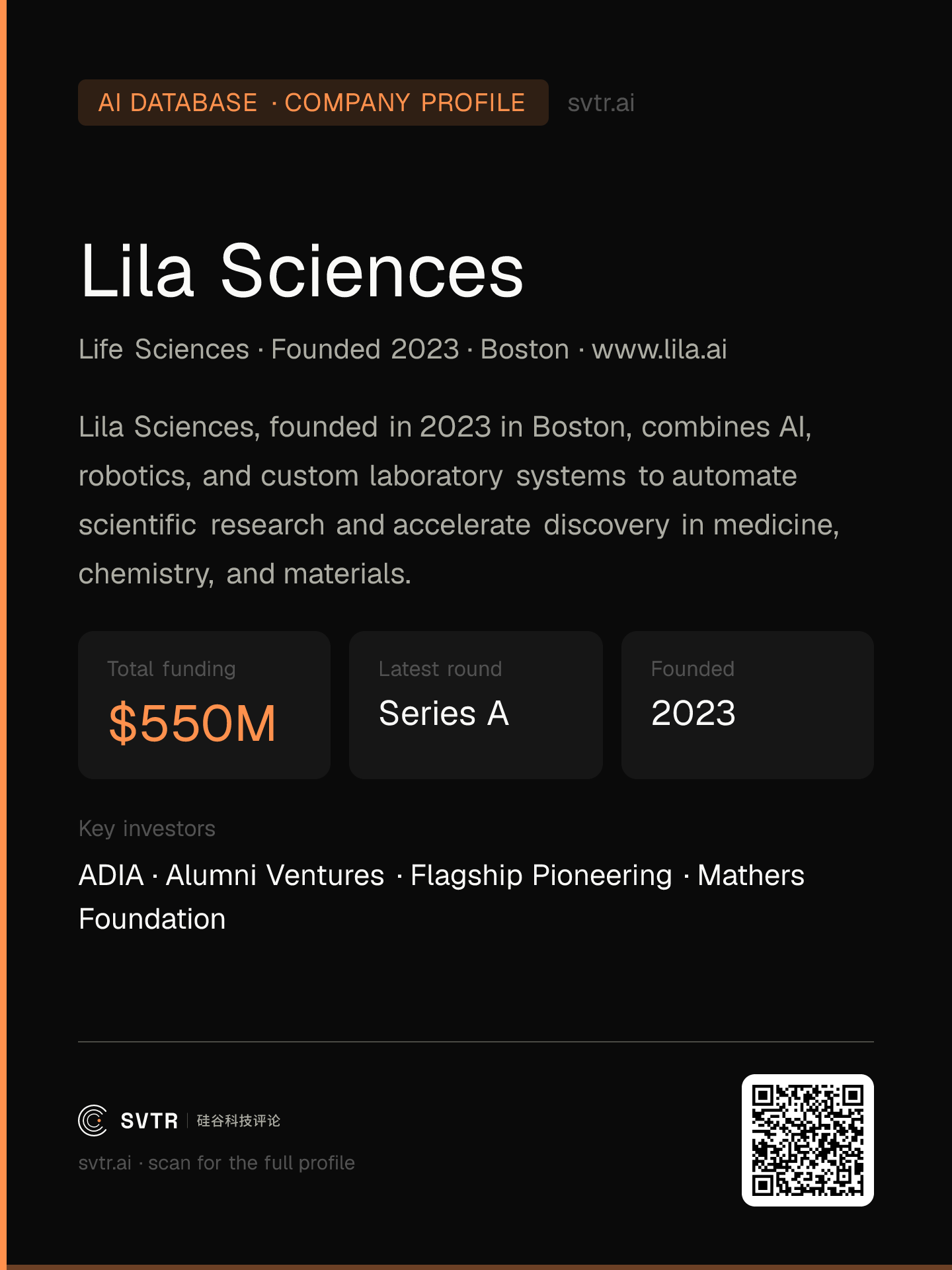
The Team: Another Product Off the Flagship Line
Lila's pedigree is high. It's a project Flagship Pioneering (the maker of Moderna) incubated in 2022 and unveiled only in March 2025. CEO Geoffrey von Maltzahn is a former Flagship partner who has co-founded ten companies; chairman Noubar Afeyan is Flagship's founder and a Moderna co-founder. At launch it fielded Harvard geneticist George Church as chief scientist and former Harvard Medical School professor Andrew Beam as CTO.
But don't just look at these people; look at the Flagship machine. It isn't a normal VC, it's more like a factory that manufactures companies: 80 to 100 ideas incubated internally each year, filtered in stages, founded, funded, and controlled in-house, yielding 100-plus companies and 25 IPOs so far, Moderna the largest among them. The machine's logic is to bet in parallel and mark valuations up round by round; whether any single company works doesn't decide the overall return. So with Lila's $8.5B, it's worth separating how much comes from the company itself and how much from Flagship's usual markup cadence. In 2025, some Flagship companies were already cutting staff.
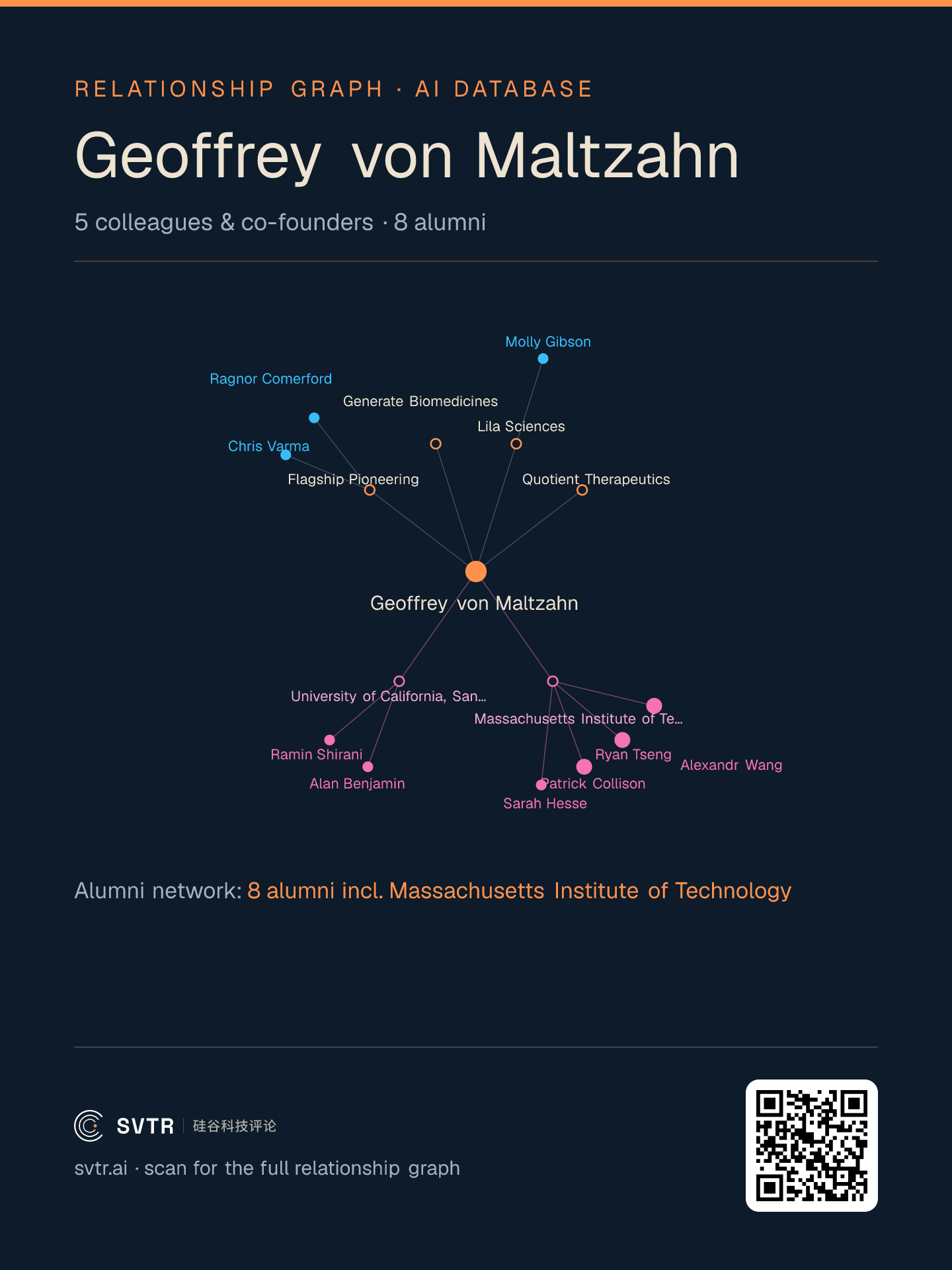
The bench von Maltzahn pulled from Tessera, Generate, and Kaleido, plus Flagship's money, is what Lila held from day one.
What It Does: Betting on a Data Flywheel Rivals Can't Match
Most AI-pharma companies optimize a single step, whether molecule generation or protein structure. Lila wants the whole loop: hypothesize, design, run, learn, all handed to AI plus robots.
The real bet is a flywheel: once the loop turns, its models learn from the experimental data they generate themselves, and the more it runs the thicker that data gets and the harder it is to catch. That's a different thing from a pure-software company living on public data, and different too from the last generation of drug-only AI: Lila spans life sciences, materials, and chemistry from the start. This is where the bull case lives. If the flywheel turns, the moat is proprietary data no one else can reach; if it doesn't, it's just a very expensive automated lab. By its own account, as of late 2025 the platform still needs humans watching.
This Isn't the First Time Someone Made This Bet
Here's the cold water. The story of "an AI platform that discovers drugs by itself" was told more than a decade ago, and it raised real money. Recursion, Exscientia, BenevolentAI, and Atomwise are all over ten years old; AI drug discovery has burned plenty and has yet to produce a single approved, marketed drug. In November 2024, the field's two public leaders, Recursion and Exscientia, simply merged and huddled together.
Lila is season two of the same promise: a fuller platform, more compute, a higher valuation, and nothing shipped yet. Its biggest difference from its predecessors is spanning multiple domains and a stronger base model; its biggest similarity is pricing the valuation to the sky before any revenue or clinical result shows up.
Money and Progress
Lila raises far faster than it ships. A $200M seed in March 2025, a $235M Series A at a $1.2B valuation in September, a $115M extension in October past $1.3B, with NVIDIA's NVentures joining on that extension. On hardware, it signed a 235,000-sq-ft lab in Cambridge, runs about 250 people, and plans to extend its factories to San Francisco and London. The external scorecard is still those four demos with no data.
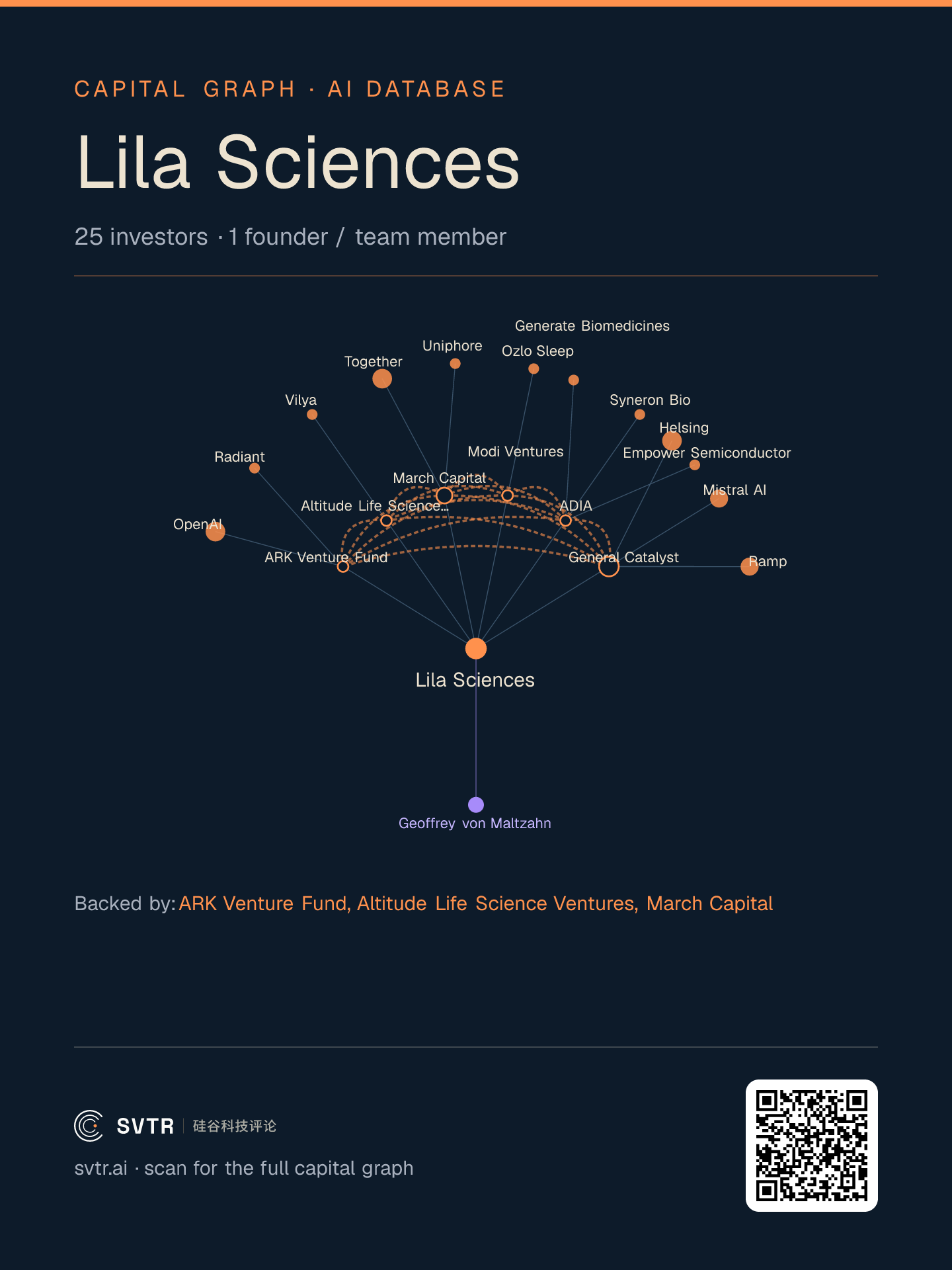
How It Makes Money
Lila describes three routes: platform deals with large enterprises, letting external startups use the platform, and spinning out its own companies, with discoveries licensed for fees. But it says it plainly: rather than push one drug to approval, drive the platform toward "superintelligence" first, and plow near-term order revenue back in. It sounds good, and it also sidesteps something: whether a drug worked leaves clinical data anyone can check, while "the platform is getting stronger" is something no one can falsify in the near term.
The Right Comp Is Isomorphic
The company truly on Lila's line is Isomorphic Labs, not the antibody player Chai or the public Recursion. The two are suspiciously alike: both spun out of a top AI parent in 2021-22 (Isomorphic from DeepMind, Lila from Flagship), both build a platform rather than a single pipeline, both fed by near-limitless money. In May 2026 Isomorphic just raised $2.1B.
But lay the money out and the two aren't in the same league. On cash actually in the door, Lila's $550M is only mid-pack among the peers we track, behind Isomorphic and Xaira. What ranks Lila second is its rumored valuation, not its confirmed funding, and the two are roughly 15x apart.
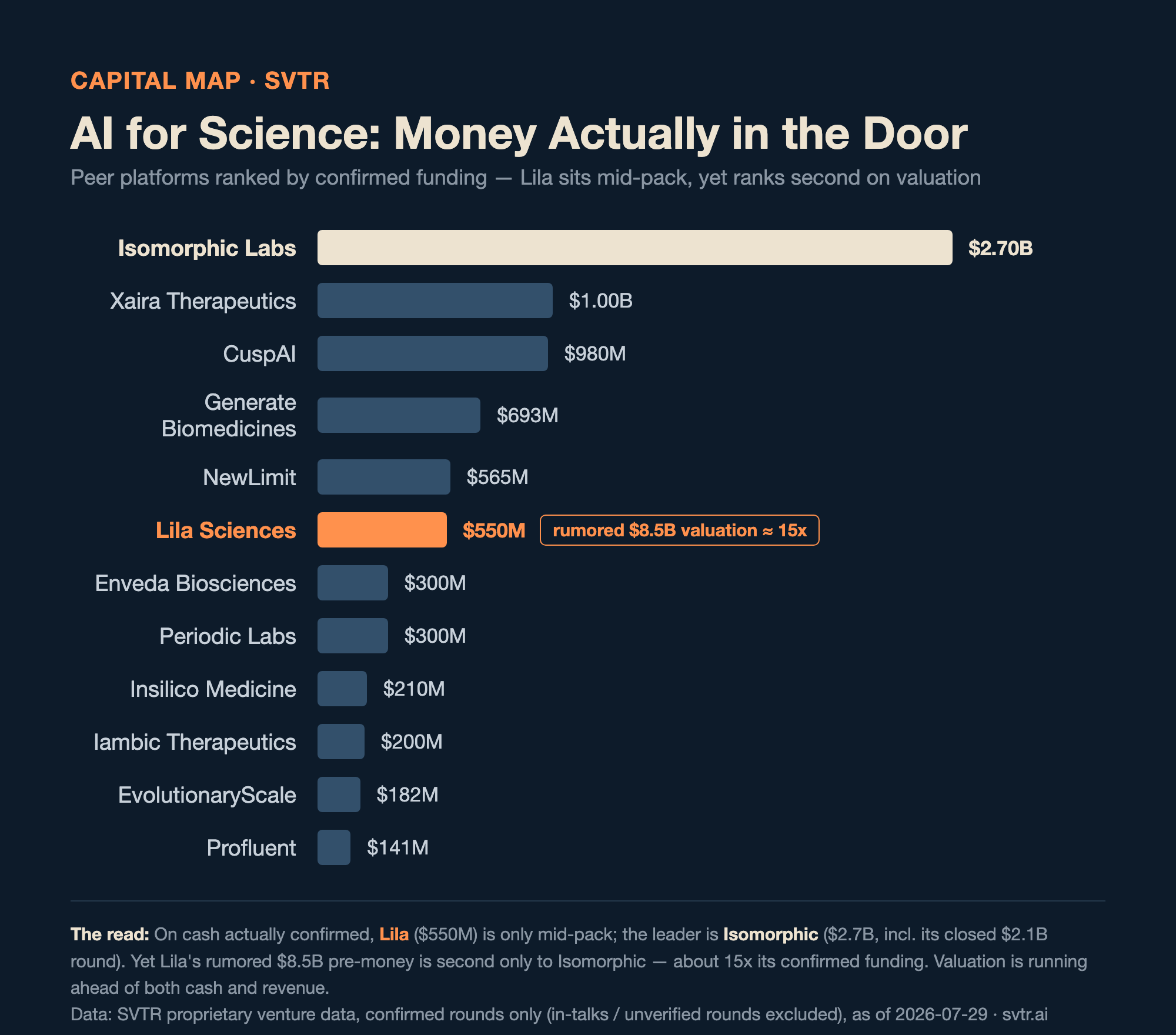
And a more important one: Isomorphic already collects money from Eli Lilly (up to $1.7B) and J&J; Lila has zero confirmed revenue. On the same "platform-first" script, Isomorphic has cleared the "a big pharma is paying" bar, and Lila hasn't.
In China, the Money Buys Labs That Take Orders Now
On the same question, RMB capital answers far more pragmatically. XtalPi, founded in 2015 on quantum physics plus AI plus automated labs, went public in Hong Kong in June 2024, has ready customers like Eli Lilly and Sinopec, and lives on R&D-services revenue it can deliver immediately. DP Technology took the "multi-scale modeling plus machine learning" route, raised over 800M RMB in 2025, and deploys with Fosun, CATL, and BYD.
The difference isn't only in tactics, it's in the soil. China's players have ready CRO customers and a Hong Kong listing path, so they can take orders first and talk valuation later; the US players lift valuation round by round in private markets. For a cross-border investor these are two very different bets: one on cash flow and listing timing, the other on when the "scientific intelligence" option pays off.
SVTR View: Lila's valuation buys a call option on "scientific AGI," not a proven business. For dollar funds building frontier models, it's a reasonable bet, low odds and huge payoff; but remember the last generation of AI pharma was priced the same way and ended in a merger. For cash-flow investors, XtalPi's "orders first, valuation later" is the model you can actually underwrite.
Risks and Verdict
Money is the first hurdle. Training a frontier model runs to hundreds of millions, and Lila has raised less than many equally ambitious peers while burning half of it on hardware. Second, cross-disciplinary robotic automation still hasn't been made to work. Third and most dangerous: full autonomy is nowhere in sight; "scientific superintelligence" is still a vision, not a product.
Lila is the highest-valued and hardest-to-falsify name in this wave of scientific intelligence. Its team and capital are solid, but an $8.5B pre-money valuation (if it closes) runs far ahead of revenue, while its comp Isomorphic already has pharma paying. Only one thing is worth watching: when Lila produces its first verifiable dollar of commercial revenue, and by then, exactly how it differs from the predecessors that never made this work a decade ago.
Sources: Contrary Research, Bloomberg, BioPharma Dive, Semafor, FierceBiotech, and company announcements, cross-checked against SVTR's own venture data.