

This Week's Brief
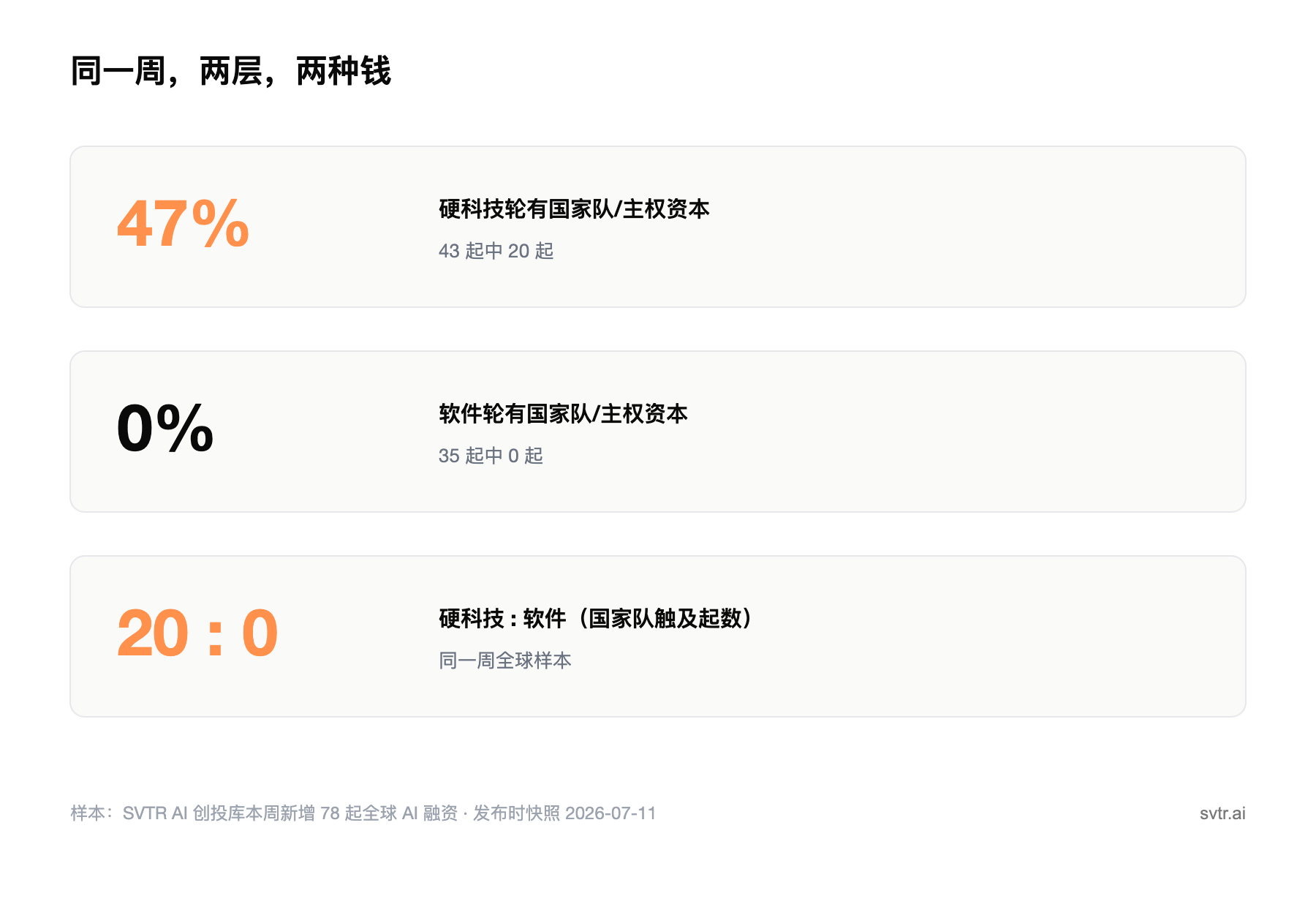
This week's largest AI-related capital event was SK Hynix's $29 billion Nasdaq ADR, the largest ever, with public markets replenishing HBM memory, the physical bottleneck of AI compute. At the venture level, the more pointed question is who is writing the checks: for large single tickets in chips, fusion, quantum, robotics, and defense, the money increasingly comes from sovereign wealth funds, state-backed institutions, and strategic industrial capital (Qatar's sovereign fund into SambaNova, Germany's state development bank KfW into Proxima Fusion, the NATO Innovation Fund into Kraken). Money still being raised for software and application-layer companies is almost entirely from financial VCs. Per this week's flagship Signal #24, nearly half of hard-tech rounds touched state capital, versus zero for software rounds. From public markets down to venture capital, money is flowing toward AI's hardest problems.
I. Market Observations
This section is a curated selection plus SVTR's judgment. The complete rolling event stream across all four categories of market events (funding / IPO / M&A / fund closes) updates in real time at AI Venture Daily #165.
1. IPO / Listing Activity
| Company | Raise | Exchange | Focus |
|---|---|---|---|
| SK Hynix | $29B | Nasdaq SKHY (ADR) | HBM / DRAM memory chips |
| CXMT (ChangXin Memory Technologies) | Undisclosed | Shanghai STAR Market 688825 | DRAM memory chips |
| Eacon (易控智驾) | $295M | HKEX 07687 | Autonomous mining trucks |
| Rokae Robotics (珞石机器人) | $104M | HKEX 03752 | Industrial / collaborative robotics |
| JIIOV Technology (极豪科技) | Undisclosed | HKEX | Smart terminal sensing and interaction |
| Standard Nuclear | Undisclosed | NYSE STDN | Advanced nuclear fuel (HALEU) |
| Csquare * | $1.35B | NYSE CSQR | AI data centers / colocation |
| Rebellions * | Undisclosed | Korea Exchange (planned) | AI chips |
| Syntiant * | Undisclosed | Nasdaq SYTN | Edge AI processors |
SVTR take: This week's single largest capital event was SK Hynix completing a roughly $29 billion Nasdaq ADR offering, surpassing Alibaba's $21.9 billion in 2014 to become the largest ADR listing in history. It isn't a venture round; it's public markets replenishing the physical bottleneck of AI compute. HBM, the high-bandwidth memory that feeds Nvidia's GPUs, needed a single raise of $29 billion, and only public markets are deep enough to absorb that. The other side of the exit channel keeps opening for Chinese hard tech: CXMT is pushing toward the STAR Market, a state-level DRAM IPO following Hygon and Cambricon; Rokae Robotics and Eacon are heading to the Hong Kong Exchange; on the US side, Standard Nuclear (advanced nuclear fuel) is listing on the NYSE. This round of listings is opening doors for storage, chips, robotics, and nuclear fuel, the "strategic assets," not for large language models.
2. Notable Funding Rounds (Confirmed This Week, by Disclosed Amount)
| Company | Round | Amount | Lead Investor(s) | Focus |
|---|---|---|---|---|
| SambaNova | Series D+ | $1.0B | General Atlantic, Qatar Investment Authority | AI chips (US) |
| Proxima Fusion | Series B | $470M | KfW Capital, SPRIND, RWE | Stellarator fusion (Germany) |
| Oratomic | Series A | $300M | ARCH, Spark, Khosla | Neutral-atom quantum computing (US) |
| Skello | Growth | $228M | Bridgepoint | Scheduling SaaS (France) |
| Kraken | Series B | $175M | NATO Innovation Fund, British Business Bank | Autonomous unmanned surface vessels (UK) |
| Even Realities | pre-B | $150M | Meituan, Tencent | Privacy-focused smart glasses (China) |
| Quaise Energy | Series B | $144M | Prelude, JERA, Idemitsu Kosan | Ultra-deep geothermal drilling (US) |
| Morphic Robotics (墨奇智能) | Angel | $141M | Alibaba, Tencent, CAS Star (中科创星) | General-purpose home robotics (China) |
| Snapmaker (快造科技) | Series C | $139M | Cathay Capital, TAL Education, Meituan, Hillhouse | Desktop 3D printing (China) |
| Oxylabs | Growth equity | $130M | Warburg Pincus | Web data collection (Lithuania) |
SVTR take: Among this week's confirmed, disclosed-amount rounds, the largest carry the shadow of state capital or strategic industry: Qatar's sovereign fund sits inside SambaNova's $1 billion; Proxima Fusion's fusion power venture is backstopped by Germany's state development bank KfW, its national innovation agency SPRIND, and utility giant RWE; Kraken's unmanned surface vessels are backed by the NATO Innovation Fund and the British Business Bank. On the China side, Morphic Robotics, Snapmaker, and Even Realities were led by strategic and state-linked institutions such as Alibaba, Tencent, Meituan, and CAS Star. The marginal capital now betting on "atom-level" hard tech is no longer purely return-seeking VC money; it's money that wants supply certainty and strategic autonomy.
3. Currently Raising (Rumored / Not Yet Closed)
| Company | Amount | Round | Focus | Investors |
|---|---|---|---|---|
| Mercor | $500M | Undisclosed | AI training data / expert matching (US) | Financial VCs |
| Lovable | $300M | Undisclosed | Natural-language app-building platform (Sweden) | Menlo Ventures |
| Lyzr | $100M | Undisclosed | Enterprise AI agent platform (US) | Financial VCs |
SVTR take: In contrast to the hard tech among confirmed rounds, the rumored rounds still being raised this week sit almost entirely in software and applications: Mercor (training data), Lovable (vibe-coding app generation), Lyzr (enterprise agent platforms), all backed by financial VCs. In the same week, hard tech's checks are written by state and strategic capital while software's checks are still written by financial VCs, and that dividing line keeps sharpening.
4. Strategic M&A
| Acquirer | Target | Consideration | Type |
|---|---|---|---|
| Figma | Bud (formerly Orchids, YC W25) | Undisclosed | Acqui-hire |
| OpenAI | Northslope | Undisclosed | Acqui-hire |
| Mercor | Deeptune | Undisclosed | Acqui-hire |
SVTR take: M&A was quiet this week: all three deals are acqui-hires with undisclosed consideration. Figma acquired Bud (the Orchids team from YC W25), OpenAI acquired Northslope, and Mercor acquired Deeptune. Big companies are buying people and capability, not whole business lines. Compared with the large single tickets in the primary market, strategic M&A had no heavyweight moves this week.
5. VC Fund Closes
| Fund | Size | Status | Strategy |
|---|---|---|---|
| Paradigm Fund III | $1.2B | Final close | Early-stage frontier tech: crypto + AI + robotics + drones + aerospace |
| Omni Ventures Fund I | $33M | Final close | Pre-seed manufacturing tech: software / robotics for the manufacturing economy |
| Vermilion Cliffs Fund II | $25M | Final close | Pre-seed AI infrastructure / developer tools / cybersecurity |
| Fundamentum Fund III * | $200M | Raising | India growth-stage enterprise software / AI (Series B-C) |
SVTR take: Financial VCs haven't left the field; they're just directing new money increasingly toward frontier hard tech. Paradigm's $1.2 billion third fund explicitly targets "crypto + AI + robotics + drones + aerospace." Omni Ventures, run by two former Apple engineers, focuses solely on manufacturing tech. Vermilion Cliffs is betting on AI infrastructure. Financial VCs are stockpiling ammunition for hard tech, but the marginal investor that actually decides the largest single checks is still sovereign and state capital.
II. Venture Capital Take
One-line verdict: the people writing checks for hard tech are shifting from financial VCs to state capital.
Per this week's flagship Signal #24: the SVTR AI Venture Database added 78 global AI funding events this week. Of 43 hard-tech rounds (chips, fusion, defense, robotics), 20 touched sovereign wealth funds, state-backed institutions, or strategic industrial capital; of 35 software and application rounds, zero did. SVTR's judgment: the marginal capital that actually decides which frontier gets built is changing hands. Hard tech now belongs to state and strategic capital, pure software still belongs to financial VCs, and this dividing line holds even within China. When a track's marginal investor shifts from wanting financial returns to wanting strategic autonomy, its valuation anchor, exit path, and competitive landscape all get rewritten.
III. Community Activity
Founders joining the SVTR community this week still skew "hard": Maitexin (迈特芯, Shenzhen, edge AI chips, a 3D near-memory LPU with 600GB/s memory bandwidth) and Youchuangyi (优创亿, Shenzhen, Bluetooth smart wearables, a national high-tech enterprise) fall into chips and smart hardware; Gongqing Intelligence (工擎智能, Hangzhou, industrial world models plus multi-agent autonomous manufacturing systems) and Nevamind AI (enterprise agent memory infrastructure and digital workers) fall into industrial and agent infrastructure. Investors joining skew toward early-stage, financially oriented seed investors.
This supply-and-demand picture lines up with this week's market thread: the founders flowing into the community are building edge chips, industrial AI, and manufacturing tech, exactly the hard-tech layer where state and strategic capital are piling in this week in the primary market. Demand and capital point the same direction this week: things you can touch, with a strategic edge.
IV. Editor's Picks
The Checks for AI Hard Tech Are Shifting From Financial VCs to State Capital (Signal · Forward Signal)
The SVTR AI Venture Database added 78 global AI funding events this week. Sovereign and state capital touched nearly half of hard-tech rounds (20 of 43) and zero software rounds. SVTR's judgment: the marginal capital that actually decides which frontier gets built is shifting from financial VCs to money that wants more than financial return. Chips, fusion, defense, and robotics now belong to state and strategic industrial capital, while pure software and applications still belong to financial VCs, and this dividing line holds within China too. Open the Morphic Robotics org page for the live capital relationship graph. This is the primary source for this issue's venture capital take.
AI's $3 Trillion Question: Who Pays and Who Profits Are Splitting Apart (Thesis · Investment Thesis)
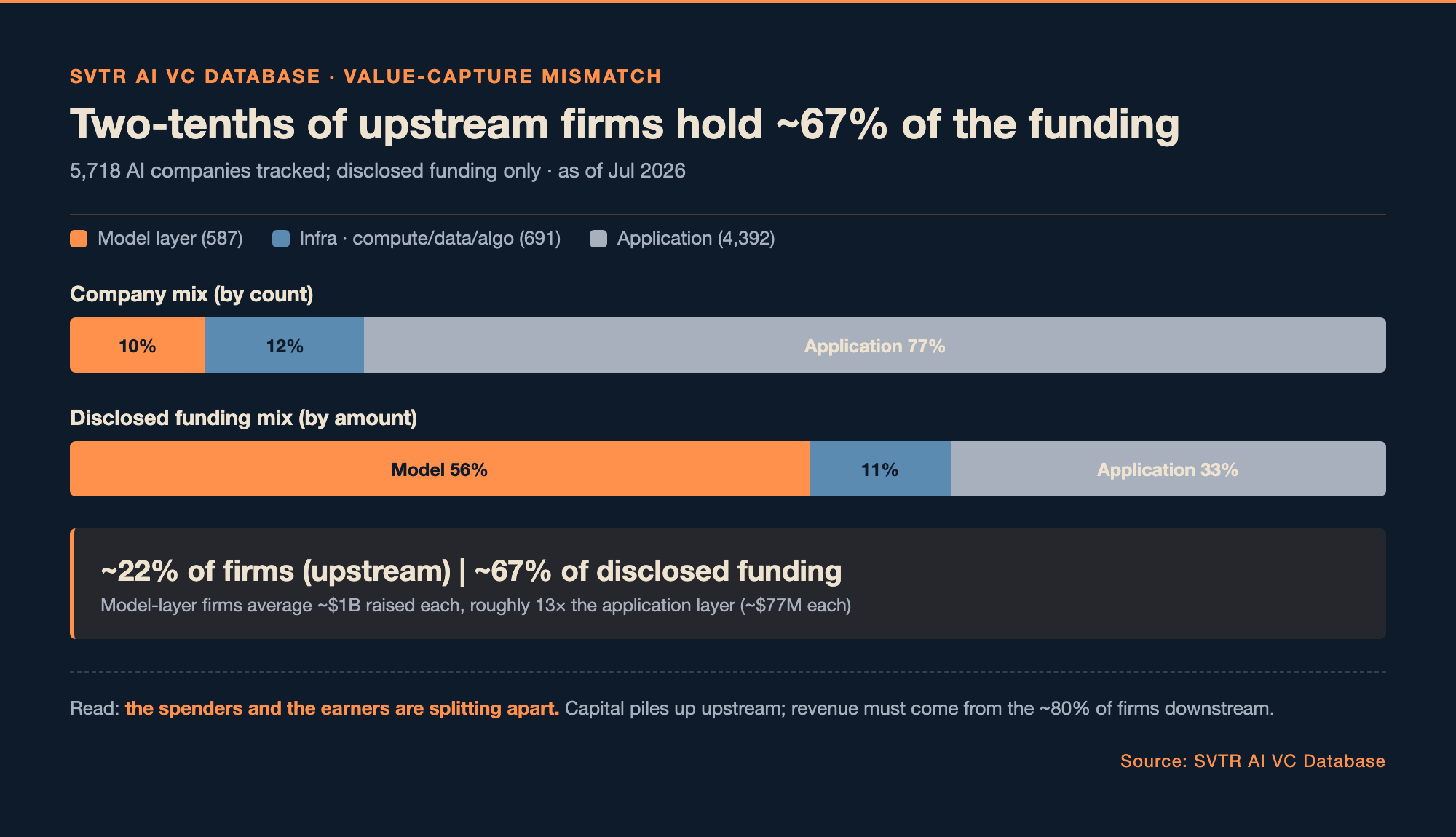
Sequoia's David Cahn estimates AI infrastructure needs to earn back roughly $3 trillion cumulatively. The risk isn't the total, it's the distribution: capital is heavily concentrated among a handful of hyperscalers and frontier labs, while revenue leaks toward users and cheaper open-source models (many from China). Per the SVTR AI Venture Database, the model and foundation layers make up only about a fifth of 5,718 AI companies tracked, yet hold nearly 70% of disclosed funding. SVTR's judgment: who pays and who profits are splitting apart, the flip side of this week's main thread on investors splitting into tiers. As the investor base stratifies, so do the returns.
V. Upcoming Events
Date: 2026-08-01 to 08-02 (PT)
Location: UC Berkeley
Tickets: Paid (in-person $499, livestream free)
SVTR score: 8.0/10
The most complete venture-matchmaking event in this window: hosted by Berkeley RDI, with 200+ speakers including Andrej Karpathy, Andrew Ng, Ion Stoica, and Martin Casado. It includes a Startup Spotlight for pitching to investors, with partners from Lightspeed, Mayfield, and NEA on the list.
Date: 2026-07-25 to 07-26 (PT)
Location: San Francisco
Tickets: Free (selective admission, with travel stipends and compute credits)
SVTR score: 7.5/10
Hosted by Y Combinator for top AI builders, with Jensen Huang, Sam Altman, and Alexandr Wang on the speaker list, and a high density of founders and builders.
VI. Capital Map
This issue's data and visualizations are live at AI Venture Daily #165: a daily rolling event stream plus sector / active-investor / by-layer funding charts, on the same data source and methodology as this section.
Note: SK Hynix's $29 billion ADR is a public-market offering, not a venture round, so it is excluded from the "funding rounds" count and the $4B figure above (consistent with the live site, which counts confirmed private rounds only).
Three takeaways from this issue's data:
- Hard tech absorbs nearly three-quarters of the money: among this week's 65 confirmed private rounds, the hard-tech layer (chips, fusion, quantum, robotics, defense, smart hardware, life sciences) took roughly 74% of disclosed funding, versus about a fifth for software. Money is moving toward "atoms," but the more important shift is who's writing the checks.
- China: many and scattered; overseas: few and large (this week's sample, not a long-term ranking): by deal count, the leaders are Intel Capital, Khosla Ventures, CAS Star (中科创星), Source Code Capital, Matrix Partners China, and Y Combinator (three deals each), with Chinese early-stage institutions and industrial capital accounting for the largest volume. But by check size, this week's two largest, SambaNova ($1.0B) and Proxima Fusion ($470M), were both led by overseas sovereign and strategic capital. Chinese institutions are writing many, scattered, early-stage hard-tech checks; overseas sovereign and strategic capital is writing fewer, much larger single tickets.
- Early stage still dominates, and the investor base is turning over from the earliest rounds: among confirmed rounds, seed / angel / Series A together account for more than half, while Series B and later make up less than 30%. Hard tech's early-stage factory is issuing deals at high speed, and more and more of those early checks carry the presence of state and strategic industrial capital. The turnover in marginal investors is starting from the earliest stage.
Note: Visit SVTR's official site (svtr.ai) or contact WeChat pkcapital2023 for the complete weekly report and project details.