

"Signal | SVTR Forward Signal"
Editor's Note
On October 14, Modal closed a $750 million Series D at a $15.75 billion valuation. Two days earlier, Infinigence AI announced a RMB 2.3 billion Series C. On October 15, China Telecom led a round in Qingcheng.AI. This week's biggest checks, on both sides of the Pacific, went to the "compute middle layer": companies that sit above the chips and below the models, and make compute usable for everyone else. The name is the same; the way each side prices it is completely different. That is what we most want to explain this week.
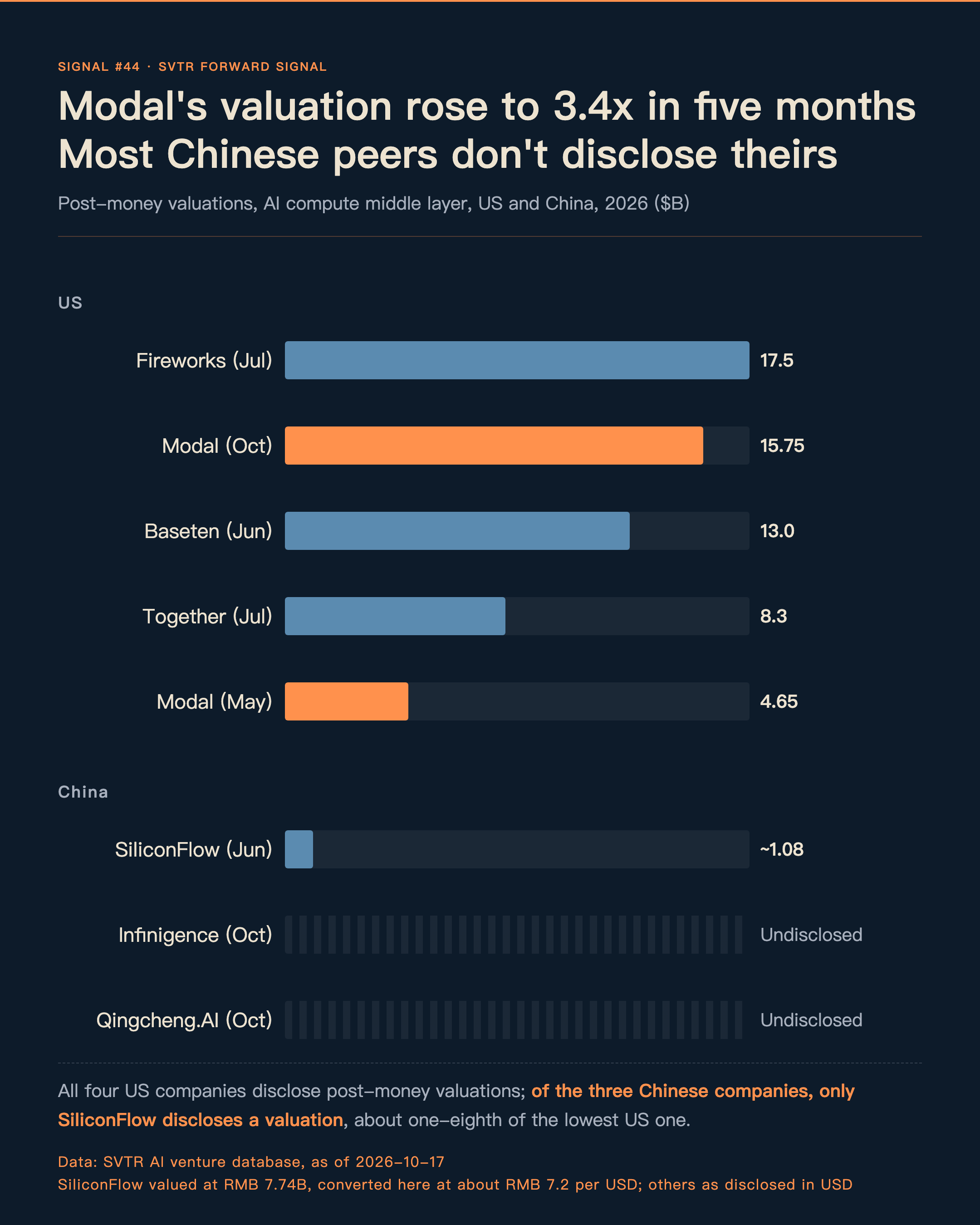
On October 14, Modal announced a $750 million Series D led by Accel at a $15.75 billion valuation. Five months earlier it was valued at $4.65 billion. Two days before that, on October 12, Infinigence AI announced a RMB 2.3 billion Series C, bringing its total raised to RMB 4.3 billion, the largest for any company of its kind in China.
Both run the same business: they do not make chips or train frontier models; they schedule compute and rent it out. Our view is that the US and China price this layer with two different yardsticks. The US prices it on revenue: in five months Modal's valuation rose to 3.4 times its earlier level, and both times it was valued at under 16x annualized revenue. In China, prices in this layer do not line up with revenue. They are pricing whether domestic chips can actually be put to work, and the money comes from the parties who most need that to succeed: telecom carriers, cloud companies, chipmakers and local state funds.
This week (October 10–16) the SVTR AI venture database tracked 97 AI funding rounds with about $3.22 billion disclosed. Modal and Infinigence together account for about $1.07 billion, a third of the disclosed total. Compute's share of disclosed dollars jumped from 8.4% over the past 12 months to 28.4%, but drops back to 6.7% without Modal. This week's anomaly is two large deals, not the whole sector rising, so we look only at what these two companies are doing with the money.
Signal 1 | Modal's valuation rose to 3.4x; its revenue multiple did not move
Put Modal's two pricings side by side:
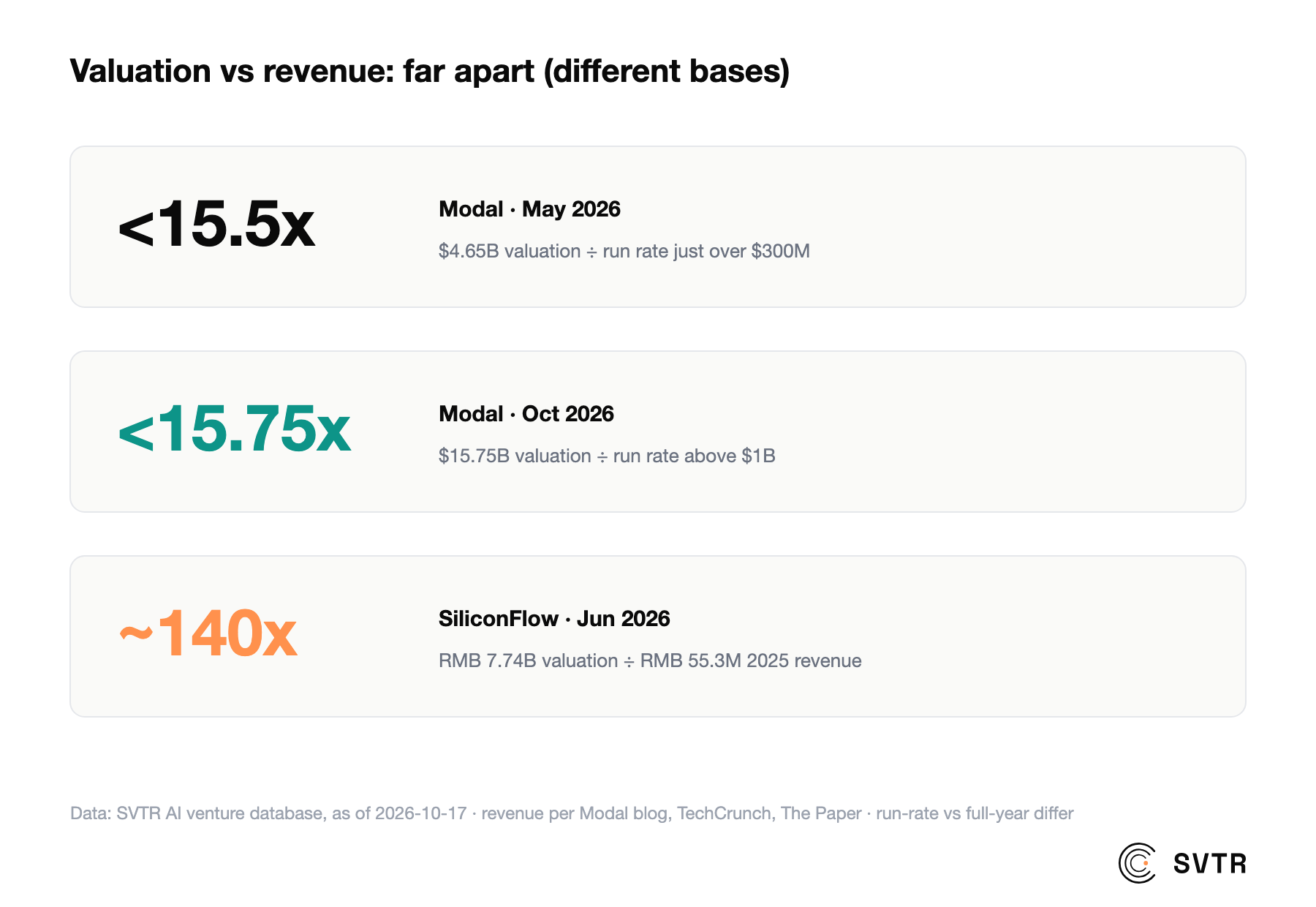
- May 2026: Series C at $4.65 billion, with annualized revenue just over $300 million, under 15.5x revenue.
- October 2026: Series D at $15.75 billion, with annualized revenue above $1 billion, under 15.75x revenue.
Almost all of the valuation increase came from revenue growth. CEO Erik Bernhardsson, a Swedish engineer who built the first version of Spotify's music recommendations, founded Modal in New York in 2021. In the blog post announcing the round, he wrote: "I can't think of a better time to be building software."
One slice of revenue deserves a closer look: sandboxes, the isolated environments in which AI agents run code. Launched three years ago, the product is now, per the blog, a $300 million run-rate business on its own, with close to 3 billion sandboxes spun up. Coding-agent company Cognition is on its customer list.
In the SVTR AI venture database, three other large US pricings in this layer this year: Fireworks, Baseten and Together (see Table 1). The money came from venture firms and from funds that usually buy public stocks, such as Atreides, Altimeter and Wellington. They are buying revenue curves. All 8 investors in Modal's round are venture funds.
Signal 2 | In China, valuation and revenue do not line up
Only one company in China's layer has disclosed revenue. SiliconFlow filed for a Hong Kong listing on June 30; its prospectus shows 2025 revenue of RMB 55.33 million and a loss of RMB 345 million. After its B+ round in June it was valued at RMB 7.74 billion (as reported by The Paper on July 2). That is roughly 140 times last year's revenue.
The multiple is not directly comparable to Modal's: one uses last year's full-year revenue, the other current annualized revenue. But even if SiliconFlow's revenue grows fivefold this year, it would still be valued at around 28x revenue, well above Modal. Neither Infinigence nor this week's Qingcheng.AI has disclosed revenue.
SiliconFlow founder Yuan Jinhui's own path says a lot about this business in China. OneFlow, the company he founded in 2017, was bought in March 2023 by Wang Huiwen's Light Year, which was folded into Meituan three months later. In August 2023 he left Meituan with the original team and switched from training to inference. The prospectus puts its market share at 1.5%: in China, this business mostly belongs to the big companies' own clouds.
Here are this year's public pricings for this layer on both sides:
Table 1 | AI compute middle layer valuations, US and China, 2026
| Company | Latest round | Post-money valuation | Revenue or bookings reference |
|---|---|---|---|
| Modal (US) | Series D · $750M | $15.75B (Oct) | Run rate above $1B |
| Fireworks (US) | Series D · $1.505B | $17.5B (Jul) | Run rate above $1B |
| Baseten (US) | Series F · $1.5B | $13B (Jun) | Hundreds of millions (reported) |
| Together (US) | Series C · $800M | $8.3B (Jul) | Bookings above $1.15B (not revenue) |
| SiliconFlow (China) | B+ round | RMB 7.74B (Jun) | 2025 full-year revenue RMB 55.33M |
| Infinigence AI (China) | Series C · RMB 2.3B | Undisclosed (Oct) | Undisclosed |
| Qingcheng.AI (China) | Series A | Undisclosed (Oct) | Undisclosed |
Data: SVTR AI venture database, as of 2026-10-17. Months in brackets after valuations are announcement months, all in 2026; valuation links point to the original announcement or report, and amounts stay in the disclosed currency with no conversion. Modal's prior round was a $355M Series C in May 2026 at a $4.65B post-money valuation, when its run rate was just over $300M. Baseten's round came in two tranches, at $13B and $11B. Revenue and bookings bases differ (annualized revenue, annual bookings, full-year revenue), so they should not be divided and compared side by side.
Roughly, on each company's own basis, the three US companies where it can be calculated are valued at about 7x to 18x revenue or bookings; among the three Chinese companies only SiliconFlow can be calculated, at about 140x last year's full-year revenue. The bases differ, so read these as orders of magnitude, but the gap in magnitude is wide enough.
Signal 3 | The cap tables tell you what they are selling
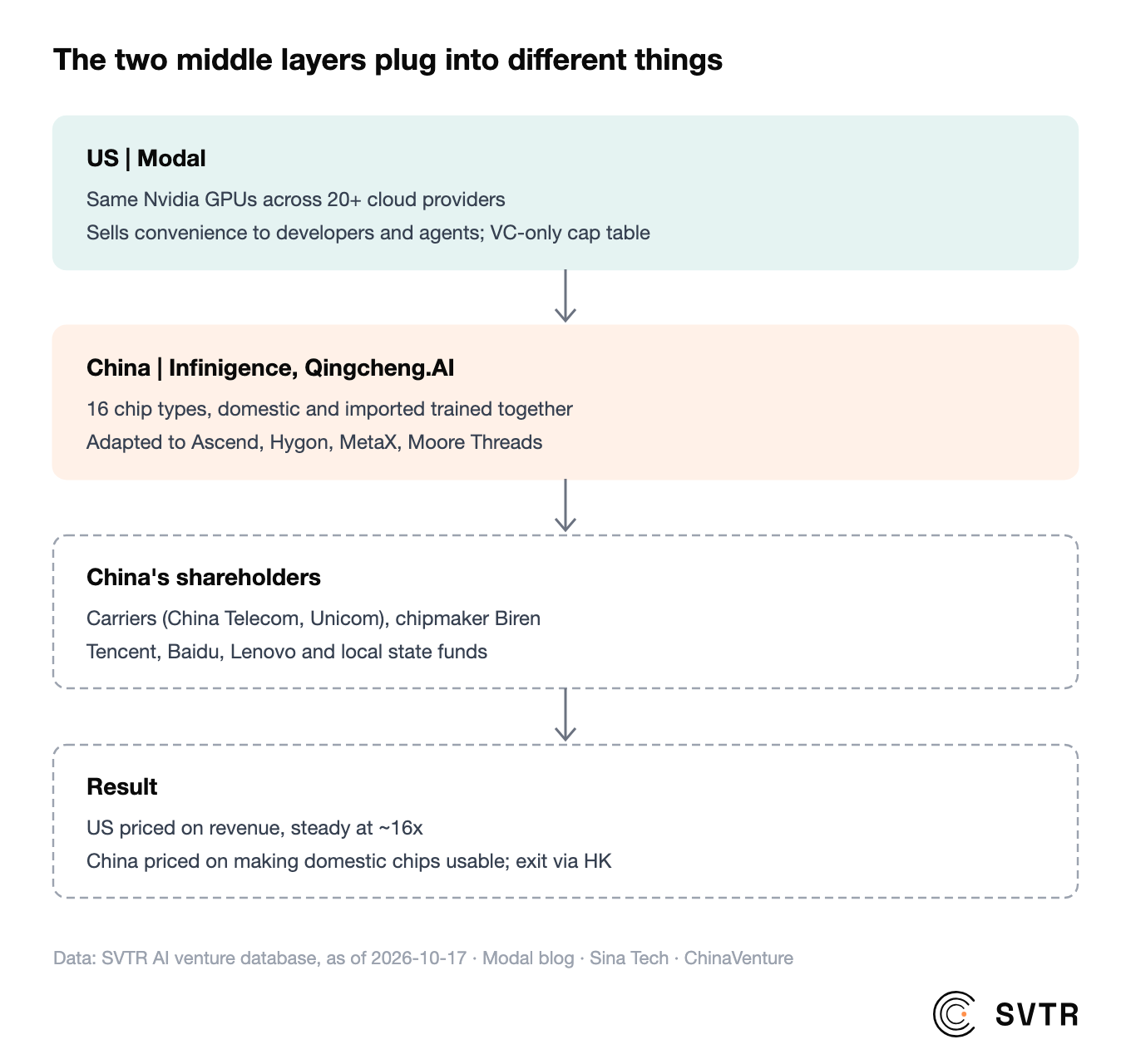
Modal spreads its workloads across more than 20 cloud providers, all offering the same Nvidia GPUs from different sellers, and sells developers convenience. Infinigence does something else: its platform connects 16 types of chips, trains on domestic and imported chips together, and has deployed 37,000 petaflops of compute. Qingcheng.AI, whose round this week was led by China Telecom, builds an inference engine adapted specifically to Huawei Ascend, Hygon, MetaX and Moore Threads chips. What China's layer sells is getting a mix of different domestic chips to work together.
The investor lists match that one for one:
- Infinigence Series C: state funds including Hangzhou Hi-tech Financial Investment, the Social Security Zhongguancun fund and Zhuhai Technology Industry Group; Lenovo, Tencent and Baidu; plus HongShan and Qiming Venture Partners.
- Qingcheng.AI Series A: led by China Telecom, with SenseTime, Teamsun and Zhizhen Technology following.
- SiliconFlow's June round (per the database): China Unicom's Unicom Xinwo, Biren Technology's strategic arm, SenseTime's strategic arm, CDB Capital and Huakong Fund.
Carriers and state compute centers that bought domestic chips need someone to make those chips run; domestic chipmakers need someone to connect them to models. They are customers and shareholders at once. Infinigence's founder Wang Yu heads Tsinghua's Department of Electronic Engineering and a decade ago led his students in founding the AI chip company DeePhi Tech; this time he sits one layer above the chips. CEO Xia Lixue did his PhD under him, researching efficient communication between heterogeneous chips. Qingcheng.AI's chief scientist Zhai Jidong is a professor in Tsinghua's Department of Computer Science and deputy director of its high-performance computing institute. Both companies funded this week come straight out of Tsinghua's chip and systems labs.
Why now
Demand on both sides stepped up at the same time. Modal's usage tripled in the five months after its Series C. Infinigence says its average daily token calls are up 40x since last December.
Exits are opening at the same time too. SiliconFlow has filed; Infinigence says it is preparing to list. Private investors are willing to pay billions of yuan for companies with no disclosed revenue on the premise that Hong Kong will take them public; this year, for the first time, specific companies are testing that premise.
Impact: two yardsticks, two kinds of risk
In the US, pricing on revenue means there is no cushion. Modal's valuation tracked its revenue for five months; if revenue growth slows, the valuation falls with it, while Modal also competes for customers with its own suppliers, the cloud providers.
In China, the risk of pricing on position lies elsewhere. If Hong Kong prices these companies below their last private round, the state funds and strategic investors who came in last take the hit first. The more fundamental variable is the chip landscape: Infinigence's business rests on there being many kinds of chips. If domestic chips consolidate to one or two vendors in a few years, how much is getting 16 kinds of chips to work together still worth?
For investors in this layer, US companies can simply be asked about revenue. For Chinese companies, the better question is: how many orders did each of those carrier and chipmaker shareholders actually place this year?
Verification
Confidence is medium: on the US side, Modal's two public pricings and revenue figures are solid evidence; on the China side, only SiliconFlow has disclosed revenue, and our view of Infinigence and Qingcheng.AI rests on their shareholder structures and business models. What would falsify this: Infinigence or Qingcheng.AI disclosing revenue that supports a multiple close to US peers (within 30x), or new rounds in China's layer being led mainly by financial funds, with carriers and chipmakers leaving the cap tables. Either would mean the view needs adjusting.
Three numbers to watch over the next 90 days:
- US multiples: when any of Modal, Fireworks, Baseten or Together discloses a new valuation alongside annualized revenue, a multiple between 10x and 25x means the pattern holds; 40x or more would mean the US is also paying for position.
- SiliconFlow's listing price: if it lists before January 15, 2027, a market cap of 80x or more its 2025 revenue means public markets accept this pricing; a market cap below its private RMB 7.74 billion means private prices need to come down.
- Who funds China's layer: among new rounds above RMB 100 million, carriers, chipmakers or local state funds appear among investors in at least two-thirds of them.
If you work at Modal, Infinigence, Qingcheng.AI, SiliconFlow, or any fund mentioned here, you are welcome to claim your company or personal profile on the SVTR AI venture database.
Follow-up | Signal #35 "AI companies are being priced in pieces": confirmed
On August 22, Signal #35 registered this indicator: over the next 8 weeks, would AI rounds with debt, credit lines or equity-plus-debt structures average at least 1 per week? From August 22 to October 16, the database records 21 such rounds, about 2.6 per week, including Nscale's two project-debt and convertible financings totaling about $6.4 billion and Motive's debt financing of more than $1.3 billion. Caveat: counted by keywords in round names and amount descriptions; 3 of them only include small loans.
Follow-up | Signal #32 "Embodied AI money is leaving the robot body": partially confirmed
On August 15, Signal #32 registered this indicator: over the next 8 weeks, would Chinese embodied-AI "upstream" rounds keep pace with "body/full-robot" rounds? From August 15 to October 9, classifying company by company, we count 14 upstream and 10 body rounds, clearing the bar; but the upstream lead comes mainly from data and simulation companies (9 rounds), and counting only components and sensing it is 5 against 10. The money is leaving the body, but data caught it first. Caveats: only rounds with exact dates are counted, and classification was done by hand.