

Between September 17 and October 5, three AI compute infrastructure companies signed a combined $9.56 billion, and none of it was plain equity:
- CoreWeave, the US-listed GPU cloud company, issued convertible notes;
- Nscale, the UK GPU cloud company, issued pre-IPO convertible notes;
- Axiom, the data center power and cloud infrastructure business that electronics manufacturer Flex plans to spin off, sold convertible preferred stock.
Of that $9.56 billion, $1 billion is NVIDIA's commitment to Nscale, expected in mid-November; the other $8.56 billion has closed.
With a convertible, investors come in as debt or preferred holders. When the company lists, or its share price clears an agreed level, they can switch into common stock. What protection they get first depends on each contract, and the three deals differ.
Our read: the biggest checks in AI compute are moving from a pure valuation negotiation toward pricing debt protection, preferred returns and equity upside together, with public-market prices as an important reference. Three deals are a pattern worth tracking, not proof that the whole compute sector has changed how it raises money.
According to the SVTR AI Venture Database, the market saw 402 AI rounds with $36.35 billion disclosed in the window. Compute accounted for 45 rounds and $16.95 billion, and its share of disclosed dollars rose from 10.9% over the prior 12 months to 46.6%.
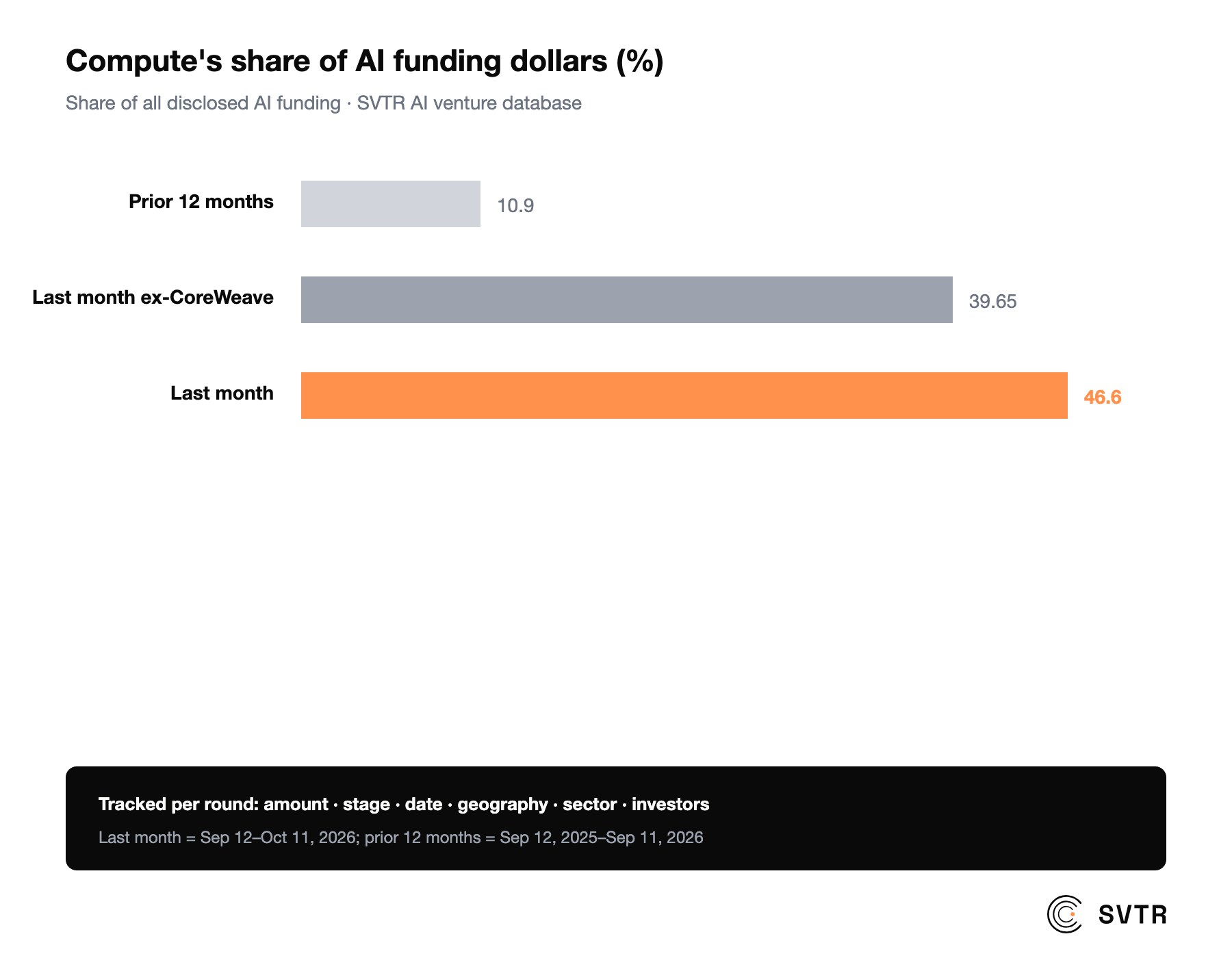
The share jump is the starting point; the change is in the instruments
Before we started counting, we fixed two ways to split the deals. One was by instrument: equity, loans, convertibles. The other was by company type: compute operators, chips, power, quantum, software.
By company type, the result is the opposite of our September 22 piece, Compute Money This Month Didn't Stay in the Cloud; It Went to Silicon and Power. Three compute operators, CoreWeave, Crusoe and Nscale, took 67.6% of disclosed compute dollars on their own. But money moving back and forth between cloud and silicon is common, and one month of it proves little.
The split by instrument shows something the previous 12 months did not have. Three of the four largest deals were convertibles, accounting for 56.4% of disclosed compute dollars. Of the prior 12 months' 301 compute rounds, only 2 were tagged as debt in the database, and both were loans: Nscale's $3 billion term loans on August 31, and General Compute's $400 million loan from Upper90 in July. There were zero convertibles.
Take out CoreWeave, the largest deal, and compute still holds 39.65% of the market, while convertibles still make up 42.0% of the remaining compute dollars. One company is not carrying this signal.
| Company | Instrument | Amount | How it is priced |
|---|---|---|---|
| CoreWeave | Convertible notes due 2033 | $4.2B, including a $500M option exercised in full | Listed; conversion price about $97.85, set as a premium to the share price |
| Nscale | Pre-IPO convertible notes | $3.36B, of which $1B is an NVIDIA commitment | Converts automatically at IPO |
| Axiom | Convertible preferred | $2.0B | Initial enterprise value of $37.5B; spin-off listing planned for Q1 2027 |
| Crusoe | Series F equity | $3.9B | $30.9B post-money |
How each deal manages risk
- CoreWeave: priced on September 18 and settled on September 22, with a 2.875% coupon. The conversion price is about 22.5% above the September 17 close of $79.88. The initial purchasers exercised their $500 million option in full on September 18, bringing the issue to $4.2 billion. The company spent about $566.2 million in total on capped calls, which reduce dilution to existing shareholders on conversion. Buyers were qualified institutional buyers, not named in the release.
- Nscale: announced September 25 and led by Third Point. $2.36 billion came in at closing. The other $1 billion is a commitment from NVIDIA, expected in mid-November. The notes convert automatically into stock when the company goes public. The announcement does not disclose an interest rate, maturity, conversion discount or principal protection, so whether investors have a fixed return is not visible.
- Axiom: signed October 2 and announced October 5. General Catalyst and Koch Equity Development, Koch's investment arm, led it at an initial enterprise value of $37.5 billion. It pays a 10% annual cash dividend until the separation. Flex's 8-K states that if the separation has not closed by the end of 2027, Flex guarantees Axiom will redeem the shares at 115% of the purchase price in cash, or 125% in Flex shares, in each case minus cash dividends already paid and subject to other contractual adjustments. So it is not a full 15% or 25% on top of the dividends.
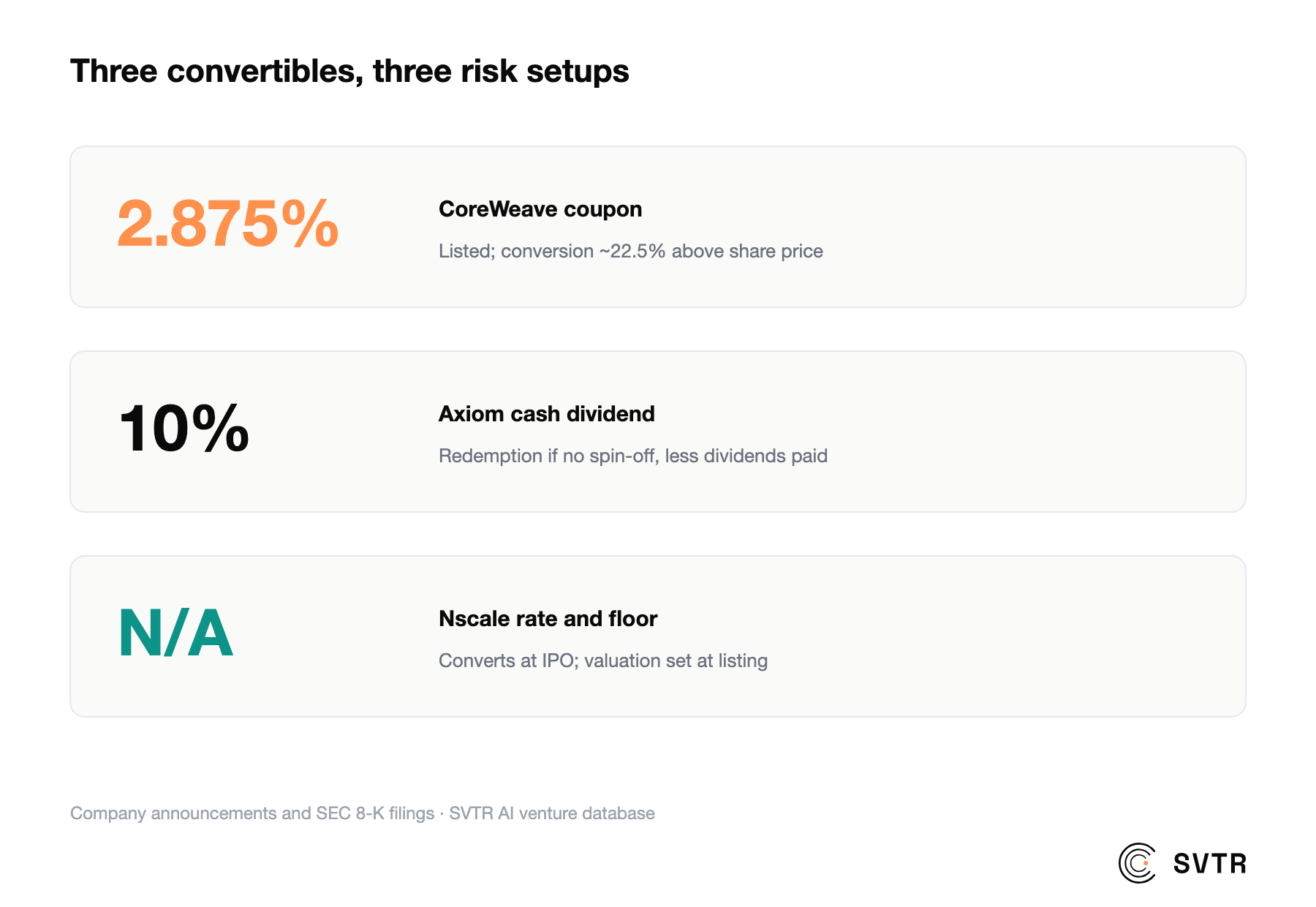
What the three have in common is not a guaranteed floor. Each uses a convertible to bridge disagreement over valuation and risk, and each does it differently:
- CoreWeave is already listed, so its conversion price is set off the public share price, and investors also get a 2.875% coupon.
- Axiom's entry price was already agreed at a $37.5 billion enterprise value; investors get a dividend plus a redemption guarantee if the spin-off fails.
- Nscale is the only one that truly leaves its valuation to listing day. The announcement says only that the notes convert at IPO, with no visible floor.
So the more precise statement is that public-market pricing is becoming an important reference for some large compute financings, not that all three companies gave up on a private-market valuation.
Who is buying
Nscale's investor list shows best who these instruments attract. Of 17 investors, at least 8 are hedge funds: Third Point, Citadel, Hudson Bay, Davidson Kempner, QRT, Context Capital, Castleknight and Ghisallo. Convertible arbitrage is one of Context Capital's main strategies. According to the database, only 3 investors overlap with Nscale's $2 billion Series C in March: Citadel, 8090 Industries and NVIDIA. Same company, a different set of buyers.
The chain runs like this: capital spending keeps growing, raising money through plain equity alone gets more expensive, companies turn to convertibles, and those securities bring investors with public-market, credit and structured-finance skills into private deals. The first three steps are visible in all three deals; the last one rests mostly on Nscale's list for now and needs more examples.
The one plain-equity deal among the top four went to Crusoe, an AI cloud company that builds its own power and data centers. Atreides Management, Mubadala Capital and Valor Equity Partners co-led it. We covered Atreides and Valor co-leading AI interconnect rounds in September in Signal #41. Our October 4 weekly also noted that 4 of that week's top ten deals included funds whose main business is buying listed stocks. So even this equity deal was led by funds that mostly invest in US public stocks.
From collateral contracts to combined pricing
In August, Signal #37 argued that the collateral behind compute financing had moved from the company to its contracts. This month went one step further. The money that has no contract to secure it is starting to come through convertibles, which price a coupon, a dividend, a redemption guarantee and a conversion right in a single contract. Within three weeks, three unrelated companies chose the same type of instrument, but three deals are still only three deals.
The remaining 41 deals total $3.49 billion and are almost all plain equity. But mid-sized GPU clouds are using debt too. GMI Cloud announced $668 million on September 30: $223 million of Series B equity and a $445 million credit facility led by CTBC Bank.
What to check next
Over the next 30 days (October 12 to November 11), watch three things:
- Whether convertibles and debt still make up more than 30% of disclosed compute dollars. If the share falls back below 5% with no new billion-dollar convertible, these three deals were just three companies' timelines happening to overlap.
- Whether NVIDIA's $1 billion for Nscale arrives on schedule in mid-November.
- Whether compute companies negotiating pre-IPO rounds, such as Lambda, covered in our October 11 weekly, end up using plain equity or convertibles. Convertibles would strengthen this read; all-equity rounds would mean it needs revising.
Caveats
- The database puts loans and convertibles in a single "debt/convertible" category. The claim of zero convertibles in the prior 12 months comes from checking the 2 deals in that category one by one. Large rounds tagged "undisclosed" or "strategic" may hide convertible structures we have not identified; Axiom itself is tagged as a strategic investment in the database.
- CoreWeave is a public company, and the database counts its convertible notes as a funding round. The $4.2 billion is the actual issue size: CoreWeave's September 22 8-K confirms the $500 million option was exercised in full.
- The $9.56 billion is counted at signed amounts. $1 billion of Nscale's $3.36 billion has not yet arrived; counting only closed money, the three deals total $8.56 billion.
- Nscale's announcement does not disclose the notes' interest rate or downside terms, so this piece describes its protection only as far as the announcement goes.
- Lead tags in the database are incomplete: in Crusoe's round, the source names Mubadala Capital as a co-lead, but the database tags it as a participant.
- GMI Cloud's $445 million credit facility is not in the database.
Methodology: The window runs from September 12 to October 11, 2026, and deals are assigned by announcement date, not by weekly issue number. Each round counts once; rumored and unverified rounds are excluded. Only disclosed amounts are summed; rounds without a disclosed amount count toward deal numbers but not dollars. Country is based on the portfolio company's headquarters. Share = disclosed compute dollars divided by disclosed dollars across the whole market in the same period; the comparison window runs from September 12, 2025 to September 11, 2026. Instrument types were checked deal by deal against company announcements and regulatory filings. Deals from the last few days are still being added, so the most recent figures may run low. These are counts of public facts, not SVTR ratings or investment advice. Full deal-level records are in the SVTR AI Venture Database.