

Bay Angels Live Pitch Event · Bay Angels · Palo Alto · October 22, 2026
About these notes
SVTR was in the room. These are our own notes and judgments, not the organizer's official record.
- Facts and judgments are kept apart. What founders said on stage is marked "according to their remarks on stage"; our own view is labeled SVTR Take.
- No live fundraising details. All six companies were raising that night, but the rounds, amounts and investors under discussion are left out of these notes.
- Names follow the slides. The automatic transcript misheard all six company names (Calaris came out as "Polaris", Clyn as "Clean AI"); we corrected each against the slides and the event page.
- Neither the event page nor the Bay Angels website states a Chatham House rule (content may be used, speakers not named).
Six five-minute pitches
Bay Angels describes itself as one of Silicon Valley's oldest angel investor networks; Roger King founded it in 1997. The October event was hosted at Nordic Innovation House in downtown Palo Alto: doors at five, an hour of networking over pizza and beer, pitches at six, five minutes each plus five minutes of Q&A. The judges included Christine Castro of Innovate Bay; two of the six companies (ChargeMate, Immergo) listed Innovate Bay as a backer on their slides.
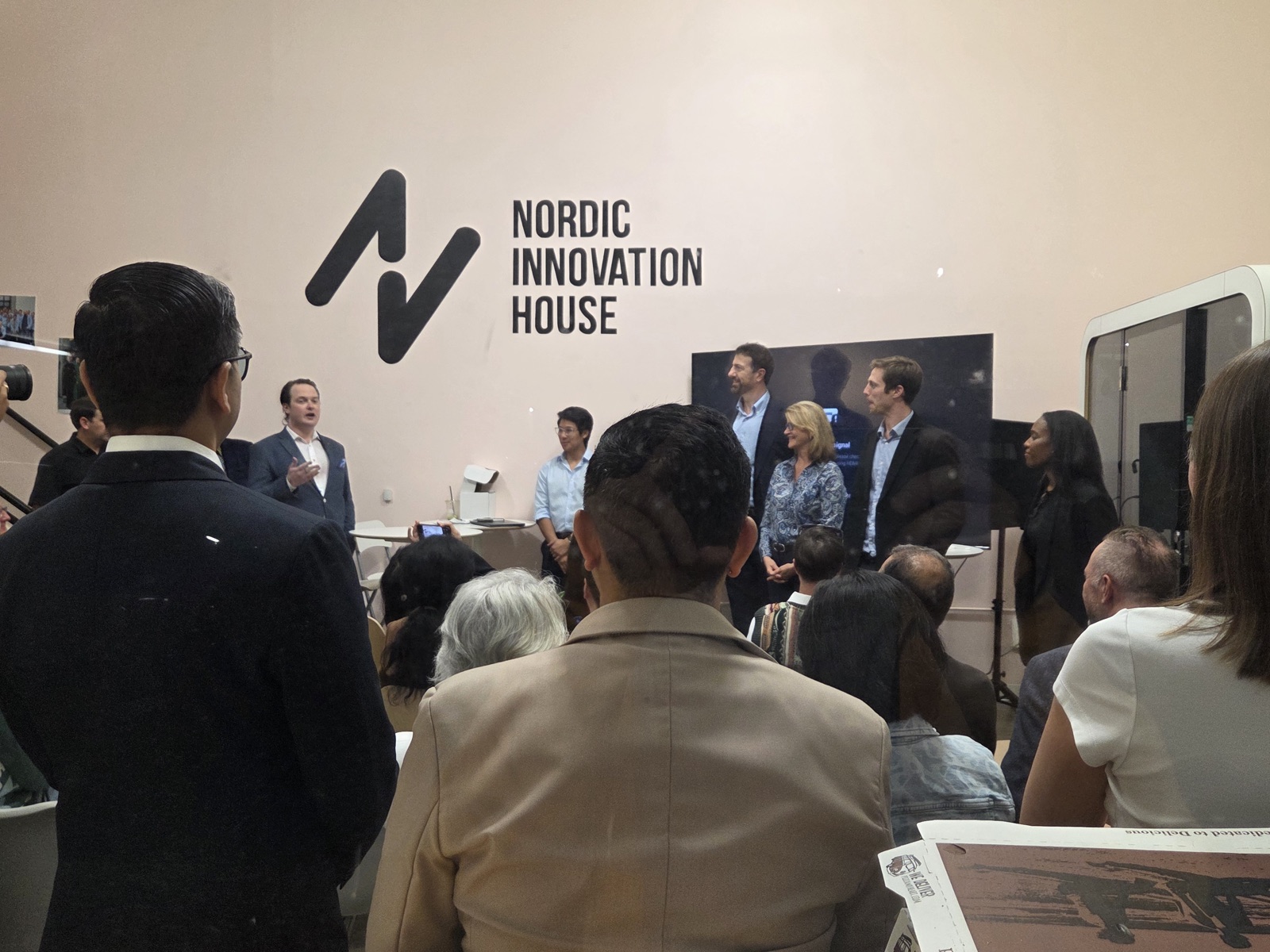
After the pitches, the host (left) calls the founders back to the front. Photo: SVTR, October 22.
- ChargeMate AI: an AI operations layer for EV charging sites; agents answer driver calls, watch the network and dispatch field technicians.
- Clyn: cleaning verification for hotels and short-term rentals; AI scores every photo.
- Cadents: risk decisions for enterprise IT assets; each device gets one action: isolate, replace or accept the risk.
- Tweelin: reads device presence signals to tell who is free right now and connects people directly, skipping calendar coordination.
- Calaris Diagnostics: a saliva test for fatty liver disease, spun out of Griffith University.
- Immergo Labs: therapist and patient put on headsets and do rehab together in the same 3D space.
The first four stayed away from general customer service
All four enterprise software pitches were about a workflow in one industry that nobody has organized yet. The following is according to their remarks on stage.
- ChargeMate: charging sites report 98% uptime, yet only 71% to 85% of drivers actually get a charge; behind a single site sit systems from more than ten vendors. AI handles a call for $3, versus $10 to $15 for a human. On Mercedes-Benz High Power Charging, the session success rate rose from 85% to 91%.
- Clyn: property managers' spot checks are only 20% accurate, and cleaners upload more than two hundred photos a month that nobody reviews. Its competition slide puts Turno, Guesty, Hostaway, Jobber and ServiceTitan in the "schedule, don't verify" column.
- Cadents: the real competitor is the spreadsheet. When ServiceNow bought Armis, "they bought visibility, not decision."
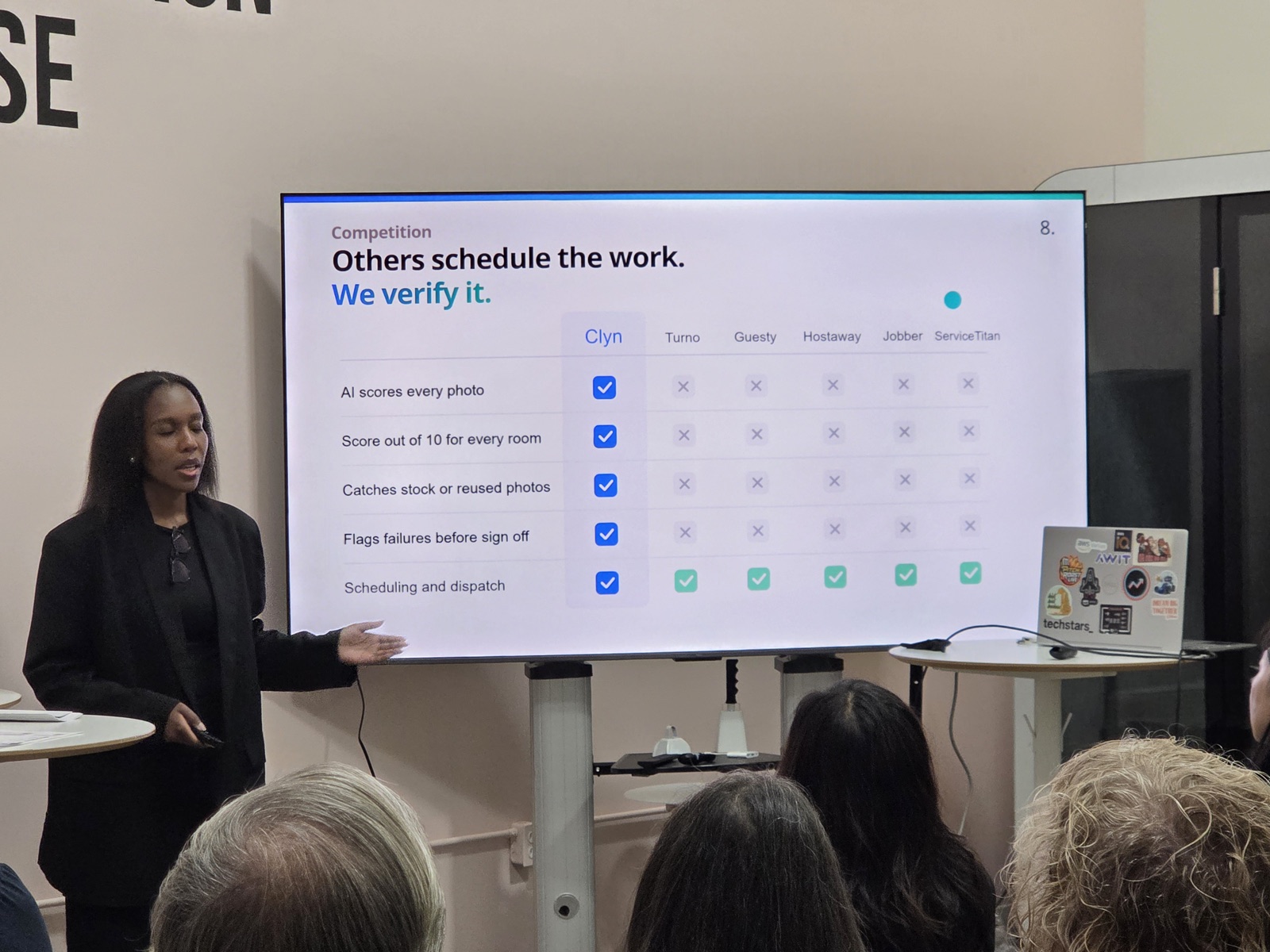
Clyn's competition slide: the five scheduling and dispatch tools tick only "Scheduling and dispatch". Photo: SVTR, October 22.
SVTR Take: money in general-purpose AI customer service agents is already stacked high. The SVTR AI Venture Database records that Sierra raised $950 million in May, at a reported post-money valuation of $15.8 billion; Decagon raised a $250 million Series D in January at $4.5 billion. Together the two are valued at more than $20 billion.
None of the four on stage called itself a customer service agent. Each picked the part a general agent cannot reach: field operations that must plug into systems from a dozen vendors, verification that needs someone to look at the photos, replacement decisions built on vulnerability feeds and vendor notices. At the angel table, the AI application race is no longer about whose agent talks better. It is about who gets an industry's system interfaces and unorganized data first.
That also explains the founders' résumés. ChargeMate's Brad Crist ran product across more than 3,000 charging assets at Volta Charging; three CEOs, Clyn's Diana Muturia, Cadents' Julie Case and Tweelin's Dario De Santis, have all worked at Cisco. All four are industry veterans of ten years or more, selling a fix for a problem they handled with their own hands in their last job.
Two healthcare companies: slow by design
The following is according to their remarks on stage.
- Calaris: results in 10 to 15 minutes, with sensitivity and specificity in the mid-80s. The FDA De Novo Class II pathway takes about four years, and the company is also seeking Breakthrough Device designation. Its senior clinical advisor is Richard Sterling, inventor of the FIB-4 score (the index doctors most commonly use to screen for liver fibrosis). Drugs approved in 2024 give fatty liver detection its first "find it and you can treat it" economics.
- Immergo: 43 veterans on the platform; it has signed its first U.S. Department of Veterans Affairs contract, as a subcontractor under a $14 billion master contract. The three co-founders hold PhDs from UC Santa Cruz and have worked together for nearly a decade.
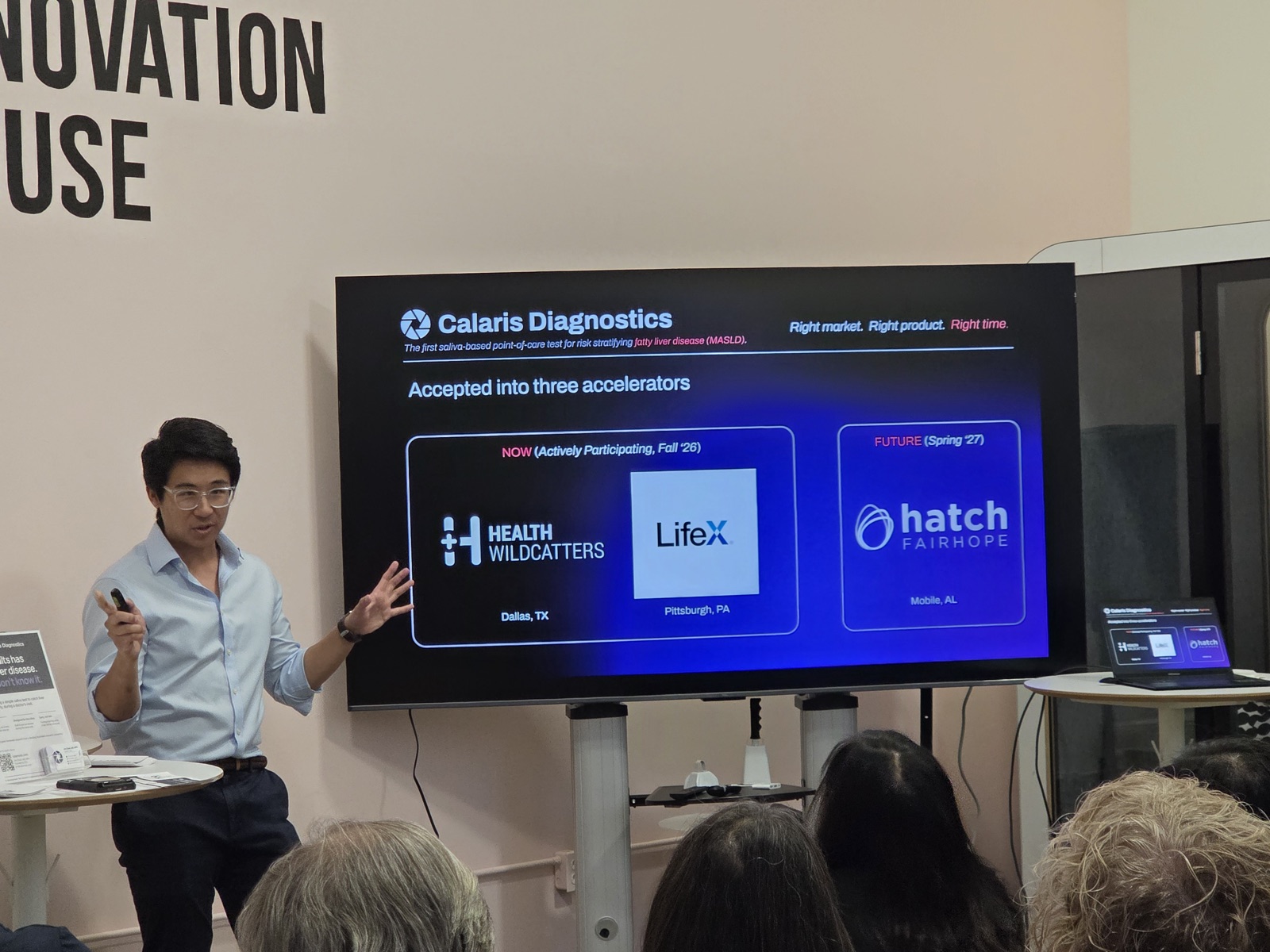
Calaris founder Jim Chen on the company's accelerators: Health Wildcatters and LifeX now, Hatch Fairhope next spring. Photo: SVTR, October 22.
SVTR Take: these two run on a completely different return clock from the first four. Calaris's own plan is to exit the liver test asset in four to five years before moving on to head and neck cancer; Immergo's revenue waits on the VA subcontract to scale. Angels looking at them are judging whether the regulatory path and the payer (clinics, the VA) can carry the company to that day; the revenue curve comes later. Same night, same room of angels, two entirely different yardsticks.
Still to verify
The following are on-stage claims we have not yet confirmed through public sources:
- ChargeMate's success-rate figures on Mercedes-Benz High Power Charging;
- Clyn's stated customers Mars and Denver Health;
- Immergo's subcontract with the Department of Veterans Affairs;
- Calaris's test sensitivity and specificity (no published clinical data yet).
Full profiles of all six are in Deal Showcase
These notes cover only what we saw and what we think. Full project profiles for all six companies are now in SVTR Deal Showcase: team and track records, product and customer progress, and the option to request an introduction to the founders through SVTR.
Deal Showcase is a shelf of companies currently raising, authorized by their founders and curated by SVTR, open to Intelligence paid members who have completed investor verification.
Verified and analyzed by SVTR. Funding data from the SVTR AI Venture Database and public reporting (Bloomberg, 2026-01-28; Quartz, 2026-05-04).