

SVTR Online Venture Session · From Payments to Agentic Commerce · September 11, 2026
The most concrete moment of the session happened inside a phone call. Max So, founder of Bravo, ran a live demo: a user types that they want a table for Friday night, the AI dials the restaurant, confirms the time, the party size and whether they want a window seat with whoever picks up, hangs up, and the table is booked. Nothing routes through a reservation site.
Most "AI does it for you" demos of the past two years stop right there. The real question is the next step: how does dinner get paid for, and why would the restaurant honor the charge.
The people who signed up for a dining session mostly came to see whether AI can collect money
The registration mix is itself a signal. Of 32 sign-ups, 21 came from investment firms, 9 from founders and 2 from corporates. At a session about restaurant cashback and prepaid balances, two-thirds of those registering were investors.
What they are looking for is plainly not another local-services app. The sample the private market is short of right now is an AI application that can go all the way from conversation to payment. Dining is one of the few offline categories where all five steps, discover, book, visit, pay and return, stay intact and happen daily, which is why it keeps being used as the test bed.
Thirty dining AI companies in the database, and only two touch the diner's wallet
Per the SVTR AI Venture Database, a search across primary-business descriptions turns up roughly 30 AI companies with dining as their main setting. Classified by those same descriptions, more than twenty of them sell to the restaurant: AI phone ordering, order and inventory systems, scheduling software, back-of-house robots. Only two work from the diner's side and hold the wallet and the payment. One is Blackbird Labs, which has raised $85 million. The other is Bravo, the company presenting that evening.
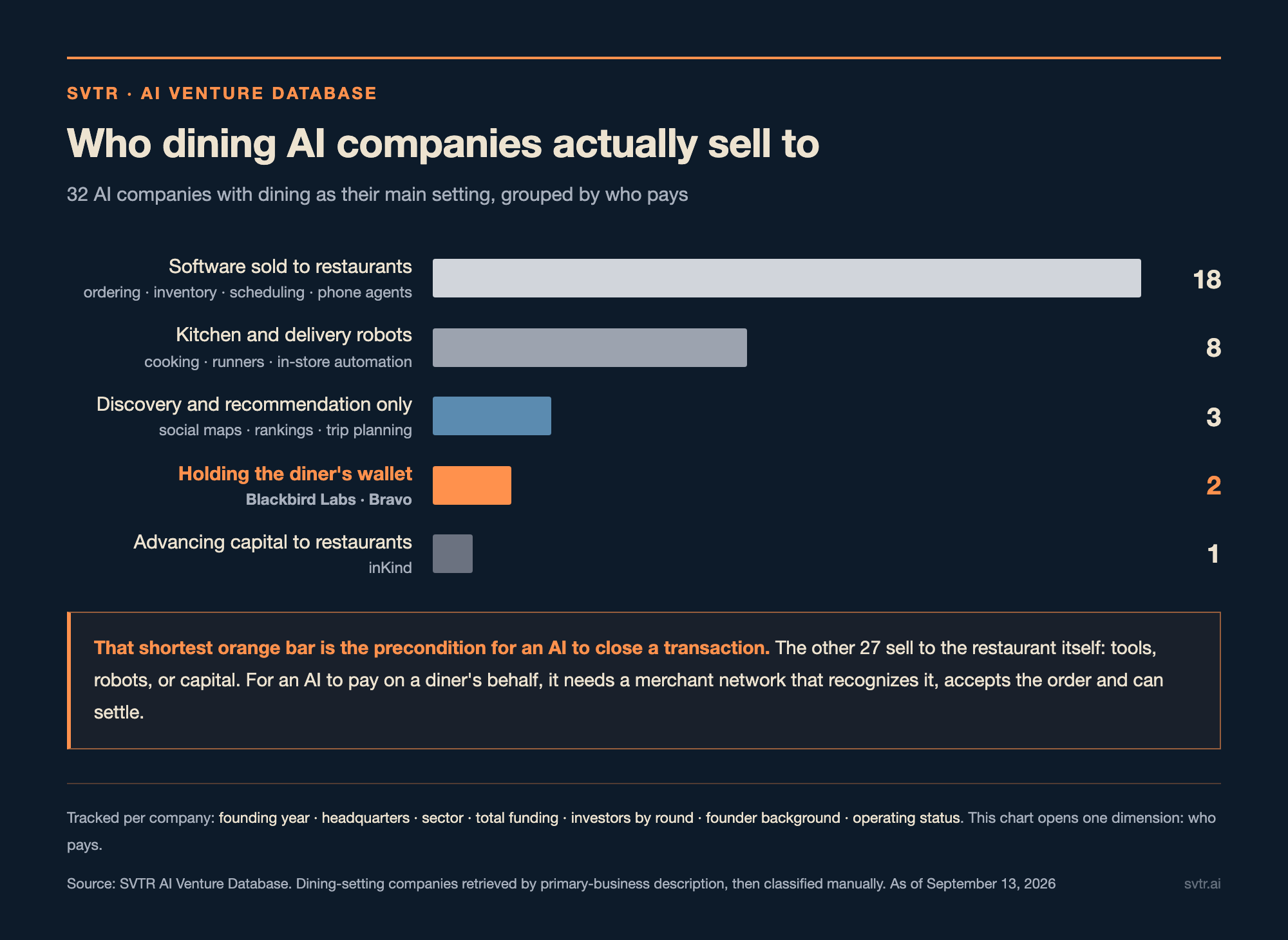
The flow of capital says more. The largest fundraiser in this group is inKind, with three rounds in 2026 totaling roughly $1.2 billion, mostly debt and mezzanine financing, and a stated use of proceeds that leaves little room for interpretation: advancing growth capital to nearly 10,000 restaurants within a year (per its August 2026 announcement).
Capital entering dining is currently taking the lending route to the restaurant, and very little of it is betting on an AI consumer entry point. Selling tools to restaurants is a business and lending to restaurants is a business, yet neither is agentic commerce, meaning an AI that completes a transaction on the user's behalf rather than stopping at a recommendation. For an AI to actually pay, it needs a merchant network that recognizes it, accepts the order and can settle. Almost nobody is building that network.
A spread business worth ten dollars an order
Bravo's approach is to buy that network one restaurant at a time with prepaid cash. Per Max So's account on the call: a user loads C$50 and gets C$53 of credit; Bravo takes that money and buys future dining credit from restaurants at roughly 80 cents on the dollar, and the spread is the revenue. The restaurant gets cash upfront and placement on the platform, the user gets cashback usable across the whole network, and Bravo gets the preference data behind every transaction.
The AI sits on top of that flow. Conversations are broken into structured tags; his example was "family of four, two kids, likes it spicy." A second system watches the merchants, using health inspection records and social media reviews to judge how a restaurant is doing and how likely it is to close.
His case for differentiation rests on risk structure. Per his account, a US company that has run a similar model for a decade is fundamentally a lender, advancing tens of thousands of dollars per merchant, which confines it to higher-risk restaurants; Bravo puts up under ten dollars per transaction, which is why it can sign chains. He said Vancouver has been running for two and a half years, merchant retention is above 97%, and GMV went from about $1 million in 2024 to about $6 million in 2025.
What this session changed in our read of the category
Building out the offline side is grinding work, not technical work. What this session made clear is a transaction rail assembled restaurant by restaurant and advance by advance. On the AI layer, time ran short and no quantified progress was presented. We think Bravo’s moat sits in merchant relationships and settlement capability, with the model second.
That also means there is no shortcut to a new city. Going from Vancouver to San Francisco or New York, users can compound on their own; the merchant network has to be signed again from zero. One more thing worth watching in the prepaid model: the money sitting on the platform belongs to users, and the larger it grows, the heavier the obligation to honor it.
For early-stage funds focused on AI applications, the answer this session gives is plain: produce the share of transactions completed under AI guidance. With that number, agentic commerce has started. Without it, it is still a demo.
SVTR Online Venture Sessions feature one company each, for AI founders and investors worldwide. Join us and let's talk.