

"Signal | SVTR Forward Signal"
SVTR Editor's Note:
On October 20, Galbot and Fourier both showed up in YITA Dynamics' seed round. YITA was founded only in May; its founder, Zhong Xuegang, previously ran humanoid joint development at Fourier. Two competing robot makers bought into a supplier that came out of one of them. In August we argued that embodied-AI money was moving upstream. What the past two weeks show is the next step: Chinese robot makers are pooling money to raise component makers as suppliers they all share.
On October 20, YITA Dynamics announced seed and seed-plus rounds totaling more than RMB 100 million, with two robot makers on the cap table: Galbot and Fourier. Founder Zhong Xuegang rose to head of R&D for Fourier's humanoid power division, leading three generations and more than 20 joint modules, with close to 50,000 units shipped. After he left to start his own company, his former employer did not pull that work back in-house. It became a shareholder, alongside a rival.
Our view: Chinese humanoid robot makers are using small equity stakes to turn component makers into suppliers shared by several of them. The stakes do not buy exclusivity. They buy a place near the front of the line when capacity is tight, and a seat at the table when designs change. In the US, Figure is doing the opposite, bringing actuators, hands and batteries into its own factory.
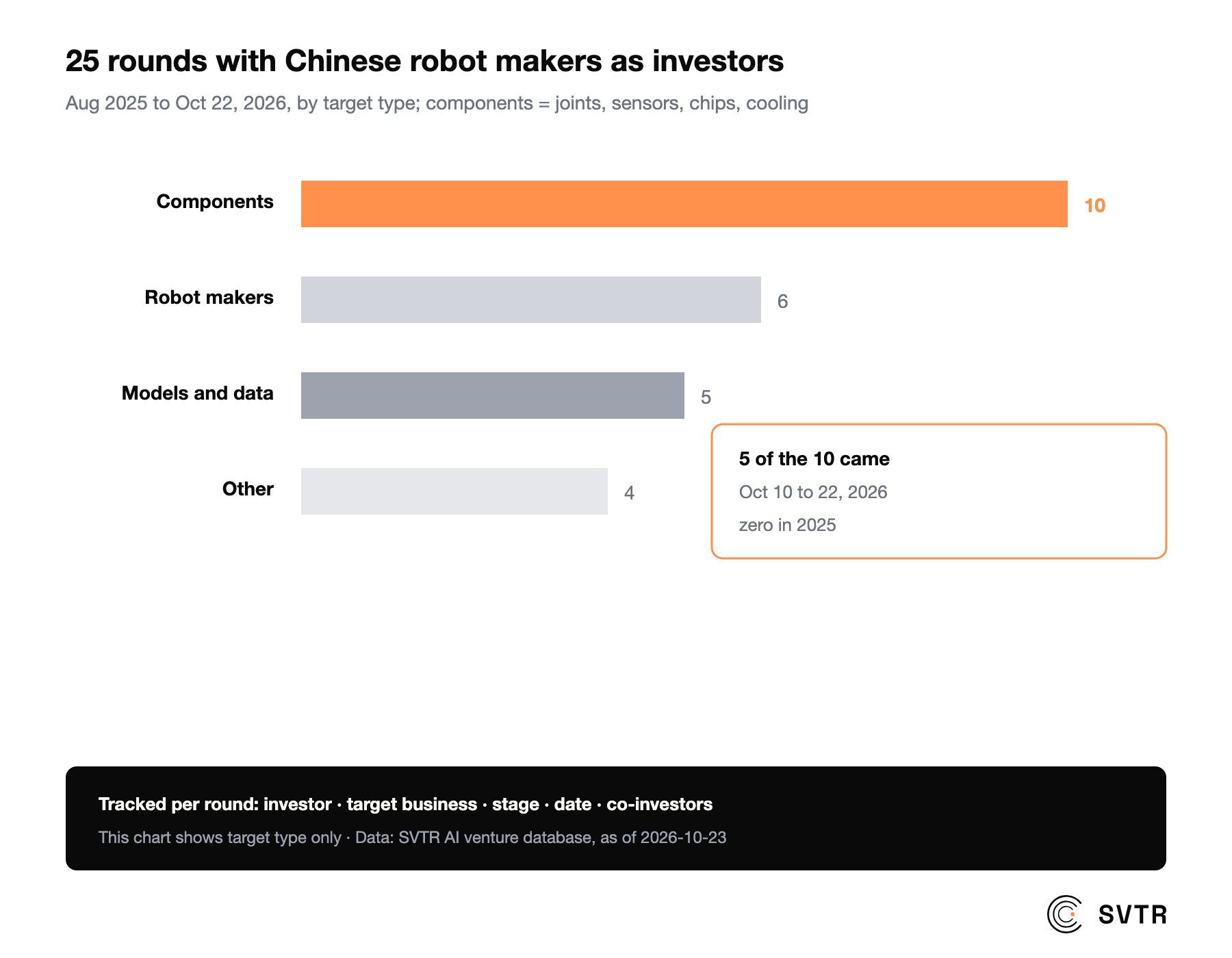
According to the SVTR AI venture database, of 25 rounds since August 2025 in which robot companies invested in other companies, 6 came between October 10 and 22. Five of those six went into joints, sensors, chips or cooling, and three had two or more robot companies in the same round.
Table 1 | Rounds in which Chinese robot companies invested in other companies (Aug 2025 to Oct 2026)
| Period | Rounds with robot-company investors | Of which into components | Two or more robot companies in the round |
|---|---|---|---|
| 2025-08 to 2026-02 | 7 | 0 | 0 |
| 2026-03 to 2026-09 | 12 | 5 | 2 |
| 2026-10-10 to 10-22 | 6 | 5 | 3 |
Data: SVTR AI venture database, as of 2026-10-23. Confirmed rounds where the investor is a robot maker, dexterous-hand maker or embodied-model company, 10 in all: AgiBot, Galbot, Fourier, X Square Robot, Galaxea AI, Linkerbot, Five Ages, Ecovacs, AheadForm and Woan Robotics (SwitchBot); a round with several of them counts once. Components means joints, reducers, screws, sensors, chips and cooling; robot makers, embodied models, data, quantum computing and brain-computer interfaces are excluded. The database has no record of a US robot maker investing in another company.
On August 15, Signal #32 set a bar for this: if robot makers invested in upstream component or data companies at least three times in one quarter, it would count as a structure rather than isolated cases. That indicator does not come due until November 14, and there have already been seven since August 15.
Signal 1 | Rivals on the same cap table
In three of October's six rounds, several competing robot companies sit on the same cap table:
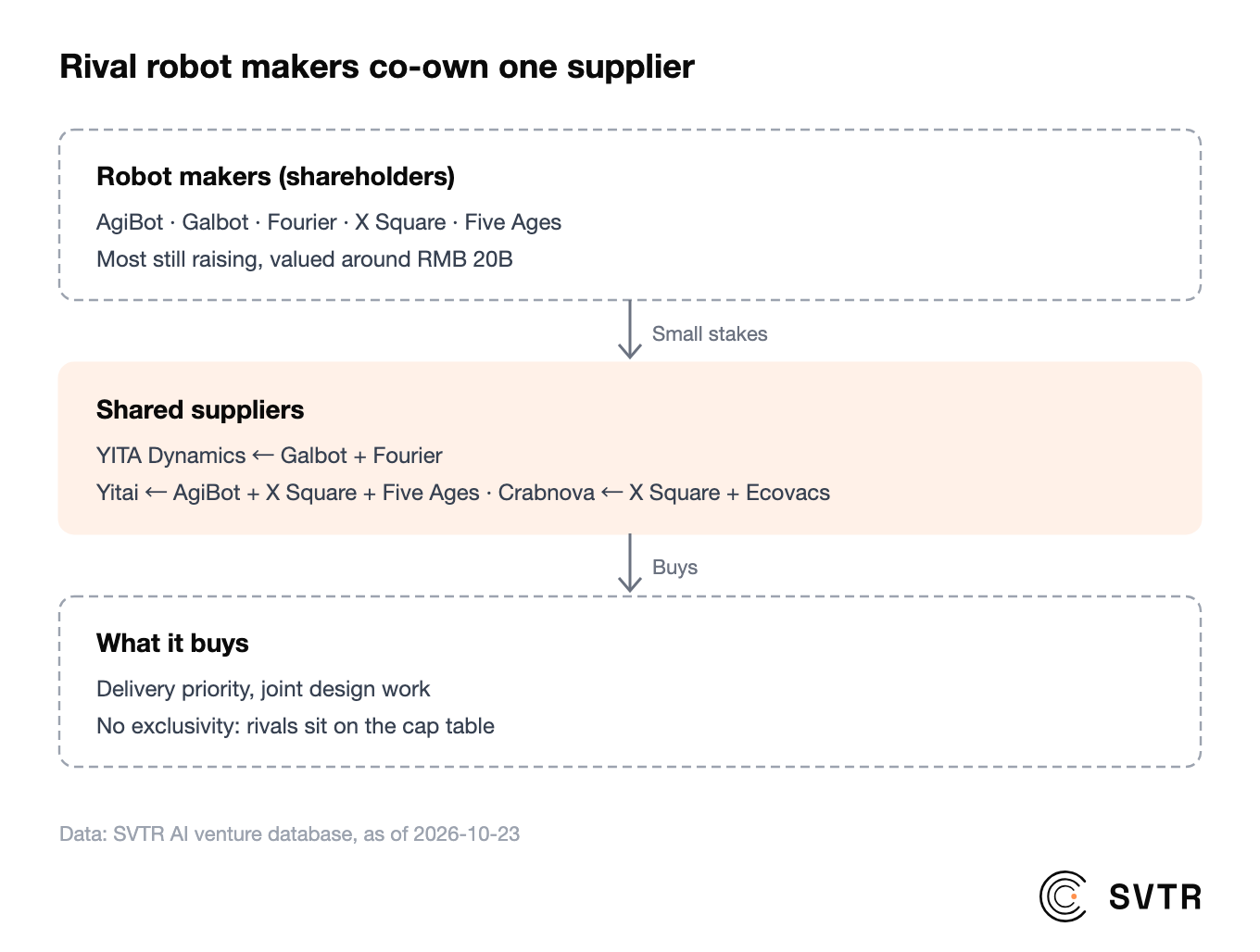
- YITA Dynamics (joint modules and force-controlled dual arms): Galbot and Fourier in the same round.
- Yitai Technology (turns real spaces into data robots can use): AgiBot, X Square Robot and Five Ages together, alongside Huawei's Hubble and JLC.
- Crabnova (harmonic reducers and joint modules): X Square Robot came in new; existing shareholder Ecovacs added to its stake.
There were two earlier cases this summer. In July, AgiBot and dexterous-hand maker Linkerbot both joined the A+++ round of joint-module maker Motorevo; in June, the same two backed embodied-data company Liqing Intelligence. By October, half of the deals looked like this.
When a supplier lets several customers buy in, none of them can demand exclusivity. None of the six rounds disclosed how much each robot company put in; the YITA, Crabnova and Yitai rounds were all in the "more than RMB 100 million" bracket, so no single robot maker's stake is likely to be large. The money works more like a reservation: when capacity is tight, shareholders' orders go first; when a design needs to change, shareholders' engineers can walk straight onto the supplier's line.
Signal 2 | From joints to chips and cooling
On October 19, AgiBot made two investments in one day, and neither was a mechanical part.
- ChipV: technology from the high-performance processor lab at Tsinghua University's School of Integrated Circuits; makes RISC-V automotive-grade chips and robot compute chips. AgiBot and several investors from Anhui and Hefei backed the Pre-A round. According to Rongzhong Finance, its motor-control chips have shipped more than 1 million units, with 5.2 million units in new orders signed for 2026.
- Haina Zhileng: founded in Hangzhou this February; cools AI chips and robots. AgiBot came in as a strategic investor.
Until now, the components robot companies bought into were joints, screws, tactile sensors and six-axis force sensors: Linkhou, Motorevo, Xinqi Robotics, Mosense and Qidian Zhikong. Every joint motor in a robot needs a control chip, and the more compute a robot carries, the harder it is to cool. AgiBot's stakes moving into electronics suggest robot makers now worry about more than joint lead times.
Signal 3 | US peers bring components into their own factories
When Figure introduced its BotQ factory in March 2025, it was explicit: actuators, hands, batteries and final assembly are done in-house, and only piece parts go to outside vendors. Its reason was that humanoid robots have no mature supply chain, so it had to build one itself.
The difference comes down to supplier density. The Yangtze and Pearl River deltas already have batches of joint, reducer and sensor makers to choose from, so a robot maker can join several suppliers' queues with small stakes. In the US, independent humanoid component makers are still rare, so robot makers keep the key parts in their own hands. The first approach is cheaper and faster, at the cost of using the same parts as your rivals. The second gives more control, at the cost of staffing and building capacity for every part yourself.
Why now: volumes are up, and robot makers have cash
- Output: AgiBot's 10,000th general-purpose embodied robot came off the line on March 28; going from 5,000 to 10,000 units took just over three months. Its 15,000th followed at the end of June.
- Money: Galbot has raised about RMB 7 billion in its 34 months and is valued at more than RMB 20 billion. X Square Robot closed four rounds in two months ending in late June, at a post-money valuation above RMB 20 billion.
- What a joint is worth: Motorevo founder Chen Wankai has said that high-torque integrated joints make up nearly half the cost of a humanoid robot (National Business Daily, April 2026).
For the first time, robot makers are producing enough to strain their suppliers, and they have raised enough to share some of it with them. Trading equity for a place in line is more flexible than a long-term purchase contract and cheaper than building a factory.
Impact: a component maker's cap table is its customer list
For component founders, several robot makers buying in is the best proof of orders, and it makes the next round easier. The cost is that customers and shareholders become the same people: if robot makers' fundraising slows, the component maker loses orders and follow-on investors at the same time.
For funds investing in component rounds, more robot makers on the cap table means more diversified orders, but check whether they actually place orders. A robot-maker shareholder that puts in money but no orders is only a name, however famous.
For robot makers, it is a sum to work out: using raised money to become a supplier's shareholder buys what, exactly? Delivery ahead of rivals, or just a place on the same list as them?
Verification
Confidence is moderate. "Rivals buying in together" rests on five independent deals pointing the same way; "the stakes buy a place in line" is an inference, since neither stake sizes nor supply terms are public. The 2025 numbers may be low: many early rounds in the database are recorded only to the month, and small stakes by robot makers may be missing. Falsification: if robot makers start taking control of or acquiring joint, sensor or chip makers, or if stakes keep accelerating after component capacity loosens and prices fall, this view needs revising.
Three numbers to watch over the next 90 days:
- Rounds in which robot companies invest in component makers: from October 24, 2026 to January 22, 2027, at least 6 in the database means the pattern continues; 1 or fewer means the wave has passed.
- Several robot companies in one round: at least 3 new cases with two or more robot makers, dexterous-hand makers or embodied-model companies in the same round would make "shared suppliers" standard practice in this sector.
- Control or acquisition: whether any robot maker takes a majority stake in, or acquires, a joint, reducer, sensor or chip maker; a single case would mean the "stakes do not lock up suppliers" view does not hold.
Deal Showcase: teams raising on the same supply chain
- Bimotal: designs and makes high-performance robot actuators in Berkeley, with revenue above $6 million. It is a rare independent US actuator supplier; whether its customers buy in the way Chinese robot makers do is a direct test of this piece in the US.
- Atlas Spatial Intelligence: uses 3D reconstruction to provide labeled spatial data for robot training and drone navigation, the same kind of work Yitai does.
The Deal Showcase is open to SVTR members who have completed investor verification, with full team details, funding needs and materials, and introductions through SVTR. If you are building robot components or embodied data, submit your project.
If you work at YITA Dynamics, Yitai, ChipV, Galbot, Fourier, AgiBot, X Square Robot, or any fund mentioned here, you are welcome to claim your company or personal profile in the SVTR AI venture database.
Follow-up | Signal #36 "The lead seat in AI rounds now goes to customers, rivals and suppliers": confirmed
On August 29, Signal #36 registered this indicator: over the next 8 weeks, AI rounds in which an operating company (not a fund) took the lead, co-lead or sole seat would average at least 3 a week to confirm, or 1 or fewer to refute. From August 29 to October 23, a line-by-line review of the database found 59 such rounds, about 7.4 a week, with no week below 5; excluding corporate venture arms, there were still about 37, about 4.6 a week. Examples include Samsung Electronics leading Mistral AI's €3 billion Series D and Siemens leading Skeleton Technologies. Caveats: investor type was judged by hand, on a slightly broader basis than the original; these rounds were about 7% of all rounds, the same as in the registration week, so the trend is holding, not accelerating.