

SVTR Editor's Note:
This week the Canadian government committed up to C$1.6 billion for a stake in Cohere, on condition that its headquarters, jobs and compute stay in Canada. Korea has already used a national fund twice this year to anchor domestic inference-chip companies; this time the anchor went into a model company. We compared the shareholder lists of AI chip and model companies outside the US and China over the past 12 months to see where government money sits in a round, and what it takes in return.
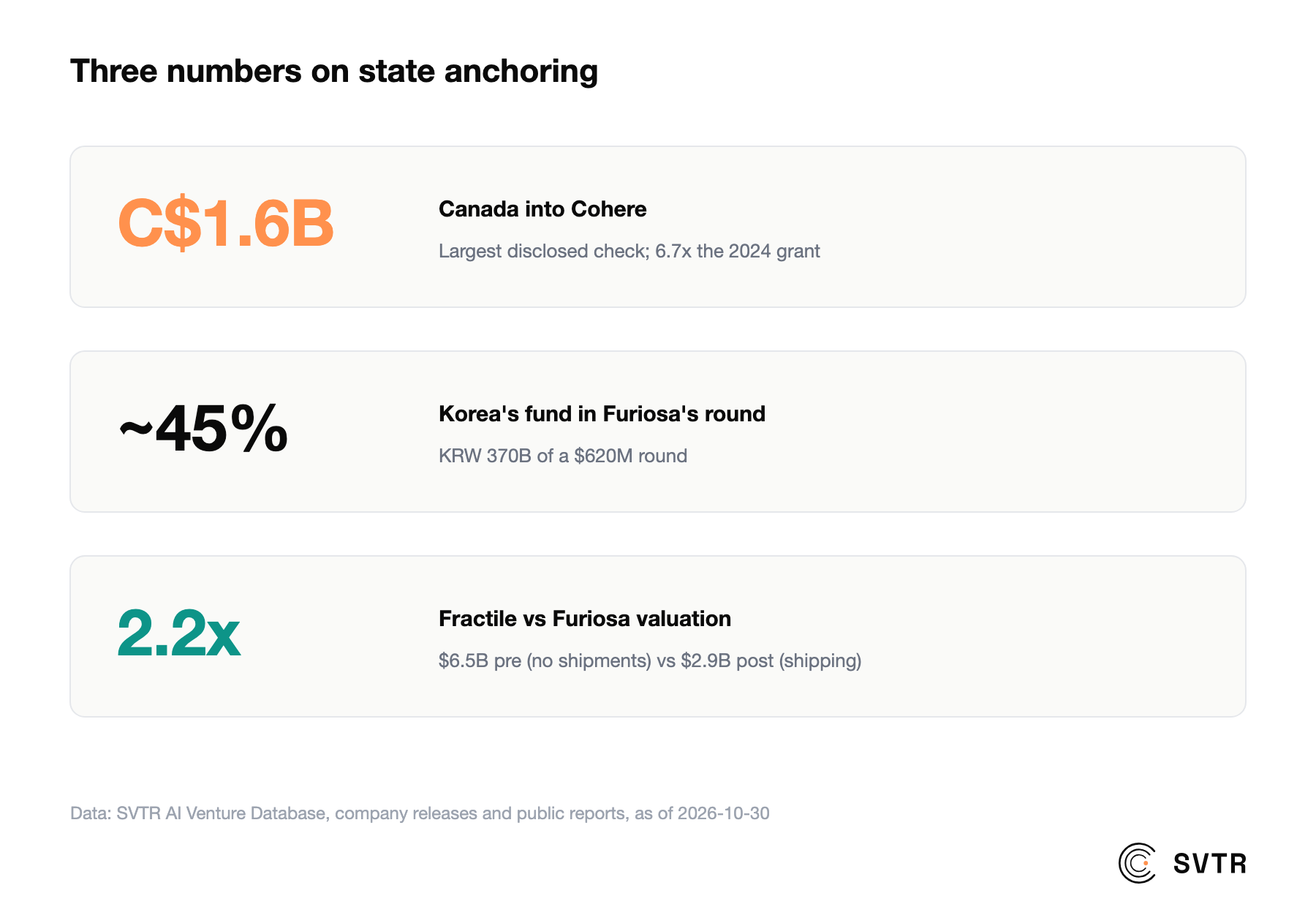
On October 29, Cohere announced the initial close of its Series E, targeting up to C$7 billion at a C$35.7 billion valuation. The lead investor is German retail group Schwarz Group, with a commitment of about $600 million. The Canadian government is putting in up to C$1.6 billion through the state-owned Canada Development Investment Corporation, the largest disclosed check in the round, released in stages against jobs and revenue targets. There are three conditions: the headquarters stays in Canada, Cohere adds more than 1,000 tech jobs in Canada by 2030, and over the same period it invests C$1.7 billion in Canadian data centres.
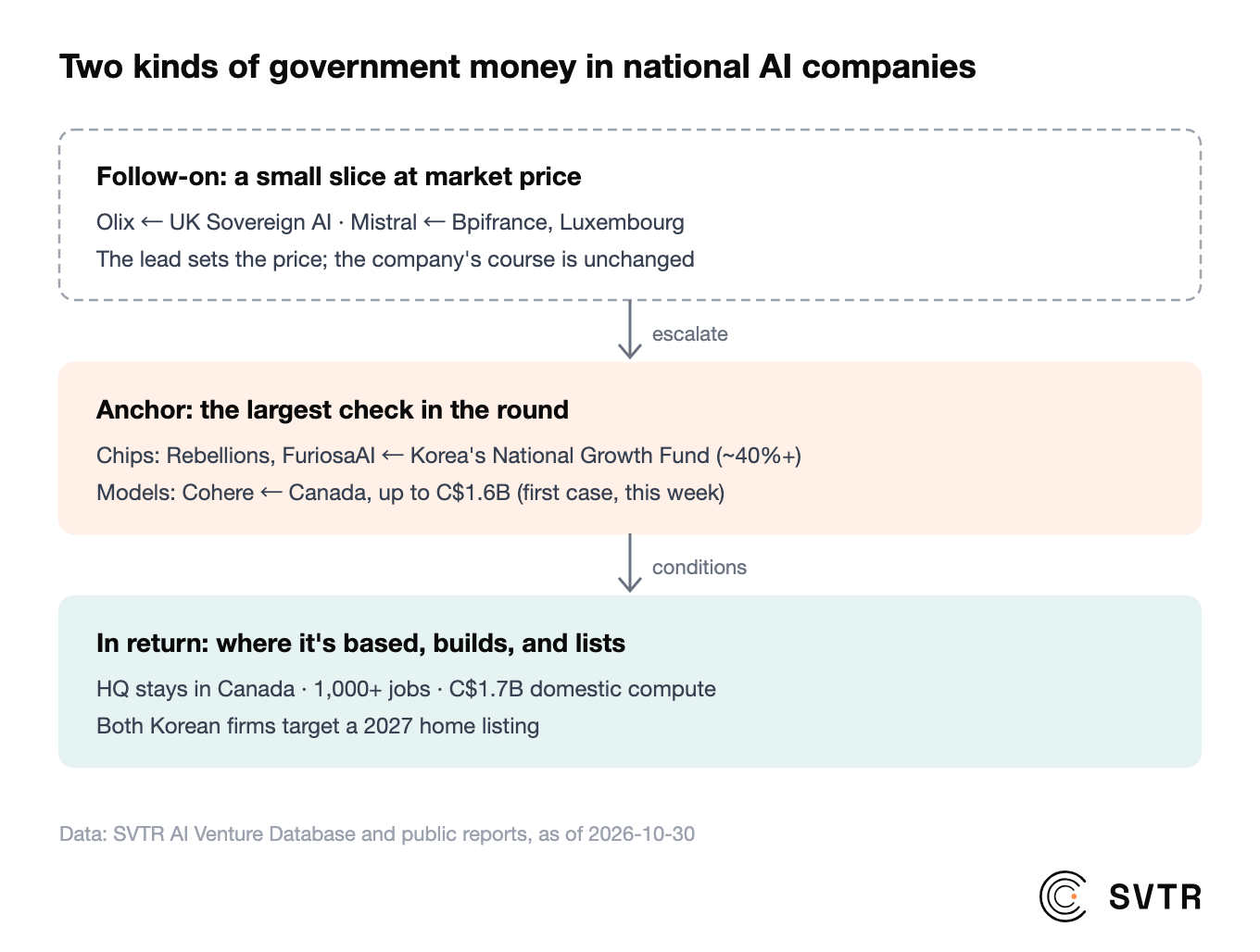
Our view: national capital anchoring domestic AI companies showed up first in chips this year, and this week it reached models. Anchoring and following are two different kinds of money. A government fund that follows buys a small slice at the market price and does not change the company's course. A government that anchors writes the biggest check in the round and gets a say in where the company is based, where its compute is built and where it will eventually list. Where the state anchors, the price also tends to settle on domestic benchmarks, though so far that is visible only in chips.
Signal 1 | Canada moves from subsidizing Cohere's compute to owning a piece of Cohere
This is not the first time Ottawa has funded Cohere. In December 2024, then Deputy Prime Minister Chrystia Freeland announced up to C$240 million for Cohere to build a domestic data centre with CoreWeave, the first outlay under Canada's C$2 billion Sovereign AI Compute Strategy, structured as project funding. Less than two years later, the government money going to the same company has grown about 6.7 times, and the relationship has changed: Cohere was a grant recipient, and now the government is a shareholder.
None of the conditions is about returns. All three buy location. The staged structure says even more: the money follows jobs and revenue targets. What the government wants is for Cohere to grow up as a Canadian company; financial return comes second.
The round also carries a second country's agenda. Schwarz Group holds more than 20% of German model developer Aleph Alpha, which has signed a merger agreement with Cohere. After the merger Berlin becomes Cohere's second headquarters, and Aleph Alpha's contracts with Germany's federal ministry for digital affairs and the state government of Baden-Württemberg come with it. Schwarz also plans to bring Cohere's models onto its own STACKIT cloud. A Toronto company has become the national model bet of both the Canadian government and German industrial capital.
Signal 2 | Anchoring started in chips; in models, governments had only followed
Looking across the past 12 months in the SVTR AI Venture Database, 12 AI foundation model and AI compute chip companies outside the US and China raised rounds of $100 million or more. Government money appears on the shareholder lists of 7 of them, but in only 3 did a government write the largest or near-largest check in the round: Rebellions, FuriosaAI and, this week, Cohere. The table lists 7 of the 12.
Table 1 | AI model and chip companies outside the US and China: where government money sits in the round
| Company | Latest round and valuation | Position of home-government money | Layer |
|---|---|---|---|
| Cohere (Canada) | Oct 2026, target C$7B, valued at C$35.7B | Canadian government up to C$1.6B, largest disclosed check, three conditions | Model |
| Mistral AI (France) | Sep 2026, $3.48B, $24.4B | Led by Samsung Electronics; Bpifrance and Luxembourg followed | Model |
| Ineffable Intelligence (UK) | May 2026, $1.1B seed, $5.1B | US funds such as Sequoia in front; British Business Bank and the Sovereign AI fund followed | Model |
| Rebellions (Korea) | Mar 2026, $400M, $2.34B post | National Growth Fund about $165M, roughly 40%, co-lead | Chip |
| FuriosaAI (Korea) | Oct 2026, $620M, $2.9B post | National Growth Fund about $280M, roughly 45%, largest investor in the round | Chip |
| Olix (UK) | Aug 2026, $312M, $3.3B | Led by Fundomo; UK Sovereign AI fund followed | Chip |
| Fractile (UK) | Oct 2026, about £577M, $6.5B pre | None | Chip |
Data: SVTR AI Venture Database, as of 2026-10-30. The 12 are AI foundation model and AI compute chip companies headquartered outside the US and China with a single round of $100 million or more in the past 12 months (interconnect and networking chips excluded). Of the 5 not listed, Tenstorrent, Taalas, Sarvam AI and Sakana AI have no government money, and Axelera AI's government money followed. Government shares are estimated as the publicly reported commitment divided by the round size. FuriosaAI's round size and the National Growth Fund's contribution follow the company release (Korean media report about KRW 800 billion in total, of which KRW 370 billion from the National Growth Fund). Fractile's amount is the sum of UK Companies House share allotment filings from September 9 to October 23; the roughly $600 million reported earlier was the target under discussion.
In March Korea gave the National Growth Fund's first direct investment to Rebellions, and in October it put up about 45% of FuriosaAI's round. Both were anchors. In models, government money had always come after someone else: Mistral AI's round was led by Samsung Electronics, with France's Bpifrance and the Luxembourg government following; both UK rounds were led by US funds. Cohere is the first model company in this table in which its home government wrote the largest check. In July, SVTR's Signal #24 argued that state capital goes into hard tech and not into software. Models sit between the two, and this week a government anchored one for the first time.
Signal 3 | In chips, the effect of anchoring on price is already visible
Two chip rounds in the same week make the difference plain. Furiosa's chips are in volume production at TSMC and in use at LG AI Research and Samsung SDS; in March 2025 it turned down an acquisition offer from Meta of about $800 million; this round values it at $2.9 billion post-money. Fractile has not delivered a single production chip. It has a preliminary chip purchase agreement with Anthropic worth about $250 million, and its Series C, co-led by Lightspeed and Redpoint Ventures, sets a $6.5 billion pre-money valuation, 6.5 times its level five months earlier. The two Korean companies anchored by the state are both shipping, yet they are the two lowest-valued chip companies in the table, and both point their exits at home: Rebellions CEO Sunghyun Park told CNBC in July that the company is targeting a Korean listing in the first half of 2027.
In models the gap does not show yet. Cohere's C$35.7 billion valuation is roughly $25 billion, close to Mistral, which has no government anchor. Cohere disclosed annualized revenue of $240 million in February 2026 and since then has only said it grew 165% year over year. So we commit only to the first half: anchoring changes where a company is based and where it lists. Whether it also pins a model company's price to domestic benchmarks will have to wait for Cohere's next pricing.
Signal #44 argued that in the compute middle layer, the US prices on revenue while China prices for domestic chips. These two deals in Korea and Canada sit closer to China's yardstick: the state first decides it wants a domestic company, then supplies it with customers and capital.
Why now
On June 12, the US Commerce Department ordered Anthropic to stop serving Fable 5 and Mythos 5 to all foreign users, including foreign nationals living in the US. That set a precedent: the strongest models can become unavailable at any time. In the blog post announcing this round, Cohere cited another figure: earlier this year more than 70% of open-model tokens on OpenRouter came from Chinese models, up from 3% fourteen months before. Countries caught between the two either use American models or Chinese ones, and Cohere is selling the third option. Korea's investments in both chip companies predate the order, so the order did not cause them; it makes a government taking direct equity in a domestic model company easier to justify at home.
Impact | Who is affected
For model founders outside the US and China, Cohere has laid out a path others can copy: take government compute subsidies first, make yourself the country's only option, and convert that into equity when sovereign AI budgets arrive. The cost is written into the conditions. Headquarters, team and compute cannot move freely, and the exit of a full sale to a US tech giant narrows.
Financial investors following into these companies need to know whether they are following an anchor or a follower. Behind an anchoring government, domestic demand cushions the downside, while the upside most likely waits for a domestic listing; in chips, these companies will struggle to get the kind of price Fractile got on the strength of a US customer.
We hold this view with medium confidence: anchoring has now appeared in two countries and two layers, but in models Cohere is the only case so far. The view is falsified if Cohere is acquired by a US company or moves its headquarters out of Canada after the government invests, or if a state-anchored chip company reaches a valuation in Fractile's range without a major US customer.
Over the next 90 days we will track three indicators:
- Whether another AI model company outside the US and China raises a round in which the government writes the largest disclosed check or more than 30% of the round. One or more means anchoring is spreading in models; none means Cohere remains a one-off.
- Whether Cohere publishes the final close list and amount of its Series E, and whether the Canadian government's first tranche is paid in. A paid first tranche means the anchor has turned from commitment into equity.
- Whether Rebellions or FuriosaAI files for preliminary listing review with the Korea Exchange. A filing means anchored companies' exits really have come home.
If you work at Cohere, FuriosaAI, Rebellions, Fractile, Mistral AI, or any fund mentioned here, you are welcome to claim your company or personal profile on the SVTR AI Venture Database.
Follow-up | Signal #29 "Agent security will be absorbed by identity and security platforms": partially confirmed
Signal #29 registered two indicators on August 1, due October 30. The first asked whether, beyond Cyera buying Oasis and Okta buying Permiso, at least two more security or identity platforms would acquire agent-security startups within 90 days. Confirmed: in August Fortinet acquired Virtue AI, which does agent protection and governance; in September Upwind acquired Aegis for about $30 million and Kiteworks acquired Bonfy.AI; on October 13 Workday announced it would acquire agent identity platform C1.ai (Workday is not a security platform, so it was not counted toward the threshold). The second asked whether China would see its first independent round of $10 million or more in "AI agent and non-human identity security". Not confirmed: the SVTR AI Venture Database has recorded none since August and public searches found none, so the US-China gap persists. Limits: acquisitions were judged case by case from SecurityWeek's August and September M&A roundups and public reports; the China side relies on database coverage and Chinese-language searches and may miss undisclosed rounds.