

WAIC 2026 is held in Shanghai, with robots as the main attraction on the exhibition floor: two major fields, intelligent computing and embodied intelligence, have gathered more than 200 companies each, with humanoid bodies and dexterous hands filling the corridors. Beneath the excitement lies a more practical question: do the funds really follow the popularity? We walked through the exhibition hall and laid out the financing of 385 participating and related companies in the SVTR AI venture database, aiming to clarify one thing: the first wave of companies benefiting from the AI boom do not align with the density on the exhibition floor.
1. The Exhibition Floor is Filled with Bodies
The most direct impression on site is that robots are performing.
Several robot dogs jump at the same time, completing a 720-degree backflip in the air and landing steadily; on the ring, two humanoid robots wearing boxing gloves move, punch, and dodge, and can get up on their own after being knocked down; nearby, a robot lying on the ground does push-ups continuously, with movements more standard than many sedentary viewers. Zhijidi, Xingdongjiyuan, Songyan Dynamics, and Lingchu Intelligent line up a whole area, with humanoid bodies, dexterous hands, and quadrupedal dogs stretching as far as the eye can see.
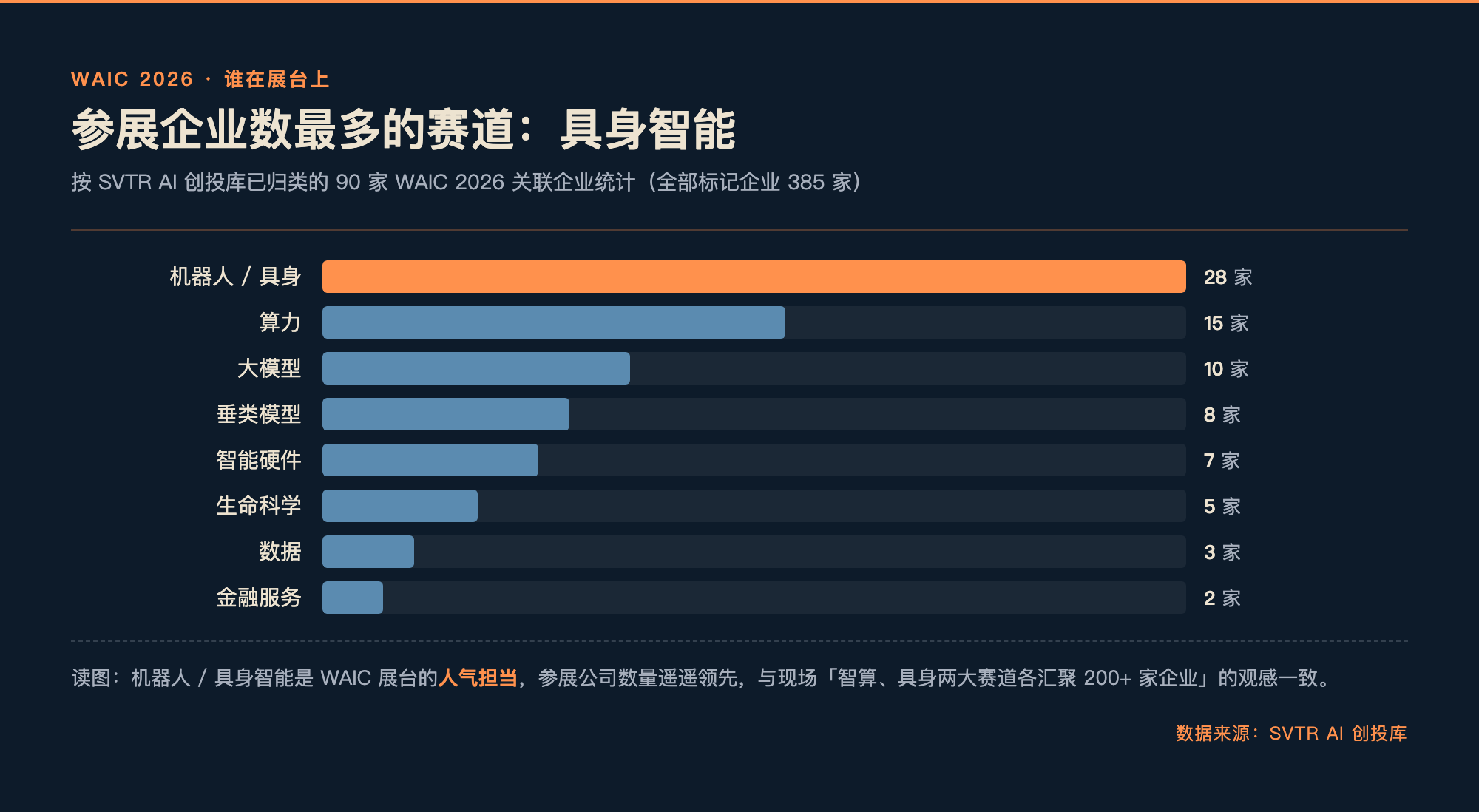
According to the SVTR AI venture database, this WAIC has tracked 385 participating and related companies, and among the 90 classified, 28 are in robotics / embodied intelligence, nearly twice the number of the second-place computing (15), and far more than the 10 in large models. This also aligns with the official statement that the two major fields of intelligent computing and embodied intelligence have gathered more than 200 companies each: embodied intelligence is the hit of this WAIC.
After walking around the exhibition floor a few more times, a division becomes clear. The areas with the densest crowds are those showcasing physical performances: robot dogs doing flips, humanoid robots boxing, and giant mechs allowing people to sit in the cockpit and control two mechanical legs in person.

More worth watching are the machines that work quietly:
- Domestic robots complete tasks like making the bed, picking up and placing items, and moving around the room without remote control or editing;
- Industrial robots identify holes on their own, pick up tools, and precisely screw in the screws.
Performance can be supported by remote control and choreography, but work cannot be faked: no remote control, one take, tests the model's autonomy, i.e., the brain. The most valuable moments on the exhibition floor happen in the brain.
But popularity is one thing, and who gets the money is another.
2. Money is in the Brain, Not the Body
When the same batch of companies' disclosed financing is laid out, the picture immediately reverses. According to the AI venture database, the total financing of the large model companies participating in this exhibition is about $11.7B, more than three times that of the robot sector (about $3.4B); while the number of robot companies is nearly three times that of the large model companies. The most popular sector is precisely the one with the least financing. A direct comparison: MiniMax's pre-IPO financing alone exceeds $1.5B, nearly half of the total financing of the 28 robot companies on the exhibition floor.
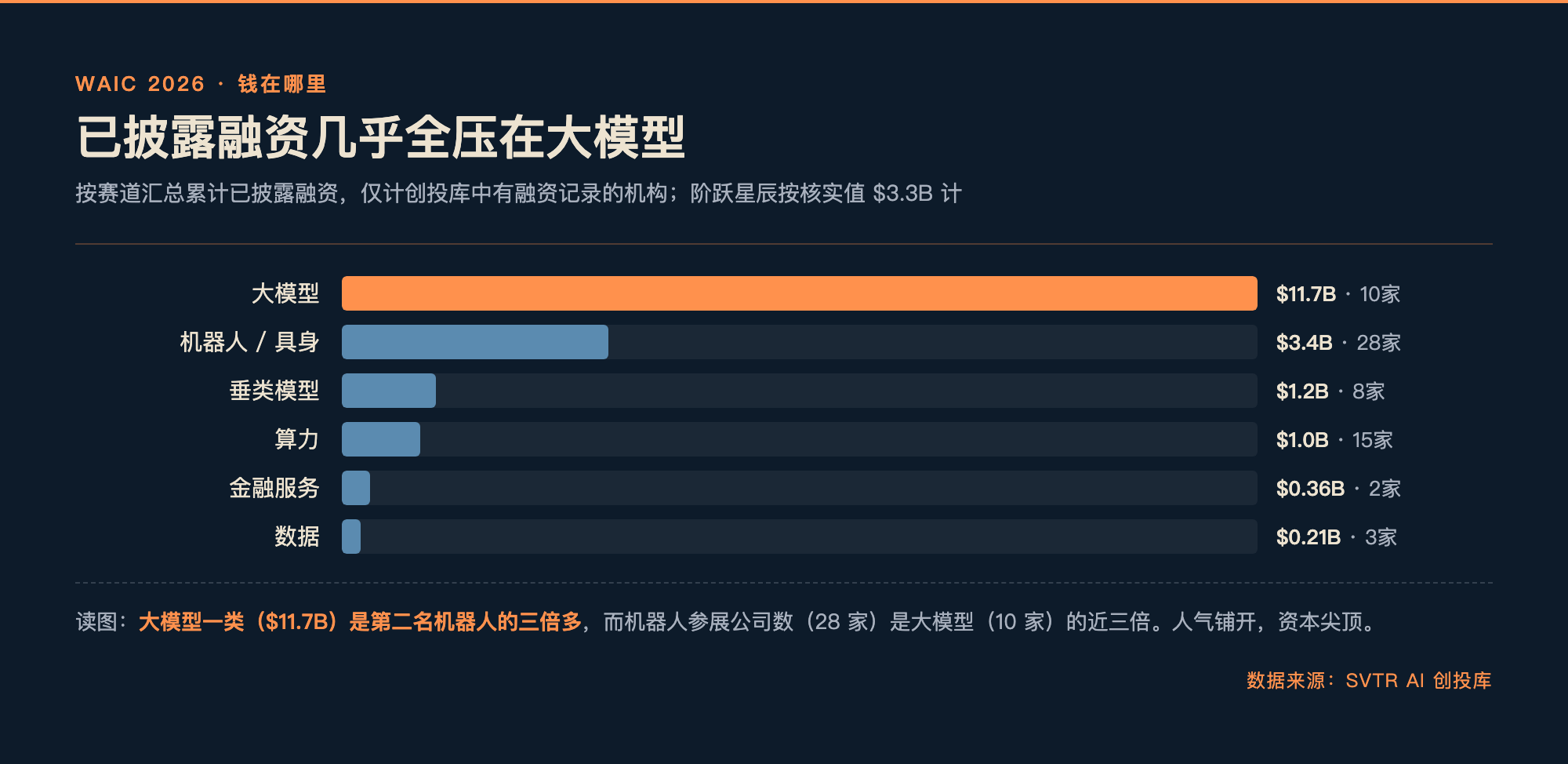
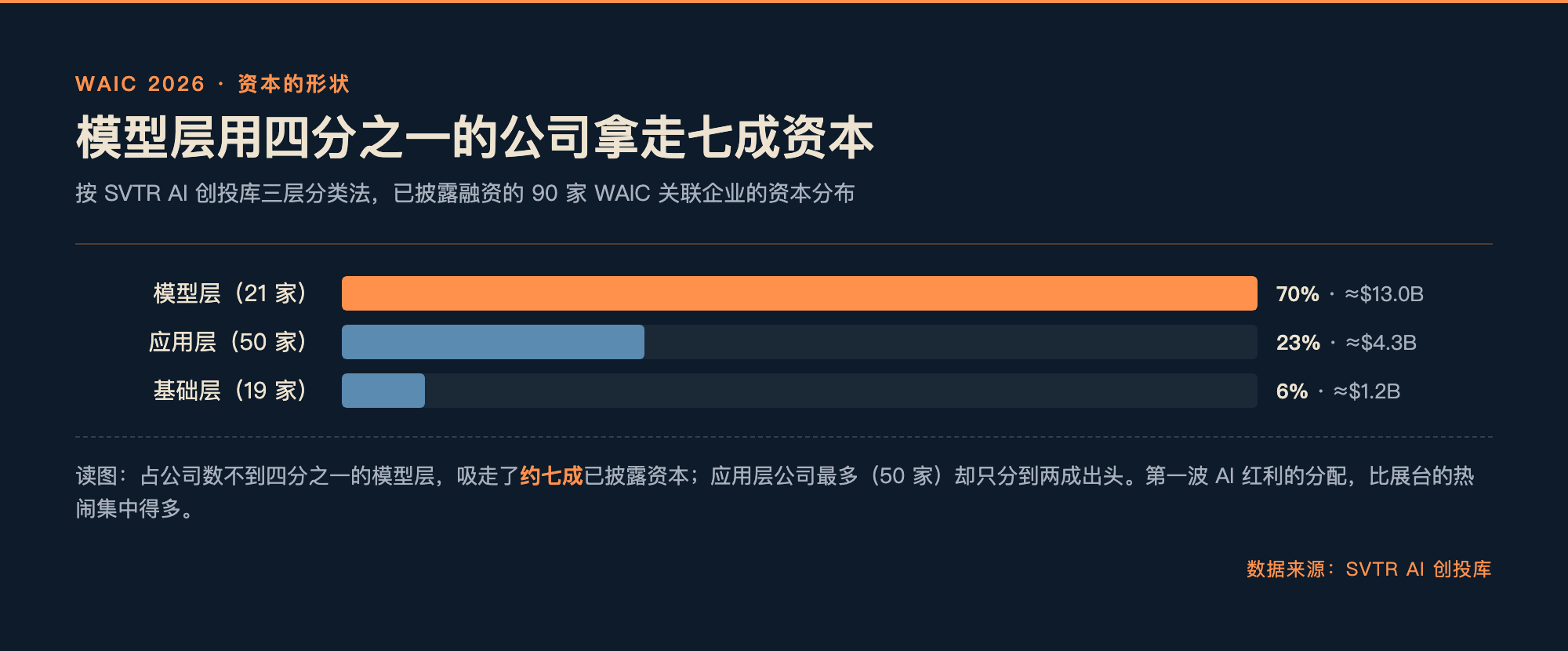
When viewed through the three-tier classification of the venture database, the structure becomes clearer: the model layer, which accounts for less than a quarter of the companies (21), has captured about 70% of the disclosed capital; the application layer, which has the most companies (50, with many robot companies in this category), has only captured a little over 20%.
The head effect is also evident in the robot sector. Zhijidi (about $670M) and Xingdongjiyuan (about $640M) alone account for nearly 40% of the disclosed financing of the 28 companies. The rest of the body companies are mostly still at the level of tens of millions of dollars. In other words, the robot sector is not without large-scale financing, but the money is highly concentrated in a few top companies, and the mid-sized body companies have very little hope of raising funds.
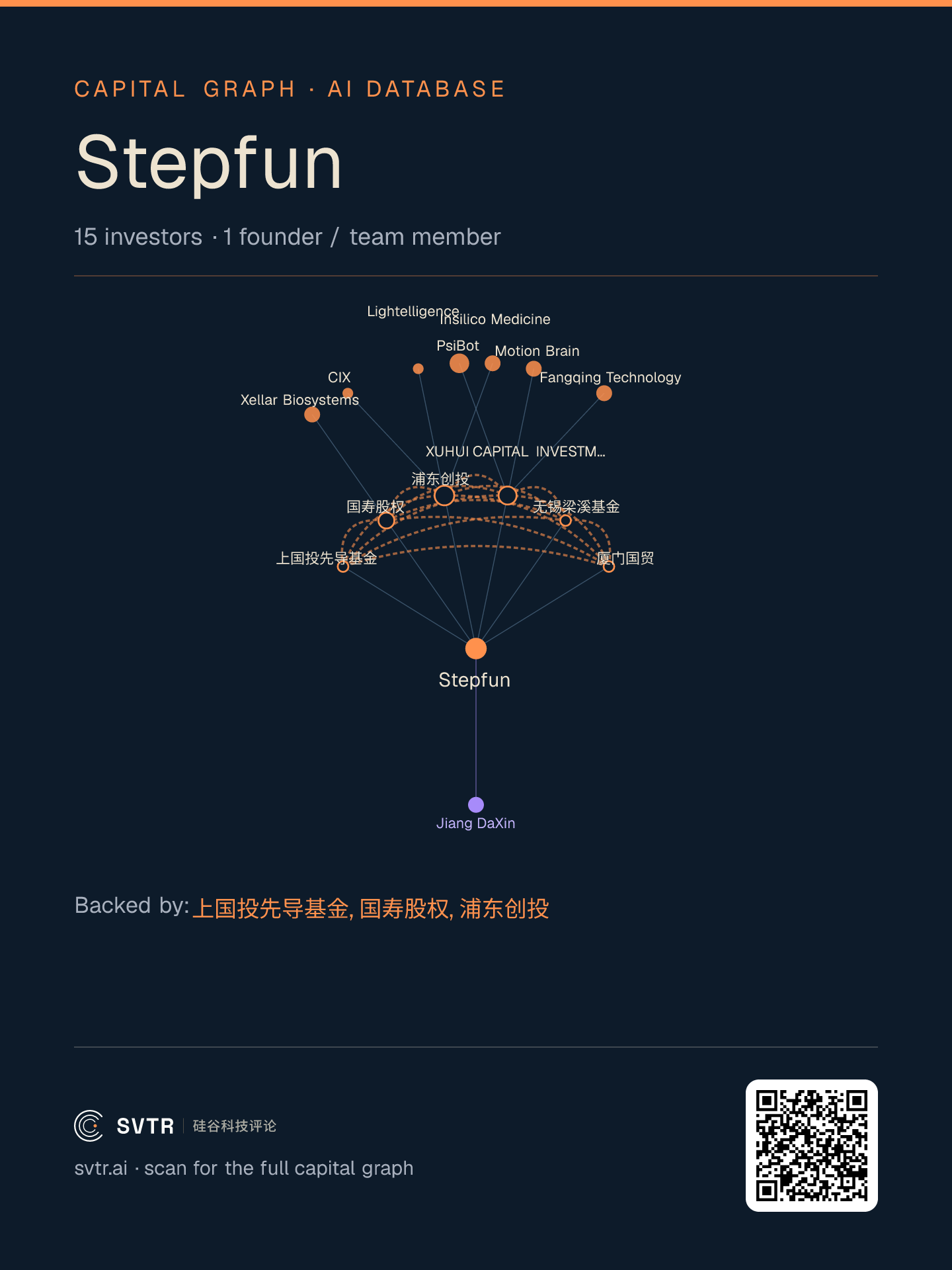
Where does the money come from? Looking at the capital relationship map in the venture database makes it clearer. The main investors in large models are two types of capital. One is the strategic investment of internet giants, with Alibaba, Tencent, Meituan, and Xiaomi almost appearing on the shareholder lists of every top large model. The other is the AI industry funds of local state-owned capital, with Beijing, Shanghai AI industry investment funds, Shenzhen Investment, and Guotou frequently leading the investment. The lead investors in the latest two rounds of StepFun are almost all state-owned capital platforms, with market-oriented dollar funds retreating to the role of follow-on investors and existing shareholders. This is the financing background of the 'brain' in China: a combination of internet giants and state capital, not traditional VCs.
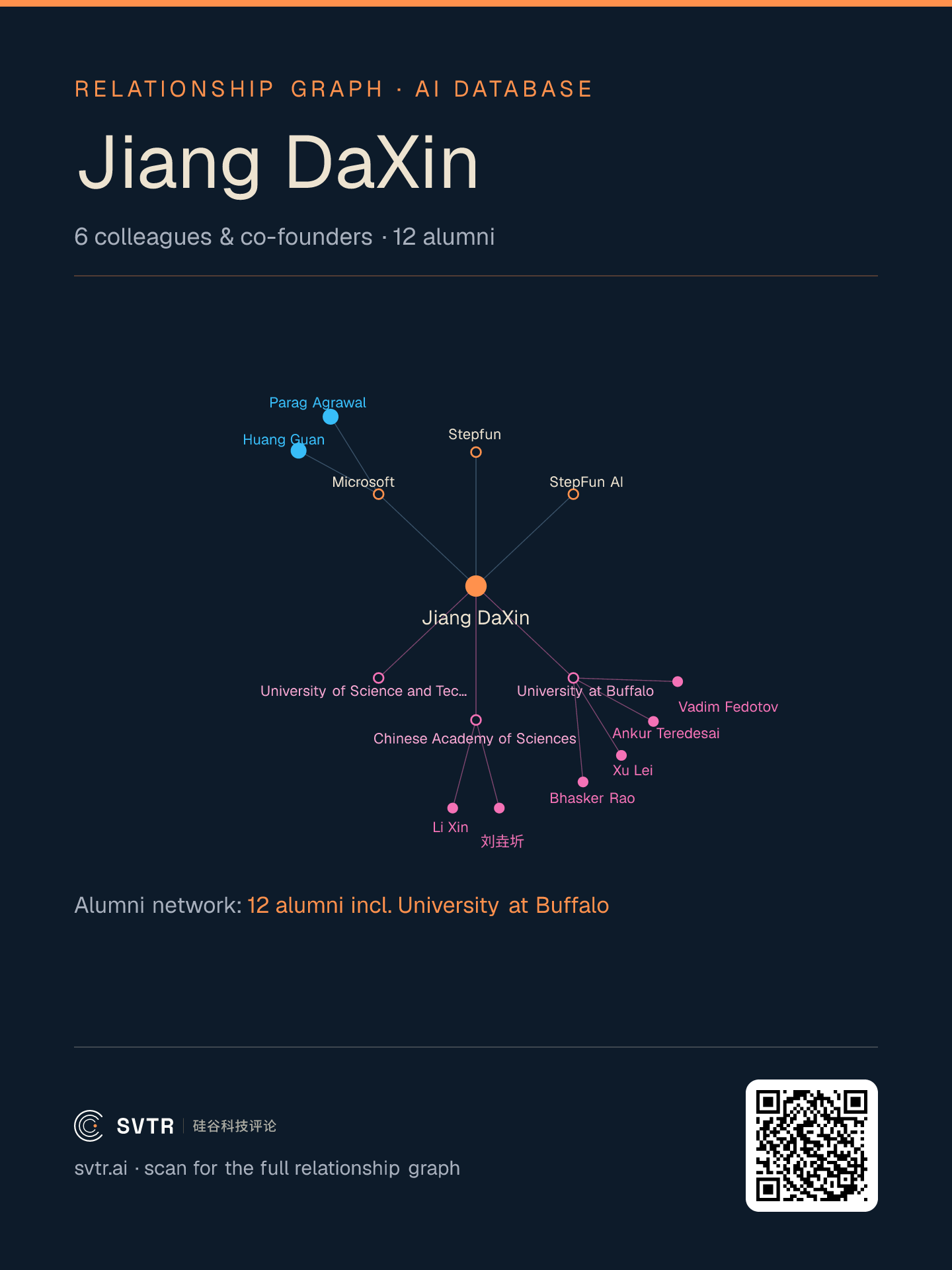
Beyond money, the most scarce resource is talent. Jiang Daxin, the founder of StepFun, comes from Microsoft, with a resume that connects USTC and the Chinese Academy of Sciences. The model layer not only attracts capital, but also a group of people who have left top laboratories and big companies. This is another side of the 'winner-takes-all' scenario: both money and talent are converging on a few companies.
So why has this capital structure emerged? The model layer is a winner-takes-all business: training a cutting-edge model requires a threshold of tens of billions of dollars in computing power and data, and the number of companies that can enter the game is naturally small, but each must absorb a huge amount of capital. The robot body is the opposite: the capital efficiency of building a prototype is high, and the technical routes are scattered, so it can start with a few million to tens of millions of dollars, leading to a proliferation of companies, but each company has very little chance of raising funds.
For early-stage hardware funds focused on robot bodies, this mismatch is worth being cautious about: the popularity on the exhibition floor does not equal the capital depth of the sector. When body companies compete in a homogenized way, each gets much less money than the model layer.
3. In the US, Even Robot Money Flows to the Brain
An overlooked comparison: the US also has big money flowing into embodied intelligence, but the structure is the opposite. China has 28 companies with $3.4B, while the US has a few companies that raise as much as the entire Chinese sector.
- Skild AI raised $1.4B in a single round in January 2026, with a valuation of over $14B;
- Figure completed a Series C round exceeding $1B by the end of 2025, with a valuation of about $39B;
- Physical Intelligence completed a $600M B round at a valuation of $5.6B. Skild's single round is nearly half of the entire Chinese robot sector at WAIC.
More importantly, the question is where the money flows. The companies that have raised big money in the US are mostly not body manufacturers, but those doing 'robotic foundational models': Skild is building a general brain that can drive any body, and Physical Intelligence is building an operational model across bodies. In other words, regardless of China or the US, capital is paying for the 'brain'. The body entrepreneurs on the WAIC exhibition floor are currently the ones with the lowest valuation from capital.
For cross-border funds, this mismatch is actually an opportunity: China leads the world in the density of body engineering and supply chain, while the US leads in the model capabilities of general brains. The most scarce and least invested in at the moment is the team that can connect 'Chinese bodies' with 'frontier brains'. Companies that can connect both ends have a better chance of standing at the starting point of the next round of pricing.
4. Bodies Will Be Oversupplied, Brains Will Be Concentrated
It is worth noting that robots are not unimportant today. The engineering breakthroughs in humanoid bodies are real: the robot horse on the exhibition floor can carry people and transport goods, and according to the exhibitor, it can work continuously for 48 hours when empty and has a maximum load of one ton; mass production is also on the rise. However, from the capital structure, an observable judgment is that in the next one to two years, the robot body layer is likely to face oversupply and consolidation, because there are too many companies and their capabilities are homogenized; the ones that can really get big money and form a head effect are still the model layer providing the 'brain'.
Leave an open question: do you think the next round of over $200M Chinese embodied financing will go to companies building bodies, or to companies building robot foundational models?

The opportunity in the body layer is precisely when it has not been fully explored by capital. In August, we launched a special SVTR AI Venture Camp for embodied intelligence and robotics at this point: connecting early-stage companies with thin financing but already validated engineering and scenarios to investors and industry players who truly understand this layer. If you are building a 'body' or want to bet on a position earlier than the brain, see you in Silicon Valley.