

Weekly Highlights
a16z closed a new $1.1 billion fund this week, with its focus clearly stated: chips, memory, networking, power, and the machines that incorporate AI. That same week, the largest private equity financing went to Xpeng Robotics, a humanoid robot company, with $900 million and a post-money valuation of $6.3 billion; five of the top 10 financings this week were for companies building machines or managing power, totaling $1.57 billion. The only company to complete an IPO this week was Pasqal, a quantum processor company, which saw its stock rise 95% on the first day. On the software side, there were 10 acquisitions this week, seven of which did not disclose the price.
SVTR Private Signal · Not Investment Advice
This week's highlights:
Xpeng Robotics (★ Evaluated, with a first-round financing of over $900 million, post-money valuation of $6.3 billion)
Socure (★ Evaluated, $156 million strategic growth investment, valuation of $5.2 billion, and same day acquisition of intelligent agent company Fravity)
Generalist AI (★ Evaluated, $198.2 million B-round expansion, valuation of $3 billion)
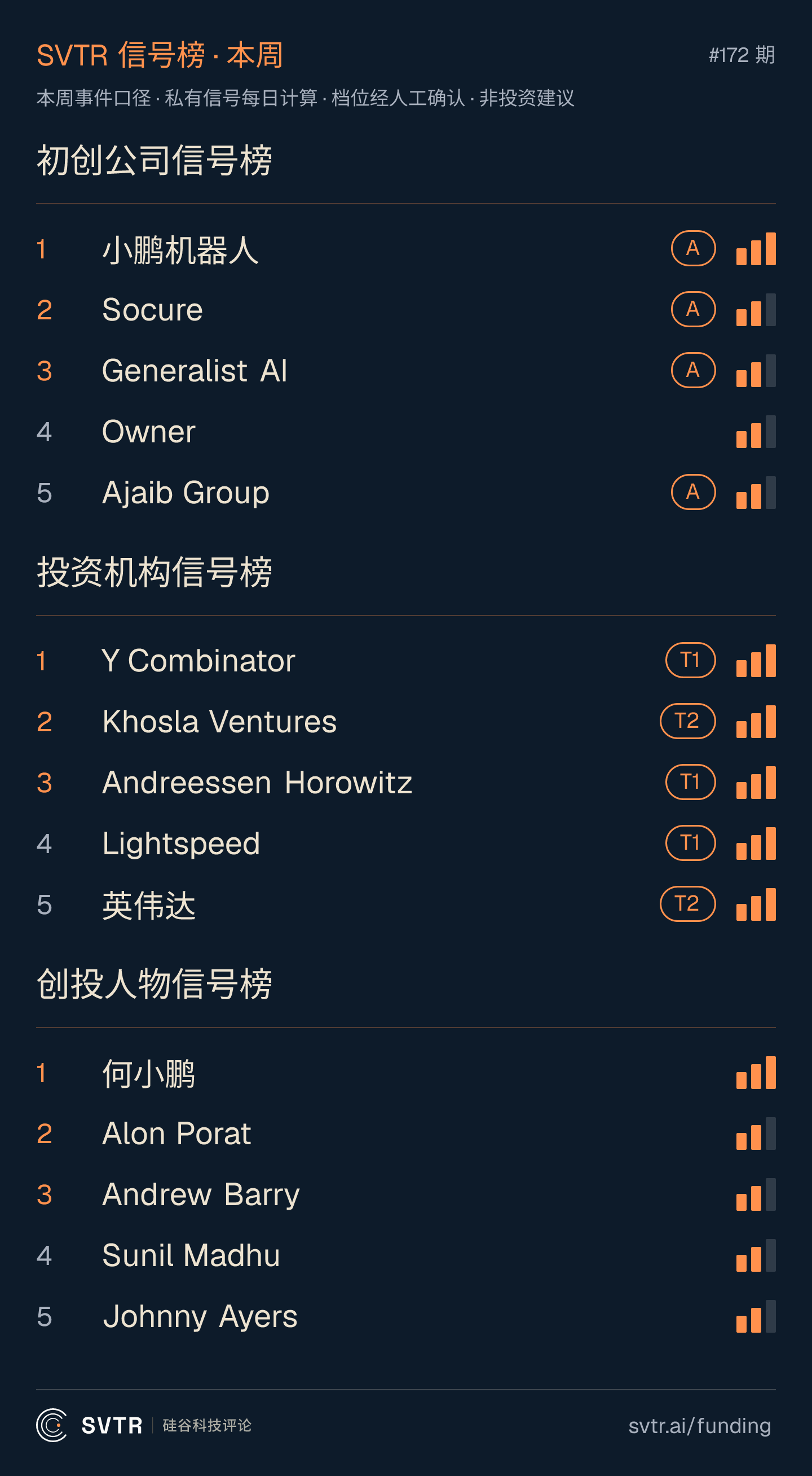
Full list available at AI Venture Daily.
I. Community Updates
① Fundraising Underway
Deal Listings added one new startup this week: an intelligent agent team targeting small business owners and certified public accountants. When a user issues a command, dozens of dedicated intelligent agents work together to conduct research, track down information, and prepare documents, currently raising funds in the seed round.
All active deals have been rated by SVTR, with a one-sentence business description attached to each. Full lists and details of the founding teams are available at Selected Deals Database (for certified investor members).
② Community Partners
This week's new community entrepreneurs were all focused on hard tech. One team is developing integrated photonic quantum chips and photonic quantum computing systems, providing chip design and fabrication services to over 30 universities and top enterprises. Another team is working on domestic alternatives for chip manufacturing EDA. There is also a 1977-established electronic-grade copper oxide manufacturer with global top ten PCB clients.
On the overseas side, the focus was on applications and infrastructure: an intelligent agent customer service platform in India (claiming to cover over 90% of inquiries across chat, email, tickets, and voice channels), a team working on digital asset research intelligent agents and data layers (completed $15 million financing, led by Pantera Capital), and a senior researcher from Microsoft Research.
Three consumer-focused companies were also in the same week: AI emotional companion hardware, a personal decision-making assistant with long-term memory, and AI styling and virtual try-on.
③ Product Updates
Default view for company and person entries is now the ranking: The AI Companies and VC Figures entries have been changed to a "Signal Board | Full Database" dual view. The first thing you see is who is active this week, and you can switch to the full database when you need to search.
Added "SVTR Market Position" to company profiles: A company's position on several rankings and its rank are now directly listed on its own profile, without needing to refer back to the rankings.
Revised the "Algorithms" category to "Training and Inference Stack": This category previously mixed companies selling model capabilities and model products. The name change also tightened the criteria, making the rankings on Rankings more accurate than last week.
II. Market Observations
① IPO / Listing Updates
| Company | Event | Amount | Exchange | Source |
|---|---|---|---|---|
| Pasqal | Completed a merger with Bleichroeder Acquisition Corp. II and listed, with a 95% increase on the first day | Approximately $360 million in cash at closing | NASDAQ (PSQL) | Company Announcement |
| Oura* | Reportedly planning to go public in the US, with the IPO expected as early as September | Targeting up to $3 billion in fundraising, with a valuation exceeding $16 billion | Undetermined | TechCrunch |
- Indicates rumors or uncompleted transactions, not included in this week's statistics or capital map.
The only company to complete the listing this week was French neutral atom quantum computing company Pasqal, which listed on August 28, in the form of a SPAC merger, but in essence, it received $360 million in cash to expand its quantum processor production, with its stock price nearly doubling on the first day. The amount of Oura is more worth noting: its E-round valuation was $11 billion last year, and if the $16 billion IPO valuation is confirmed, it would have increased by 45% in a year, while it sells a ring worn on the finger. The two deals that public markets were willing to accept this week were both businesses that needed to build production lines.
② Fundraising Underway (Rumors / Not Closed)
| Company | Fundraising Target | Valuation | Related Parties | Source |
|---|---|---|---|---|
| Instinct* | Approximately $250 million in B-round | Post-money $2.5 billion | Index Ventures, Benchmark (joint lead investors) | TechCrunch |
Instinct was founded by 23-year-old Noah Shinn, and its product is an assistant that can connect to various applications and devices, managing daily tasks through text and voice. It is still in private testing. It has raised a total of $350 million with a valuation of $2.5 billion, but the product has not yet been publicly released. This week, it also faced privacy concerns due to overly broad permissions and overly invasive user terms: the money came in before the product, and the controversy also arrived before the product.
③ Key Fundraising Rounds (Confirmed This Week, by Disclosed Amount)
| Company | Amount | Round | Lead Investor | Source |
|---|---|---|---|---|
| Xpeng Robotics | $900 million | First Round | IDG Capital | HKEX Announcement |
| Ajaib Group | $270 million | Strategic Investment | SBI Holdings | The Block |
| Owner | $240 million | Undisclosed | Growth Equity under Goldman Sachs Alternatives | Official Press Release |
| Gatik | $200 million | Later Stage | Qatar Investment Authority, Koch Disruptive Technologies (joint lead investors) | Forbes |
| Generalist AI | $198.2 million | B-round Expansion | 8VC | TechCrunch |
| Socure | $156 million | Strategic Growth Investment | Summit Partners | Company Announcement |
| Emerald AI | $150 million | Series A | DCVC, Energize Capital (joint lead investors) | Official Press Release |
| Alice | $140 million | Undisclosed | Apax Digital | Company Announcement |
| REGENT Craft | $120 million in equity (plus an equal amount in debt) | Series B | Mare Liberum, AE Ventures (joint lead investors) | Company Announcement |
| Stability AI | $76 million | Series B | No financial lead investor | Company Announcement |
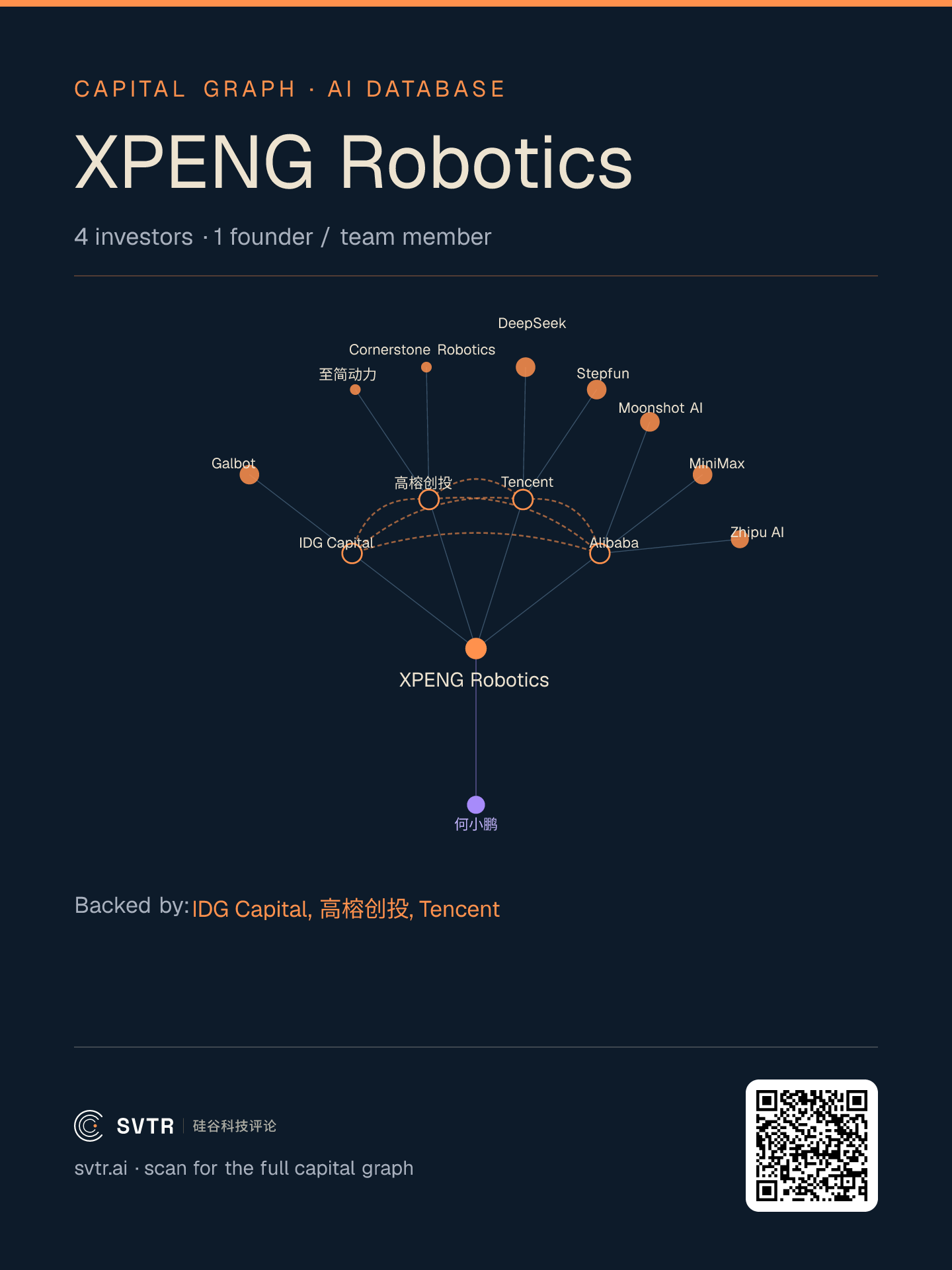
Xpeng Robotics completed a first-round financing of over $900 million on August 24, with a post-money valuation of $6.3 billion, setting a new record for the largest private round in China for embodied intelligence. Breaking down the structure, there are three layers of funding: $600 million from external institutions (led by IDG, with Gao Rong participating, and Tencent and Alibaba joining as strategic investors), $200 million from Xpeng Group itself, and $100 million from He Xiaopeng and executive-related parties, with additional stock options. He Xiaopeng has set a timeline for mass production by the end of the year and an IPO in 2027.
The second tier includes three companies worth noting. Gatik's $200 million was led by the Qatar Investment Authority and the Koch Disruptive Technologies fund, with sovereign funds and industrial groups now funding driverless truck businesses. Emerald AI raised $150 million in a Series A round at a $1.05 billion valuation, led by DCVC and Energize Capital, with NVIDIA, Samsung, and GE Vernova as followers, and its product allows data centers to adjust power consumption based on grid load, becoming a unicorn in two years. REGENT Craft's Series B round included $120 million in equity and $120 million in debt, with the debt coming from Erebor Bank, used to advance the production of seagliders from prototypes to a 255,000-square-foot factory.
Stability AI's round had no traditional financial lead investor: the three major record labels, Universal Music, Sony Music, and Warner Music, along with Electronic Arts, all invested, marking the first time an AI company received full equity investment from the three major labels. In June 2024, they were still suing AI music companies in court, and 26 months later, they were all on the shareholder list. A full analysis of this line is available in this week's Signal "The Strategic Lead Seat in AI Fundraising is Occupied by Customers, Competitors, and Suppliers".
④ Strategic Acquisitions
| Acquirer | Target | Consideration | Source |
|---|---|---|---|
| Nayax | IPS Group | $350 million (all cash) | Fortune Term Sheet |
| Navitas Semiconductor | Claros | Up to approximately $232.8 million (cash and stock, including milestone-based payments) | Company Announcement |
| Elastic | Deductive AI | Up to $85 million | Elastic Announcement |
| Amazon Web Services | DuckLabs | Undisclosed | Amazon Announcement |
| Socure | Fravity | Undisclosed | Company Announcement |
| Gamma | Lica | Undisclosed | TechCrunch |
Out of 10 acquisitions this week, 7 did not disclose the amount. Of the three that did, two bought hardware assets: Navitas' acquisition of Claros was to obtain voltage regulation and power supply technology, with the target clearly stated, from the grid all the way to the XPU; Nayax's $350 million acquisition of IPS Group was for smart parking hardware. The rest of the undisclosed acquisitions were all small teams that had been in operation for one to two years without significant revenue. Amazon Web Services' acquisition of DuckLabs, Elastic's acquisition of Deductive AI, Socure's acquisition of Fravity, and Gamma's acquisition of Lica all fall into this category. Software-side transactions this week did not stop, but they shifted from buying companies to acquiring people.
⑤ VC Fund Raising
| Fund | Size | Stage | Focus | Source |
|---|---|---|---|---|
| a16z Machine Age Fund | $1.1 billion | Early to Growth | Chips, memory, networking, storage, power, data centers, and robot systems | a16z Announcement |
| Blackbird Fund VI | 1.05 billion AUD (approximately $740 million) | Early and Growth (two vehicles) | General tech in Australia and New Zealand | Company Announcement |
| Permanent Capital Ventures II | $200 million | Series A | Applied AI | AltAssets |
| Ventures Platform Pan African II | $84 million | Pre-seed to Series A | Pan-African fintech, healthcare, SaaS, and AI | TechCrunch |
| FGV Capital II | $35 million | Pre-seed and Seed | Fintech and AI, healthcare, and business cross-over | TechCrunch |
| Capital F Fund I | $17 million | Early | Women's health, digital commerce, and AI tools | TechCrunch |
The most notable fund this week was a16z's Machine Age Fund. With a size of $1.1 billion, led by Martin Casado and Raghu Raghuram, it focuses on chips, memory, networking, system software, power, and complete machines that bring AI into the physical world. a16z's reasoning is that the hardware supply chain from chips to memory to power is all under tight capacity, and hardware projects now account for more than 20% of the transactions they see. This firm defined an era with "software eating the world" 15 years ago, and now it has set up a separate fund for hardware.
⑥ Notable Highlights
This week, almost all the money in China flowed into embodied intelligence and chip-related support. Lingchu Intelligent completed a financing of over $100 million, with investors including TopScope Group, Chery's Rui Cheng Fund, Luxshare, 77 Games, and Wuhu Investment Control, which are manufacturing and local industrial capital. Contemporary Amperex Technology (CATL) made a strategic investment in Yige Technology, a battery design automation company. Momenta moved from seed round investors to lead the Series A round of Jianzhi Robotics. On the support side, Muxi Semiconductor invested in the Series B round of Mucheang Integrated Circuit (intelligent network controller chip), and Zhongshu Rui Zhi received several hundred million yuan from the National Social Security Fund and ICBC Investment, with several local state-owned capital platforms on its list. Most of these rounds only disclosed the amount in the "hundreds of millions" category, and the unconverted amounts are not included in this week's total. Detailed information is available at AI Venture Daily.
In the US, there were two seed rounds this week that were unusually large. Keenable raised $26 million in a seed round, led by Accel and with Conviction as a participant, with a list of angels including Amazon, ClickHouse, Databricks, Google, and Snowflake; Deep Cogito's $43 million Series A was led by TQ Ventures with Benchmark as a follower.
Linear completed a $99 million old equity tender, with a valuation of $2.5 billion, led by Accel. This type of transaction does not generate new equity, but provides an exit window for early employees and shareholders. Secondary liquidity is becoming a standard feature for growth-stage companies.
III. Venture Capital Analysis
The physical layer has been separated and has become a category of assets.
In this week's 71 confirmed financings and $3.1 billion in disclosed amounts, five of the top 10 companies are in the physical world: humanoid robots (Xpeng Robotics), driverless trucks (Gatik), robot foundational models (Generalist AI), data center power scheduling (Emerald AI), and seagliders (REGENT Craft), totaling $1.57 billion, which is exactly half of the disclosed amount this week. Among the six new funds, the largest one only invests in hardware and power. The only company that completed an IPO made quantum processors. Meanwhile, on the software side, 10 acquisitions included 7 that did not disclose prices, with the targets generally being small teams that had been in operation for one to two years.
We believe that the primary market is opening up a separate pricing channel for physical assets. This channel has its own investors (sovereign funds, industrial groups, industry players, and specialized hardware funds), its own tools (equity with debt, stock options, and production timelines), and its own exit expectations (listing once the production line is operational). Software-based AI has not lost its appeal, but its transactions have returned to a more mature asset form: valuations are based on ARR, and exits are through acquisition. The change in who is funding this is detailed in this week's Signal "The Strategic Lead Seat in AI Fundraising is Occupied by Customers, Competitors, and Suppliers"; this article focuses on where the money is going.
IV. Event Announcements
YC Summer 2026 Demo Day
2026-09-10 (Thursday) · San Francisco
Free (limited to invited investors and media, about 1,500 people)
SVTR Rating: 9/10
Y Combinator S26 batch companies will officially pitch to invited investors.
Machine Earning AI Summit
2026-09-29 (Tuesday) · San Francisco
Paid (699 USD, 99 USD for founders), requires application
SVTR Rating: 8/10
A one-day closed-door event organized by Newcomer, focusing on the intersection of AI and business and finance, with participants mainly being founders and investors supported by venture capital.
V. Capital Map
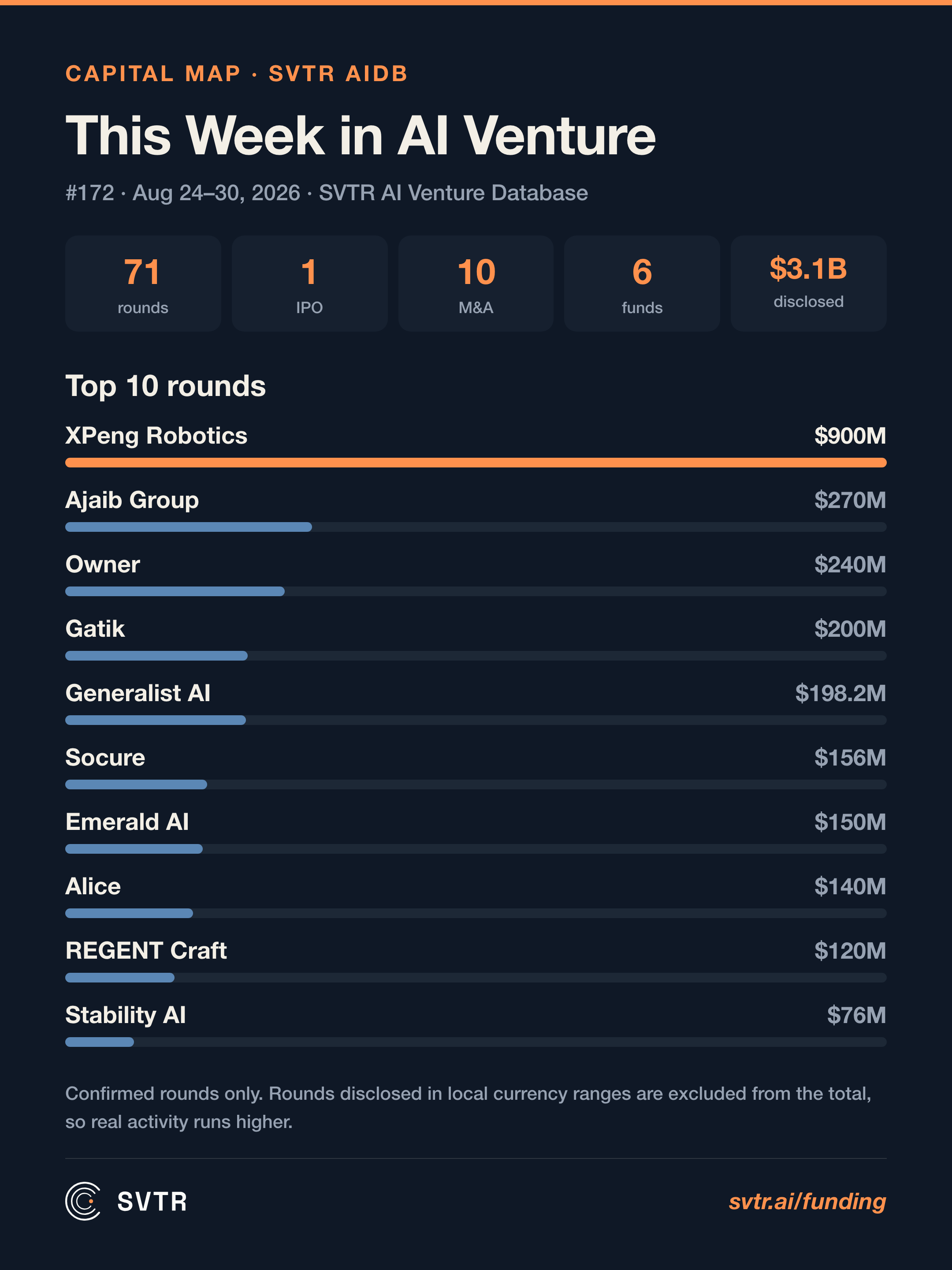
First, the top concentration: the top 10 companies accounted for approximately $2.45 billion, or nearly 80% of the disclosed amount this week, with the top one alone accounting for 29%.
Second, the physical weight: five of the top 10 companies that build machines or manage power accounted for $1.57 billion, or nearly two-thirds of the total list.
Third, the Chinese long tail is not included in the total: this week, there were more than 20 rounds in China that only disclosed the amount in the "hundreds of millions" or "tens of millions" category, and the unconverted amounts are not included in the total. The actual activity level is higher than the numbers on the map. Detailed information and sources are available at AI Venture Daily.
Note: Visit the SVTR website (svtr.ai) or contact WeChat pkcapital2023 to access the full weekly report and project details.