

SVTR Editor's Note:
Thrive Holdings raised $2 billion to buy accounting firms and IT services companies. It closed the round in August and already owns more than 70 businesses. On October 29, Will Manidis and Joe Roberts published a long essay, "The Commanding Heights," arguing that the wealth AI creates will flow to a few "commanding heights," and that roll-up platforms like this one are "constrained" and "far too small." We agree with the first half and disagree with the second. This piece is for early-stage funds focused on AI applications, and for founders selling AI software into service industries.
Thrive Holdings is a holding company set up by Josh Kushner's Thrive Capital. It does not sell software. It buys accounting firms and IT services companies outright and sends engineers in to rebuild how the work gets done. The August round came from SoftBank, D1 Capital Partners and Altimeter Capital at a $12 billion valuation. According to TechCrunch, its accounting arm has more than 50 firms and 2,000 professionals, and its IT arm about 20 companies. OpenAI took a stake in December 2025 and sends its own staff into these businesses.
For scale: according to the SVTR AI venture database, US pure-software AI application companies raised 131 seed rounds in the first ten months of 2026, totaling $1.63 billion. Thrive Holdings' single round is larger than all of them combined.
Our view: money for the AI application layer has not left. It is starting to skip the step of selling software to customers and buy the customers instead. The cheaper models get, the more of the savings stay with whoever owns the business and the client relationship. The vendor selling the tool does not keep them.
Software sellers are falling behind on price
"The Commanding Heights" is not a distant macro forecast by two economists. One author, Will Manidis, was a 2019 Thiel Fellow and founded the healthcare AI company ScienceIO, which he sold to health IT company Veradigm for $140 million in 2024; the other is Joe Roberts. They end up asking the same question: as intelligence gets cheaper, where do the profits go?
The 40,000-word essay is pessimistic about the application layer: models become commodities within months, and investors who own the last era's commanding heights while financing this era's inventions have a false sense of security.
The database supports half of the essay's argument. In US AI funding, the share of deals going to pure-software applications is falling: 30.8% in 2024, 30.1% in 2025, and 24.3% in the first ten months of 2026. Pure software here means seven sectors: enterprise services, productivity tools, developer tools, marketing, legal, education, and social and entertainment. The deal count itself has not dropped. The 386 deals in the first ten months of 2026 run at the same monthly pace as 2025's 476. What shrank is the share. New money went to robotics, defense, energy and manufacturing.
The gap in check sizes says more.
Table 1 | Median US AI round size and deal share by category, 2024 vs 2026
| Category | Median seed ($M) | Median Series A ($M) | Share of deals |
|---|---|---|---|
| Pure-software applications | 4.5 → 6.0 | 16 → 22 | 30.8% → 24.3% |
| Physical-world applications | 5.6 → 9.0 | 17 → 25 | 26.4% → 32.5% |
| Infrastructure (compute, data, interconnect, etc.) | 5.0 → 12.0 | 19 → 50 | 14.1% → 13.2% |
| Model layer | 6.8 → 10.0 | 18 → 43 | 11.7% → 9.1% |
Data: SVTR AI venture database, as of 2026-11-03. Confirmed equity rounds by US-headquartered companies; 2026 through October; excludes IPOs, debt and secondary sales; classified by each company's sector.
Two years ago, seed prices across the four categories were close, between $4.5 million and $6.8 million. In 2026, the median infrastructure seed round is twice that of pure-software applications, and the Series A gap is more than double. Investors pay more for what is hard to replace, and software sellers sit furthest from that position.
11 rounds, about $2.95 billion: companies that buy their customers
The other half is what the essay missed. One group of companies buys traditional businesses first and then rebuilds them with AI. According to the database, these companies had no rounds with disclosed amounts in 2024. In 2025 they raised 5 rounds totaling about $510 million, and in the first ten months of 2026, 6 rounds totaling about $2.44 billion:
- Thrive Holdings (accounting, IT services): $2 billion in August 2026
- Beacon Software (Toronto; buys vertical software companies serving small businesses): $250 million Series B in November 2025 and $225 million Series C in June 2026; according to BetaKit, it buys roughly one company every two weeks
- Dwelly (UK; buys lettings agencies): £32 million of equity in February 2026 and $95 million of Series B equity in July, with debt alongside both rounds
- Shield Technology Partners (Thrive Holdings' IT services platform): $100 million in June 2025
- Titan (buys IT services providers): $74 million in August 2025
- American Growth Insurance (buys independent insurance agencies): $70 million in July 2026
- Three smaller rounds: property management platform Buena, Singapore's Multiplier Holdings, which buys small accounting firms, and UK insurance brokerage platform i23
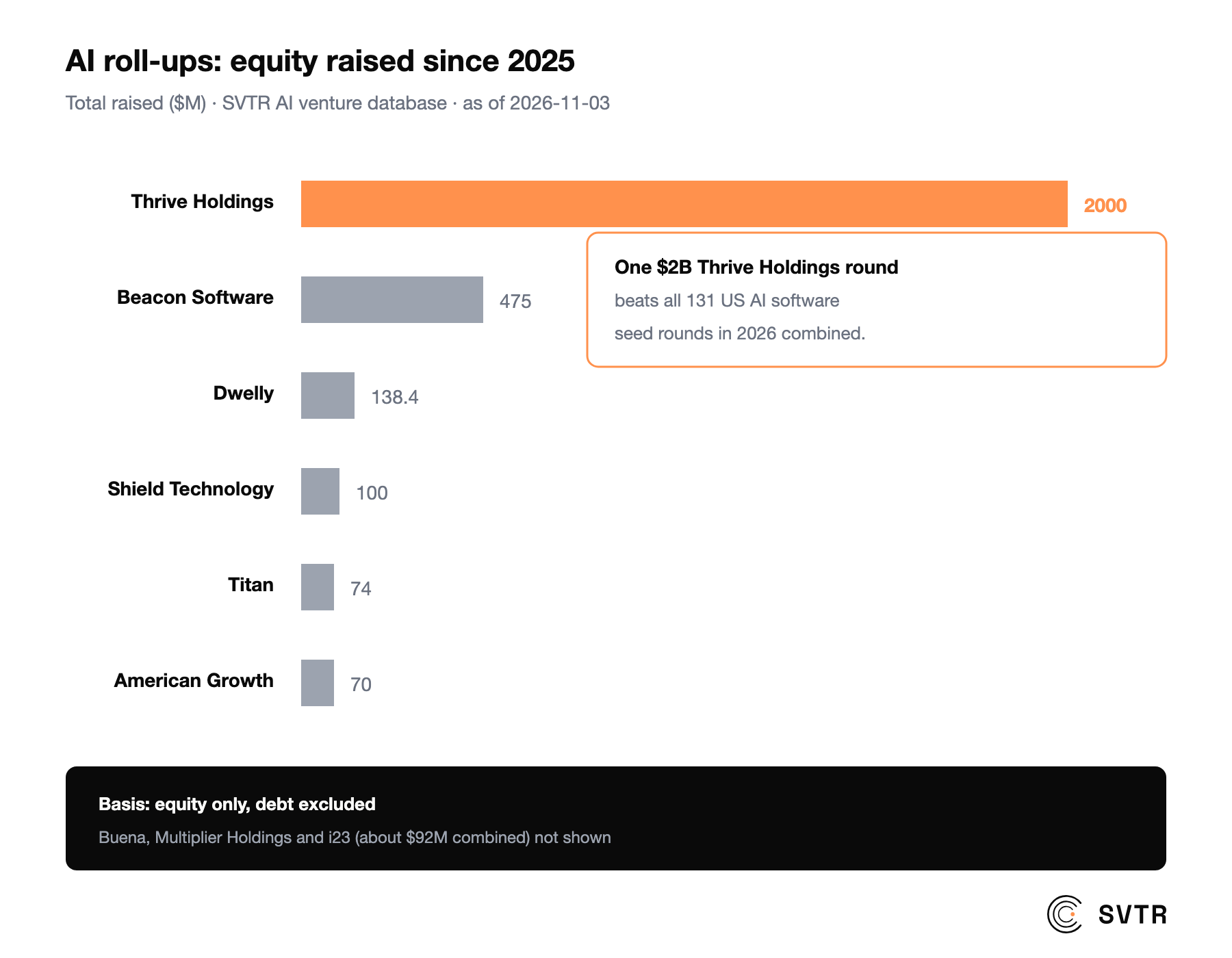
General Catalyst shows the choice most clearly. In February 2026 it led a $75 million round in Accrual, which sells tax automation software to accounting firms. It is also an investor in Titan, Dwelly and Beacon, all of which buy businesses and run them. According to TechCrunch, the funds General Catalyst closed in October 2024 set aside $1.5 billion for incubations and acquisitions. In the same industry, it is betting both ways.
The difference between the two is who keeps the savings. Thrive Holdings says its tax AI has processed more than 7,000 returns and cut preparation time by more than 30% at participating firms. A software vendor charges per seat or per subscription; once a client is 30% more efficient, the next renewal becomes a price negotiation. The owner of the firm turns that 30% of saved hours directly into its own margin. We argued in Thesis #36 that model capability itself is worth less and less, and that what is scarce is the ability to deliver a result at a given cost. Roll-ups take that logic to its end: the company delivering the result is simply owned.
Anuj Mehndiratta of Thrive Holdings put what this business protects in one line: AI won't replace field work, local judgment, or professional sign-off. An accounting firm's signature, an insurance agent's license, a lettings agency's landlords and tenants are things a model cannot take. For a services firm of a few dozen people, that is its own commanding height.
The essay calls them too small; the real limit is integration speed
The essay does not dismiss these companies. In its words, some deployment companies and roll-up platforms "may very well become durable downstream businesses that make plenty of net income for decades to come." Its objection is scope: deployment companies are limited by how many capable experts they can hire, and roll-up platforms must acquire and integrate each add-on one at a time.
That limit is real. The essay is looking at the scale of nations and trillions of dollars: US hyperscalers are expected to spend about $800 billion on capex this year, and at that scale, 70 accounting firms are small. Venture investors are asking a different question: which positions in the application layer can still absorb large checks. Funding for these companies in the first ten months of 2026 is already 4.8 times all of 2025. Capital is betting that integration speed is a solvable problem.
The OpenAI deployment company the essay mentions is one we covered in Thesis #28: four AI giants competing for the first seat inside a company that understands the workflow and decides how AI enters production. Roll-up platforms go one step further and buy the company.
Over the next 12 to 18 months, three variables will tell us whether the bet is right:
- Whether acquired firms' margins improve. So far only efficiency figures are public: tax prep 30% faster, IT tickets resolved 36 times faster. No one has disclosed before-and-after margins.
- How much debt goes into the financing. Dwelly's July round paired $95 million of equity with $75 million of debt. If later rounds lean more on debt, this looks more like a private equity leveraged buyout with AI as packaging.
- Whether acquisition pace and integration keep up with each other. Beacon buys a company every two weeks. Traditional roll-ups mostly fail by buying faster than they can integrate, and AI does not make them immune.
If models get cheaper every year, is your company selling that cheapness to customers, or keeping it?
Showcase and membership
Companies selling AI software into service industries face the same question. Tyce, in our project showcase, builds a pre-construction AI assistant that finds gaps in contractors' bids and plans. Whether its software can be tied to contractors' winning bids is the key to how much of the value it can keep.
The project showcase is open to paid-seat members who have completed investor verification. Members can view teams, funding needs and materials, and request introductions; see SVTR Membership. Founders can also submit a project.
Extended profiles | SVTR AI venture database
The profile pages for Thrive Holdings, Beacon Software, Dwelly and the other companies in this piece track every funding round with sources, so you can see who came in at which round.
If you are on one of these teams, you are welcome to claim your profile; if you spot errors or gaps, please let us know so we can keep this record accurate together.
About the data
Pure-software applications are seven application-layer sectors in the database: enterprise services, productivity tools, developer tools, retail and marketing, legal services, education and training, and social and entertainment. Physical-world applications are eight: robotics, defense and security, transportation and logistics, industrial manufacturing, climate and energy, smart hardware, life sciences, and proptech. Roll-up companies are classified by main business: acquiring traditional services firms or vertical software companies and rebuilding their operations with AI. Holding companies that only acquire AI startups are excluded. Amounts count equity only; debt is noted separately.