

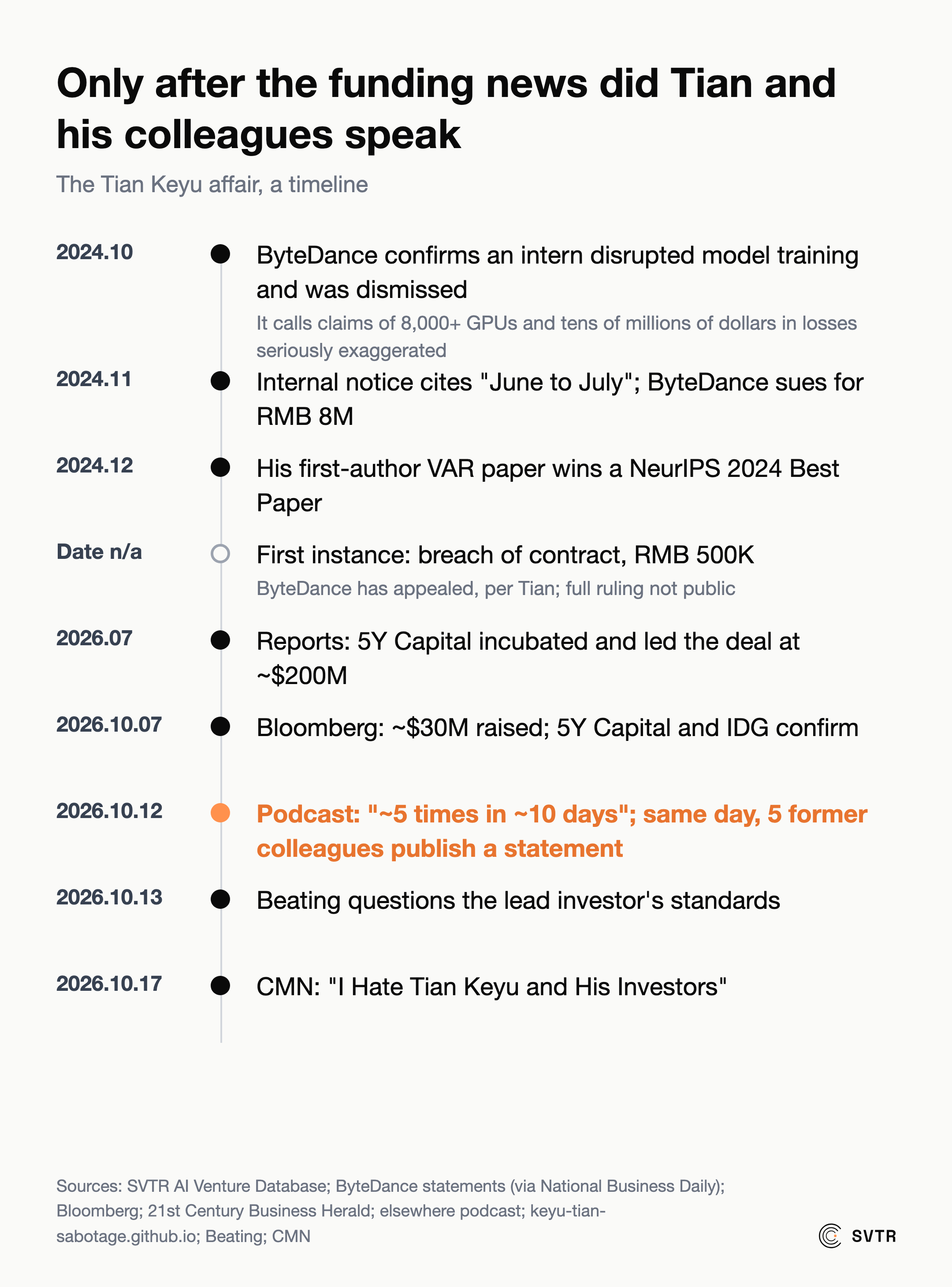
On October 7, Bloomberg reported that Tian Keyu's world-model startup had raised nearly $30 million at a post-money valuation of about $200 million, with 5Y Capital and IDG Capital confirming their participation. Two years earlier, ByteDance had dismissed him for interfering with colleagues' model training, and the two sides are still in court.
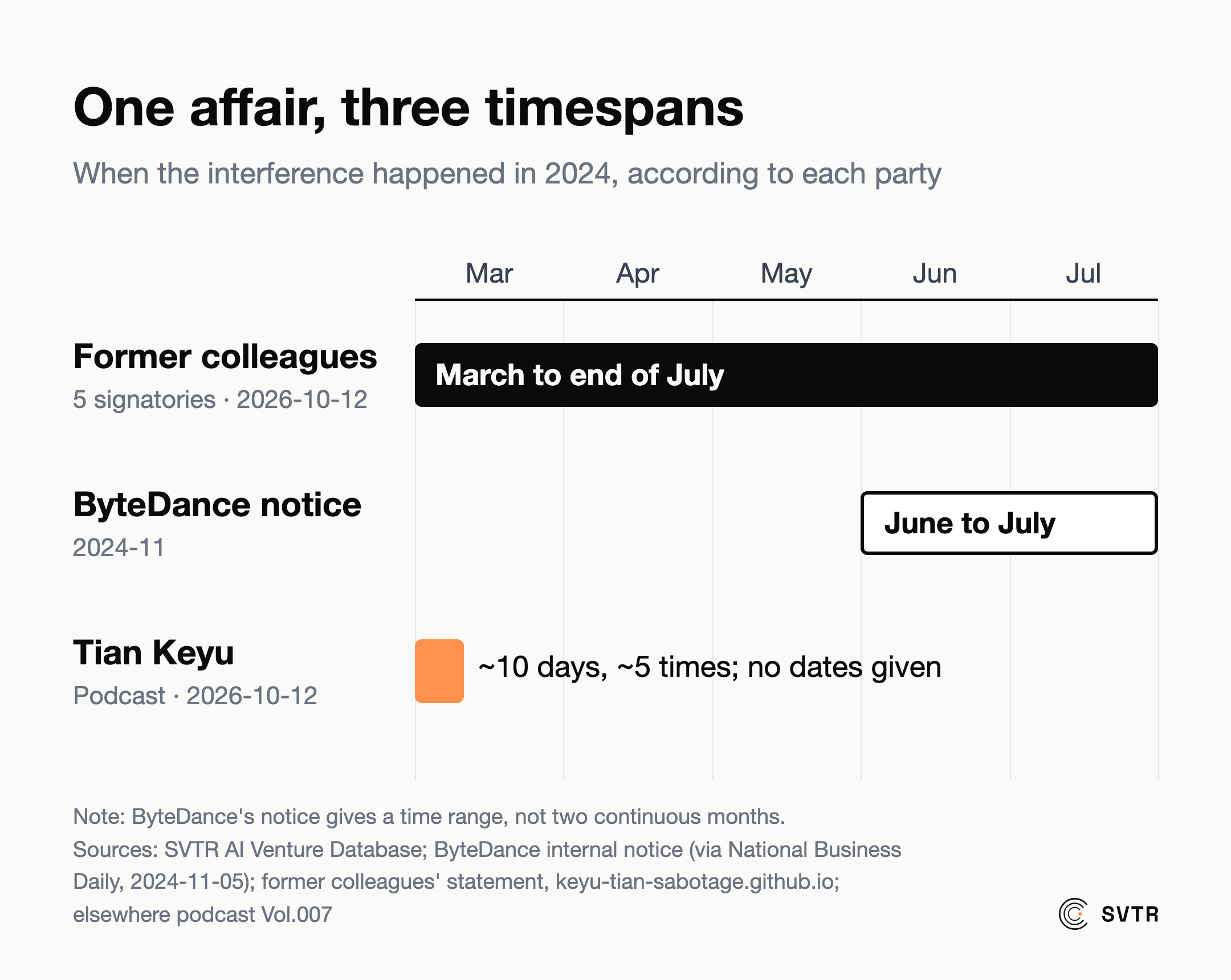
Five days later, he appeared on the podcast elsewhere and gave his first full account of what happened in 2024. He said that over roughly ten days he had stopped another intern's jobs "about five times in total." To show he was not lying, he swore: "If I'm lying, may my research be frustrated for the rest of my life."
That did not settle it. ByteDance's formal notice in November 2024 put the time range of the conduct at "June to July 2024." A public statement co-signed by five former colleagues says the interference ran from March to the end of July that year, and includes code snippets it says come from internal records.
These accounts do not contradict each other at every point, but the key gaps remain unexplained.
What deserves more attention is how China's venture media responded. One outlet gave Tian a long podcast episode to tell his story. Another set investor Meng Xing's publicly stated investment standards against this deal. CMN (投中网) published a piece titled "I Hate Tian Keyu and His Investors, and I'll Say It Under My Own Name."
Three approaches, three attitudes. Yet after reading all three, the most basic question is still unanswered: what actually happened at ByteDance in 2024?
The person at the center explained himself, former colleagues pushed back, investors wrote a check, and the media took sides. No one has established the facts.
That may be the most uncomfortable question the Tian Keyu affair leaves for China's venture media.
Three people's positions
Set the labels aside and look at the people involved.
Tian is still young. He is the first author of "Visual Autoregressive Modeling," a NeurIPS 2024 Best Paper, which proposed a new way to generate images step by step from coarse to fine. By his own account on the podcast, when Meng Xing took him to meet 5Y Capital founding partner Liu Qin, Liu said he had "a certain drive," and Tian says he "probably cried." The RMB 500,000 in damages from the first-instance ruling, he said, is roughly three years of his intern pay, and he accepts it.
Few have written about the former colleagues. According to their statement, in the spring and summer of 2024 a multi-person training project could not run stably for more than two or three hours at a time, and colleagues in Beijing, Shanghai and Seattle took turns watching the training jobs. They say they thought it was a software fault at the time. Two years later, they watched the same person return with a $200 million valuation and say on a podcast that he had only touched one person's jobs.
Whether or not every one of these allegations holds up, the researchers who say they were affected deserve to be heard. A young researcher gets a chance to start over. Do those who believe their work was disrupted get a chance at a full explanation? When capital starts pricing one person's future, who is carefully checking the past that other people lived through?
Meng Xing was Tian's first investor. As the person who led this investment, the public lawsuit should have been something he was obliged to examine carefully. When an investor sees rare research talent alongside a past that has not been cleared up, how should he choose?
None of these questions has a standard answer, and that is exactly why the story is worth reporting.
Investors are entitled to believe Tian deserves a second chance. But a second chance cannot be proven by a check alone.
Where each of the three pieces stopped
The elsewhere interview was not soft. The host pressed on the number of incidents, the motive, and whether he had tried to shift blame. It was the first time the public heard the full account from the person at the center, and that has value. But an oath is not evidence. After the episode, the gap between "about five times in ten days" and the "June to July" range in ByteDance's notice was still unexplained. Documents and records are what can answer it.
The Beating (动察) piece set Meng Xing's stated investment standards against this deal, raising the question that most needs asking about investor responsibility. A direct response from 5Y Capital would have made that question more complete.
CMN published Pu Fan's "I Hate Tian Keyu and His Investors, and I'll Say It Under My Own Name," and stated at the top: "This article may represent CMN's position." Media outlets are of course entitled to positions. The question is whether, when a venture media outlet formally tells readers whom to despise, it has done enough fact-checking first. The piece advances through a series of pointed rhetorical questions, one of them asking, in effect, whether investors are recruiting lawmen or recruiting gangsters. The stance is clear and the questions are serious. But those questions add no new facts to the case. A position taken in an institution's name should not rest on less evidence than a personal column; it should carry greater editorial responsibility.
Among the five Silicon Valley podcast episodes it recommends at the end, one could have been the most valuable material in the whole piece: a conversation between a16z's Marc Andreessen and Ben Horowitz and WeWork founder Adam Neumann. After Neumann was pushed out of WeWork, a16z invested about $350 million in his new company Flow in August 2022. The two founders' controversies are different in kind, and that case is not a template answer for Tian. What it offers is a decision process worth comparing: understand the past, discuss the risk openly, then decide whether to invest. That process appears only in a list of recommendations.
All three provided useful information, but none completed an independent reconstruction of the facts at the heart of the dispute.
Why venture media no longer report controversy
The reason is not complicated.
What venture media do best is funding announcements and success stories. When a company raises money, a positive piece can be written quickly; when someone is caught up in controversy, an opinion piece can be written just as quickly. The slow part is the step in between: obtaining the court ruling, finding the project leads from back then, getting someone who can read the code to examine those snippets, and giving every party time to respond.
That step is expensive, slow to produce results, and may offend people. So many outlets choose an easier route: either let the person at the center talk, or be angry on readers' behalf.
After reading all three pieces, we still do not know:
- Tian says he acted for about ten days; former colleagues say the problems lasted for months. Are the two sides even describing the same set of actions?
- What does the full first-instance ruling say? According to Bloomberg and the 21st Century Business Herald, the court found a breach of contract, awarded RMB 500,000 in damages and ruled his intern pay would not be paid, while rejecting ByteDance's claim for RMB 8 million and its demand for a public apology. Tian says ByteDance has appealed; the full ruling has not been made public.
- Has any qualified third party examined the code snippets the former colleagues released?
- Did 5Y Capital and IDG read the ruling before investing? Did they speak with the project leads from back then? As of October 17, we have found no public statement from either firm.
All of these questions deserve further reporting. Not every record can be made public, and not every question will end up with an answer, but the media should at least try.
A person can make mistakes, an investor can misjudge, and a media outlet can get a story wrong. What the media should least do is abandon verification before the truth is clear, and rush to tell everyone whom to believe and whom to despise.
SVTR is not outside this
As an independent third-party venture platform, SVTR produces venture data and research and also connects founders, investors and industry partners. The closer we are to the front line, the more access we have to the facts, and the harder it is to stand entirely outside relationships of interest.
That is exactly why we should publish our editorial standards and invite readers and peers to hold us to them. We do not claim to know the whole truth, but we will do our best to verify facts, disclose interests and correct errors promptly, so that more readers can see the real and complicated side of the venture industry, not just the stories each party wants to tell.
SVTR Editorial Standards
- Facts first: Distinguish facts, statements by the people involved, third-party allegations, analytical inference and opinion. Major facts must be traceable to a source; rumors are not written as conclusions, and headlines do not go beyond the evidence.
- Independent verification: Prefer original documents, first-hand information and verifiable data. Seriously contested matters are cross-checked against multiple sources where possible; what cannot be verified is clearly labeled.
- Fair response: For major negative allegations involving individuals, companies or institutions, we contact the parties and allow reasonable time to respond. If there is no response, we say so, and we do not treat silence as agreement.
- Editorial independence: Commercial partnerships, memberships, investment relationships and event sponsorships do not determine editorial conclusions. SVTR does not sell ratings or accept payment for favorable coverage; we disclose relevant interests and clearly label promotional content.
- Clear content types: Factual reporting, analysis, signed commentary and commercial content are labeled separately. Commentary may take strong positions without lowering the standard for factual accuracy. When AI assists research and writing, authors and editors remain responsible for every fact, quotation and conclusion, and never fabricate interviews or evidence.
- Respect for sources: We respect original work, protect reasonable privacy and handle insiders and tips of public value with care. We do not publish irrelevant personal information for traffic, or substitute unverified personal attacks for professional criticism.
- Transparent corrections: Material errors are corrected promptly, with an explanation of what changed where needed. Significant new evidence leads to updates.
- Public value: Funding size does not determine news value, fame does not determine credibility, and traffic does not measure the quality of reporting.
Submissions welcome: If you have first-hand facts relevant to this article, or think we got something wrong, submit or write to us at svtr.ai/contribute. Submissions are published under the author's name. We do not require authors to share SVTR's views, only that their judgments are grounded and their facts can withstand checking.
Editor's note: This is a commentary based on public information available as of October 17, 2026. SVTR did not interview the parties to the case and did not examine any internal code or training records. This article comments on work already published by elsewhere, Beating and CMN; we did not seek their responses before publication. We welcome responses from all three and will append them to this article. Disclosure of interests: SVTR has no investment, commercial or sponsorship relationship with any company, investor or media outlet mentioned in this article. If new evidence emerges, we will update this article and note what changed.