

Imagination In Action Silicon Valley AI Summit, Day One|September 14, 2026 · Google Bay View
SVTR Editor's Note
On September 14, 2026 we attended the Imagination In Action Silicon Valley AI Summit at Google Bay View. Five stages ran at once, from silicon and enterprise deployment through to biotech and capital. What made the day interesting is that speakers who never coordinated with each other said the same thing three times over: model capability is still climbing fast, and capability is no longer worth much.

According to the SVTR AI Venture Database, Cerebras raised $2.9 billion in private markets before listing, a decade's worth of fundraising. On May 14, 2026 it went public on Nasdaq and raised $5.55 billion in a single offering, at a fully diluted valuation of roughly $56.4 billion at the IPO price, surpassing Arm's $4.87 billion in 2023 to become the largest IPO of 2026. Ten years of private fundraising came to less than what the public market handed over on day one.
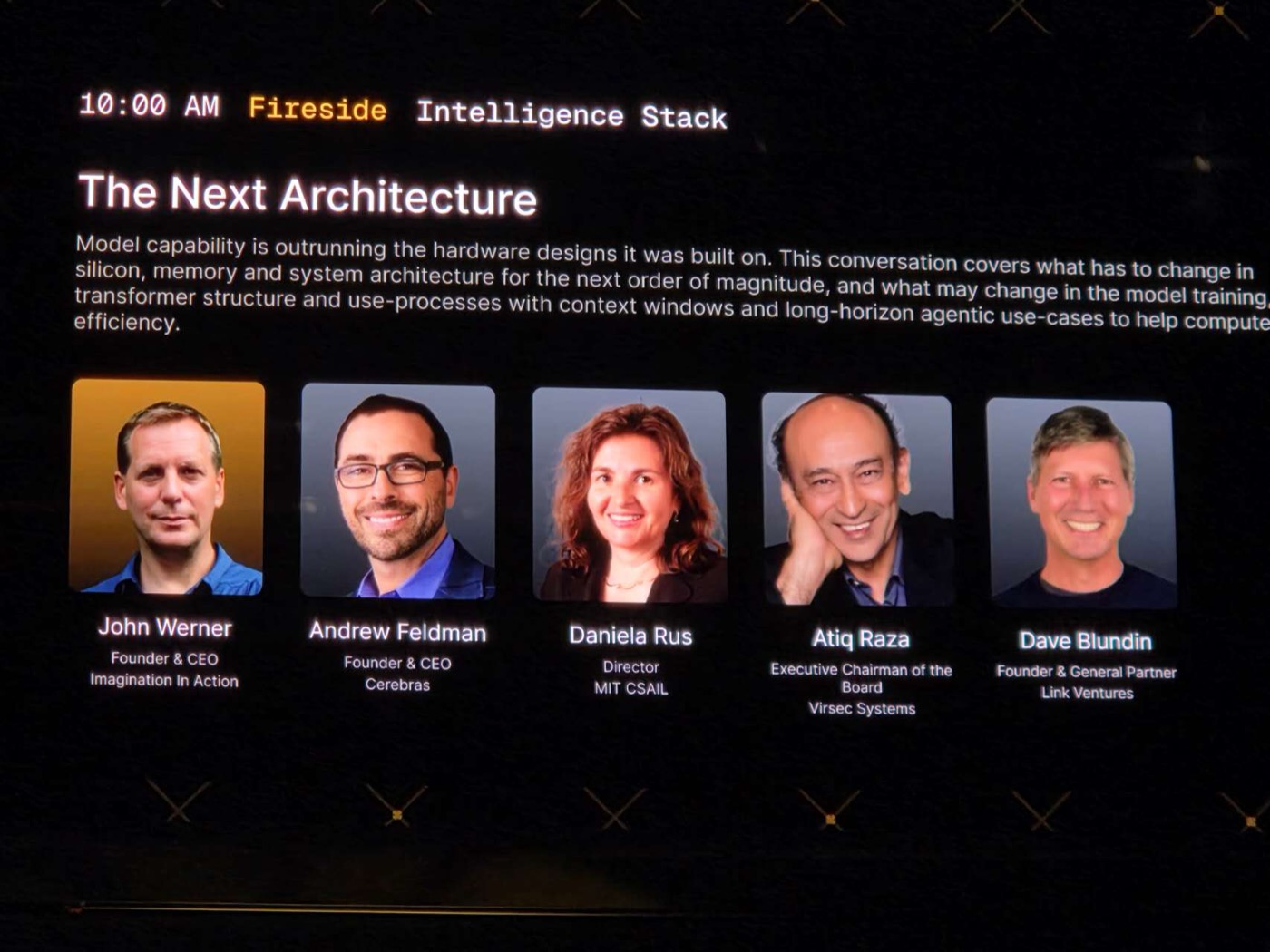
The 10 a.m. session was called The Next Architecture. The organizers put one line on the big screen: Model capability is outrunning the hardware designs it was built on. Four people sat on stage: Cerebras founder and CEO Andrew Feldman, Virsec Systems executive chairman of the board Atiq Raza, Link Ventures founder and general partner Dave Blundin, and John Werner of IIA, which runs the event.

Feldman summed up his own decade in one line: be wrong for a long time and not be dead. The bet Cerebras placed ten years ago was that speed would end up mattering. In 2020 they solved a chip architecture problem that had stood for 75 years, and nobody cared. The bet only paid off once models got smart enough to be genuinely useful.
Models are smart enough already. Now it is a race on speed
Feldman put it plainly: dumb and fast is useless. Speed became the threshold precisely because models are already smart enough. Intelligence stopped being the variable; latency took its place.
His examples were concrete. If Netflix had never solved download speed it would still be a disc rental business, and no studio bypassing theaters would have grown out of it. A coding assistant is only usable once it is fast enough to interrupt and talk back to. A personal agent that takes 8 minutes to order you a burrito is not a feature anyone wants.
Law and accounting make the point best, because they bill by time. Their smallest billing unit is 6 minutes, and whether 30 times the work fits inside those 6 minutes decides how the business gets priced.
Past a certain speed, what changes is whether the business can be run a different way at all.
But enterprises cannot get it working, and none of the blockers are the model
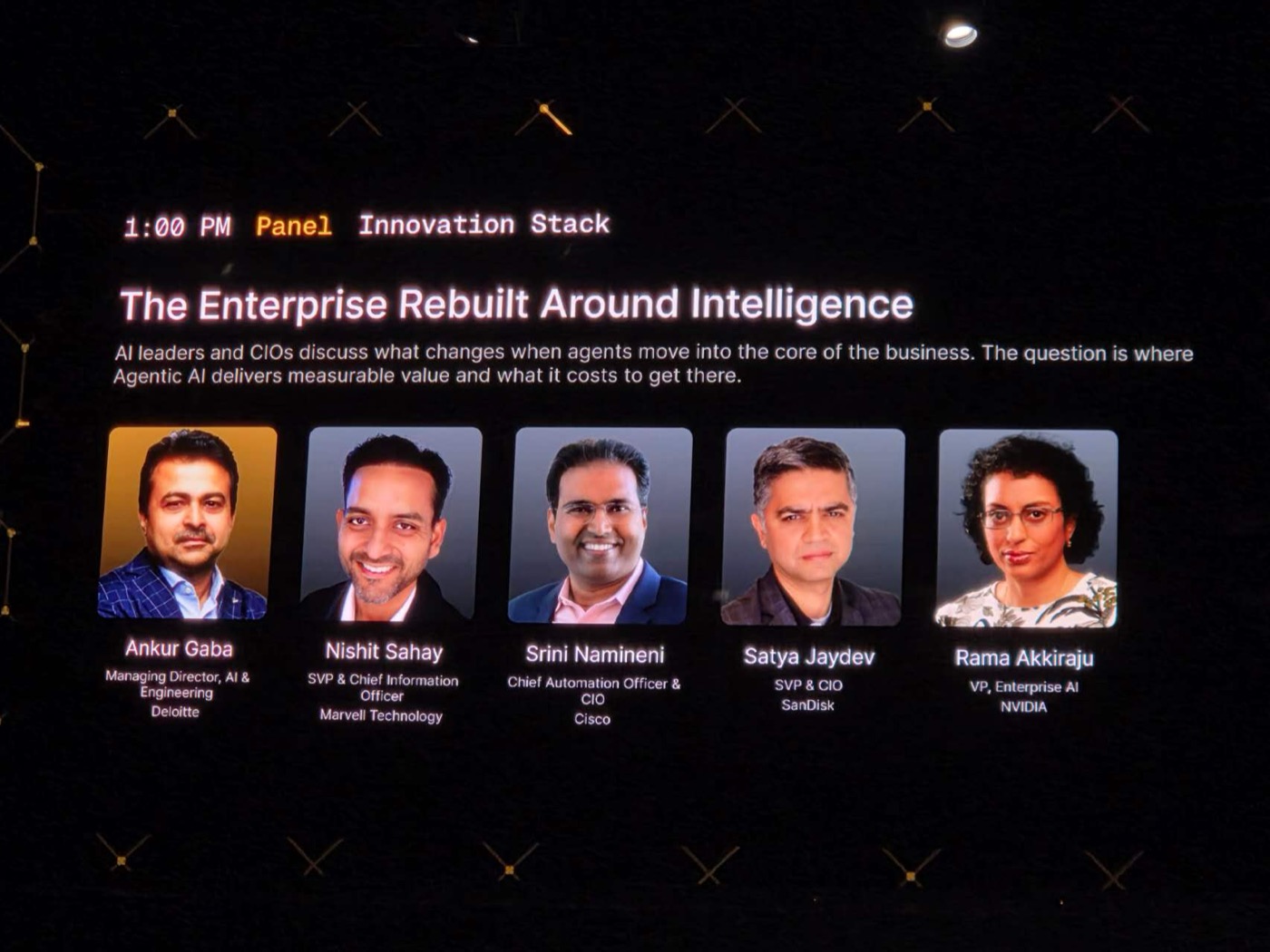
The 1 p.m. session was called The Enterprise Rebuilt Around Intelligence. All five people on stage were buyers, and their problems had nothing to do with speed.
Rama Akkiraju, NVIDIA's VP of enterprise AI, said four application areas have been in production for more than a year and a half: chip design, supply chain planning, IT and cybersecurity, and employee productivity. Srini Namineni, Cisco's chief automation officer and CIO, said the biggest win has been the software development lifecycle, and that three weeks earlier they had rolled out a personal agent to every employee, wired into Outlook and the calendar, handling things without being asked. Satya Jaydev, SVP and CIO at SanDisk, runs two tracks, one for productivity and one for differentiation, with the weight on engineering and manufacturing, because moving yield by a single point is worth several million dollars. Nishit Sahay, SVP and CIO at Marvell, needs operating leverage: the company is scaling from $2.5 billion to more than $12.5 billion, agentic AI works everywhere, and the hard part is deciding where to invest first.
Four things are blocking them, and not one of them is the model.
- Process intelligence. You have to learn how the work actually gets done, which is routinely not how everyone assumed. One company kept watching the order-to-shipment line and eventually found that what blocked fulfillment was the upstream order pull.
- Context engineering. Building semantic relationships around data is far harder than possessing the data.
- Identity and permissions. An agent inherits its creator's identity by default, privileged access included. This is the largest unsolved risk right now.
- Data foundations. Satya Jaydev's phrase for it: garbage in, garbage out, squared. SanDisk splits the whole architecture into four layers, data foundation, gateways, a semantic layer, and only then the surfaces a user touches.
Cisco's case shows best where the value sits. The company has made 250 acquisitions, and employees spend their days navigating dozens of systems. What the agent does is not make the navigating faster. It removes the need to navigate.
A tenth of the cost gets you roughly the same result
If intelligence were still the moat, one thing would not add up: why a model trained for a tenth to a hundredth of the cost lands close to parity.
Kimi K3, released by Moonshot AI in July, is a good specimen. It has 2.8 trillion total parameters but activates only 104 billion per token. Of its 93 layers, 69 use the company's own Kimi Delta Attention, a cheaper form of linear attention, and 24 use full attention, interleaved at roughly three to one. The KV cache, the slice of memory that holds context during inference and takes up most of it, shrinks by up to 75%, and decoding throughput at a 1M-token context rises by up to 6x.
Here is the part that reads backwards easily: K3's achievement is not that it is small. 2.8 trillion parameters is not small at all. Its achievement is making each token cheap.
Export controls ended up accelerating quantization work rather than stopping it. Closed frontier models now lead by roughly 4 to 8 months, with open source right behind. We drew the same conclusion in July from Liang Wenfeng's closed-door remarks: open source is itself a cost strategy.
Per the SVTR AI Venture Database, Moonshot AI has raised $8 billion to date.
Only a few players still pay for intelligence itself
Capability becoming a commodity, and capability not mattering, are two different claims.
The same summit produced a fact pointing the other way: OpenAI gave all of its Cerebras inference capacity to its own internal engineers first, to speed up its own model development. For a frontier lab, spending another unit of compute on a stronger model still beats selling it to customers.
Two economies are running at once. A handful of frontier labs are still paying for capability itself, and can afford to. Everyone else is buying capability, and the purchase price is collapsing.
The 3 p.m. session was called, plainly, Follow the Capital. It had moved to a different room, with a green wall, hanging globe lights and floor-to-ceiling windows, a completely different mood from the black box of the main stage. The investors there supplied the corroboration: one fund said that at seed, team quality and being AI-native is nearly sufficient on its own, and reported a portfolio with zero losses; one company took a $1 million seed round and reached $100 million ARR six months later.
Returns of that shape cannot come from "our model is smarter." They can only come from "we used very cheap capability to deliver a result very fast."
What gets counted now is the cost of getting one thing done
The yardstick is shifting from dollars per million tokens to dollars per outcome achieved. Frontier models are the most accurate and the most expensive; open-source and domain-specific models often land near parity at a fraction of the price.
Routing is the practice that goes with it. When we took apart OpenRouter in August we offered a judgment: routing is becoming a capability, not a category. What the enterprise side showed at this summit adds the cost dimension to it. Eighty percent of tasks run in a fixed-cost on-premises pool, and only the hardest twenty percent go to a frontier model.
It works because of an asymmetry that gets overlooked: enterprise task complexity is not getting harder at the pace model capability is improving.
So long as the routing architecture is right, the unit cost of the same job should fall year over year. For companies that get it wrong the opposite holds: the stronger the model, the bigger the bill. Over the next few quarters this line will pull apart the gross margin structure of AI application companies.
Bills are rising faster than anyone budgeted for. Token spend is growing at triple-digit percentages year over year. A Cisco internal survey found time saved per employee climbing from 3 to 4 hours a week to 7.6, and past 10 for engineering roles. The more it gets used, the thicker the bill.
What is genuinely hard to copy is data, and the ability to build physical things
Capability cannot hold value, so where did the value go. We chased this question once before, in June at the AWS Summit in China, where Amazon, a company that sells cloud, stood on its own main stage and threw the model out of the moat, putting data in its place. This summit points to two more specific answers.
The first is proprietary data. Investors converge on the view that proprietary datasets in pharma and biology outlast advantages in algorithms or orchestration. Otter.ai is the ready example. Founder Sam Liang started ten years ago from a plain observation: Gmail is searchable, but what people said out loud is not recoverable. The company built its own speech recognition and speaker identification rather than calling third-party APIs, and today has 35 million users and $100 million ARR with fewer than 200 employees, more than $500,000 of revenue per head.
Otter's history adds a footnote to this article's argument. Zoom's transcription system was originally built by Otter and stayed that way from 2017 to 2023; after Zoom went public it stopped licensing and built its own. Once a capability can be internalized, the licensor gets dropped. Otter is now moving toward a conversational knowledge engine, treating voice as a larger source of business intelligence than CRM, documents or databases, and building a knowledge graph across people, projects and customers.
The second direction is harder, and it is the ability to deliver in the physical world, which happens to be exactly where China is strong.

The 11 a.m. session, The Autonomous Intelligence Era, covered robotics, and the conclusion was that general-purpose humanoids are overrated. Steve Cousins, executive director of the Stanford Robotics Center, put it this way: the workspace determines the robot's form, and general-purpose across all workspaces has no definition. Waymo, robot vacuums and autonomous boats are none of them humanoid, and all of them useful; a microsurgery robot needs a purpose-designed form, and human fingers are no help. Someone on stage proposed a very concrete test: open a LEGO set made for a five-year-old and assemble it from the instructions. No robot today can do it, and the estimate offered on stage was another 5 to 10 years.
Worth noting is the supply chain remark: the United States has no credible actuator manufacturers, while China is far ahead in industrial robotics and the related supply chain.
Biotech looks the same. Drugs designed by AI fail at the same rate as conventional ones. The difficulty is reading biology; molecule design has long been good enough. By the numbers given on stage, roughly a quarter of Phase 1 trials now originate in China, at 30% to 60% lower cost.
Our judgment
Artificial intelligence is turning into infrastructure, and the cost is heading down. What is genuinely scarce is the ability to deliver a result at a given cost, and that sits in routing architecture, proprietary data, and physical supply chains.
For early-stage investors, our advice is to replace the diligence question "how strong is your model" with "what does it cost you to achieve one outcome, and has that number gone up or down over the past three quarters." A company that cannot answer gets more dangerous as the models get stronger.
This judgment comes from one day of observation at a conference, combined with our own deal-by-deal tracking of the companies involved. Several unrelated signals point the same way, but that is not yet enough to say the industry's structure has changed. A few things will test it: whether the per-task costs enterprises disclose actually fall year over year; whether the gap between open-source and frontier models reopens; and whether a credible actuator supply chain appears in the United States.
If delivery is what is scarce, getting your product in front of customers and industry partners is worth more than one more round of parameter tuning. The SVTR Spring 2027 Global Venture Camp: CES × Silicon Valley, recruiting 15 AI and hard-tech startups worldwide, heading to Las Vegas and Silicon Valley in January 2027 to find customers, industry partners and capital. The camp is currently at the intent-registration stage. You are welcome to register your interest.