

SVTR Editor's Note
On robots, the consensus in venture this year has shifted from "can we build a humanoid" to "which form factor actually lands." We spent a full day at the Silicon Valley summit on September 15 and concluded the question is aimed at the wrong thing: the form-factor fight is decided by a precondition that rarely makes it onto a diligence checklist. Written for early-stage funds looking at embodied AI, and for founders building robot bodies and components.
Per the SVTR AI Venture Database, as of September 2026 the robotics sector has 546 verified rounds totaling $27.2 billion. The money sits in a funnel that is nearly sealed at the bottom: Series A is the thickest layer at 191 rounds and $7.1 billion; by Series D and beyond only 11 rounds and $932 million remain; there has been a single IPO. The six new rounds between September 10 and 14 traced the same shape: Maven Robotics raised $100 million at Series A, while the lone Series D-and-beyond round went to Vecna Robotics at $31 million, less than a third of the former.
Money goes in and does not come out. On September 15 at Google Bay View, the second day of the Imagination In Action Silicon Valley AI summit ran five tracks from physical intelligence through geopolitics. What we went looking for was where this funnel jams.
There Will Be No "ChatGPT Moment"
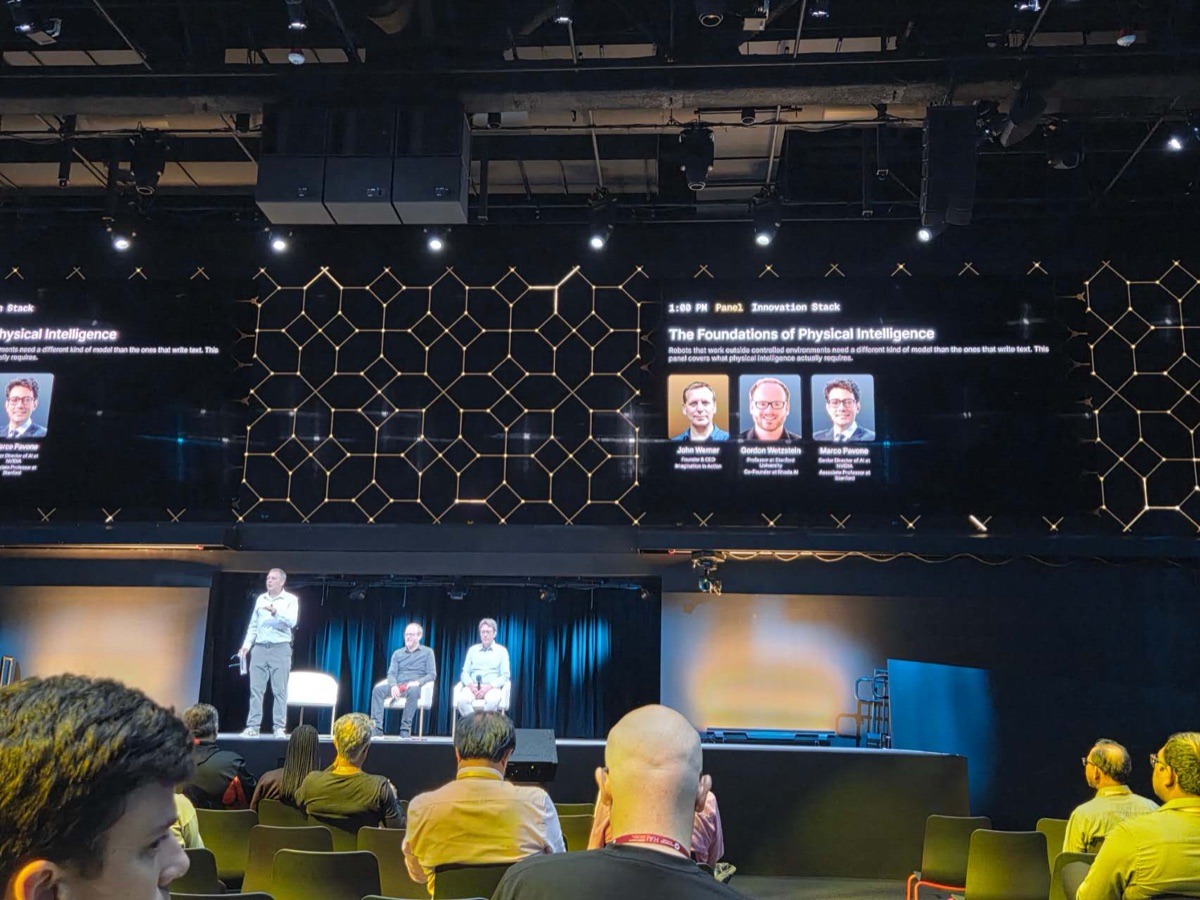
At 1 p.m., The Foundations of Physical Intelligence put Gordon Wetzstein, Stanford professor and co-founder of Rhoda AI, on stage with Marco Pavone, senior director of AI at NVIDIA and associate professor at Stanford.
Wetzstein defined physical AI plainly: closing the loop between perception, reasoning and action in the real world. What separates it from digital AI is that every action leaves an observable change in physical state. By his account on stage, this field will not get a ChatGPT moment. Hardware, regulation and safety hold penetration down; it can only be a gradual slope.
His second point is the one worth keeping: physical AI is a systems problem, not a model problem. Running one requires monitoring, contingency planning and data-collection infrastructure, and whether a company survives in the market usually turns on that systems engineering, with model quality further down the list.
Investors tend to slide past this because it sounds like engineering modesty. It is not. It says that if a robotics company's valuation is still anchored on the model or the body, it is anchored in the wrong place.
Getting It Running Is Easy. Proving How Often It Fails Is Not.
Pavone's most concrete stretch that day covered the three uses of simulation.
For testing, the technology is mature and delivering value today. For training, mature autonomous-driving companies use it, but it remains an active research problem. For validation, it is the hardest of the three, for two reasons: validation has to produce an absolute number, such as how many failures per 100 runs; and before you can substitute simulation for real road data, you first have to prove the simulator itself is accurate.
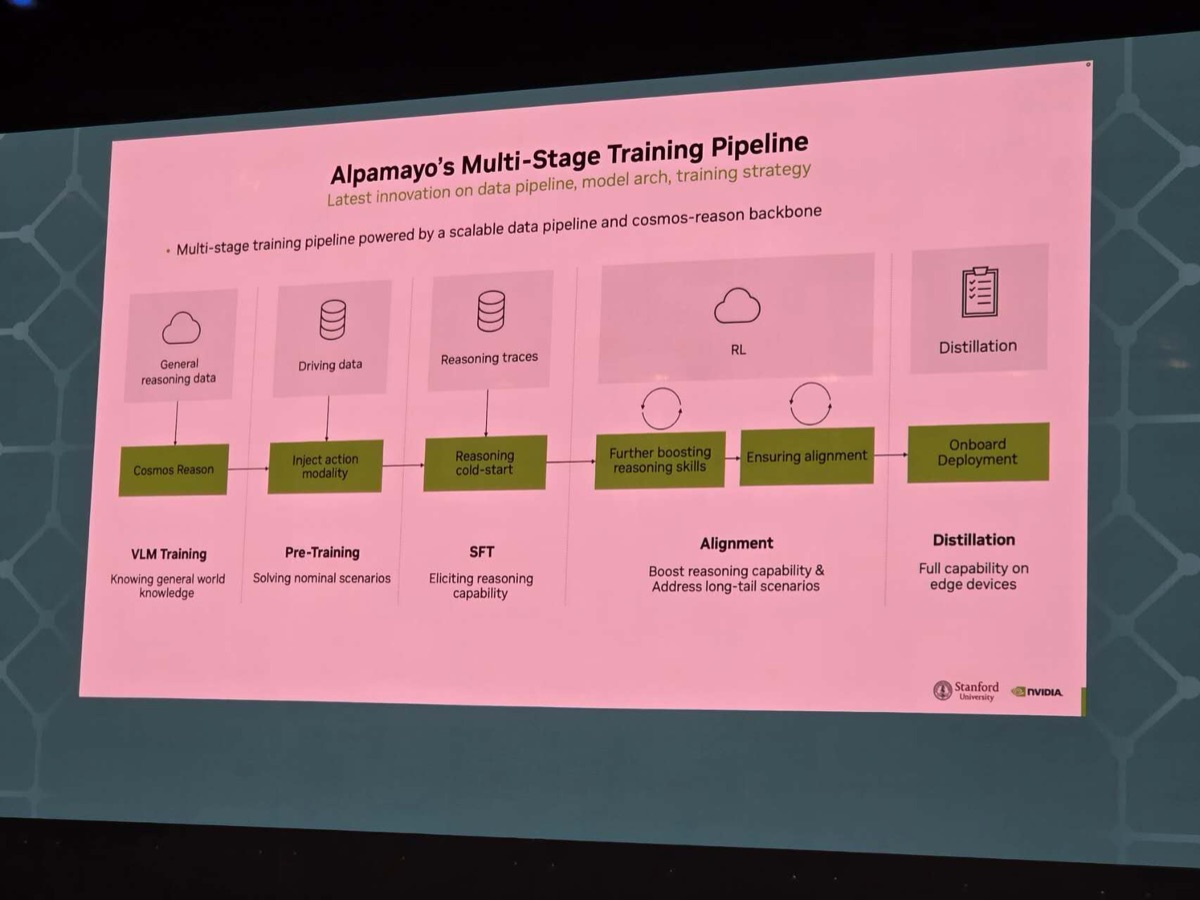
NVIDIA's own behavior corroborates this. When it open-sourced Alpamayo 1 in January 2026, it released three things at once: a 10-billion-parameter vision-language-action model, AlpaSim, a simulator built specifically for validation testing, and a dataset of 310,895 real video clips. Model, validator and data together, because the model alone is not usable by anyone.
Pavone also gave a harder technical detail on stage: the reasoning a model emits and the trajectory it emits can contradict each other, saying it will slow down while the wheel accelerates. They added a reinforcement-learning stage specifically to penalize that inconsistency. Only once aligned does the reasoning become something you can use to debug.
The commercial implication is larger than the technical one. A robot that can be asked "what were you thinking" after an incident and a robot that merely performs well are two different assets. The first can enter insurance, procurement contracts and regulatory approval; the second can only enter a demo video.
The standard answer from the technical community is dexterous manipulation: once a general-purpose hand exists, every form factor proliferates behind it. There is something to that, but it does not explain Vecna Robotics. The company has been building robots since 1998 and now focuses on moving material between warehouses and loading docks, on wheels, nowhere near dexterous manipulation. Nearly 30 years in, what it raised on September 10 was still a $31 million round. If the gate really were the hand, the jam would sit between demo and volume production. The funnel in our database jams later than that, after volume production.
Validation has already grown into a business. At the Machines That Do Science session that same morning, Scott Clark described Distributional, which he founded to do behavioral testing for enterprise AI, with $30 million raised to date per the SVTR AI Venture Database. That number is nearly invisible against 546 rounds and $27.2 billion of robotics funding, and it maps exactly onto the gate separating Series A from Series D.
The organizers put the session's subtitle on the screen: how much of the loop closes without a person in it, and how do you know when to trust the result. The second half is where the money is.

The Question About Legs Was Always a Question About Trust
At 2 p.m., Physical Intelligence Around Us was moderated by Reuters venture and startups reporter Krystal Hu. The title the organizers gave it already asks the question: robots are moving from demonstration into deployment, where are they genuinely useful, and how long does the last mile take. Two of the five people on stage had run deployments at scale, and they agreed to a striking degree.
Brad Porter, founder and CEO of Cobot, ran a full inventory at Amazon in 2018: 40 scenarios where a humanoid could theoretically help, and going through them one by one, not one actually required legs. In an ADA-compliant commercial environment, wheels are faster, simpler and more reliable, and legs are a power-hungry liability. The Proxy he builds now has four wheels, each able to pivot independently, which lets it move precisely without turning into a wall. One detail is worth keeping: the robot's eyes were deliberately set low, to tell people what it is capable of, while its actual sensing sits at six feet.
Aaron Edsinger, co-founder and CEO of Hello Robot, spent a decade building humanoids at Google and then gave his own robot just nine degrees of freedom, where 20 to 60 is standard. He calls it "robotic cubism," designed for in-home care and aging in place.
Put the two together and it reads as "humanoids are overrated." We already recorded that conclusion at our robotics pitch session in August, where none of the 10 teams that presented were building a full humanoid. What this day added sits a layer below. Safety, Porter said, is an engineering problem; trustworthiness is the higher bar, and it is the one that decides whether people will use the thing.
His arithmetic was blunt. If a robot saves a customer $300,000 a year, whether it is priced at $60,000 or $15,000 matters far less than whether it is dependable. Lower eyes, fewer joints, slower motion: each one tells the buyer where this machine's limits are. The form-factor fight has been standing in for trust all along.

China Can Build Them. America's Problem Is Who Repairs Them.
Per third-party figures cited in Bloomberg's reporting, Chinese manufacturers accounted for roughly 90% of global humanoid robot shipments in 2025, and more than 97% in the first half of 2026. The explanation offered on stage: low manufacturing cost, a government that is itself the buyer, and a data flywheel from fleet deployment, with robots placed into policing, hotels and restaurants to collect first-person data at scale.
On the American side, in late July the FCC added foreign-made humanoid and quadruped robots to its covered list. New models must be assembled in the United States with at least 65% domestic content by value to be authorized.
The reaction in the room was not celebration. Edsinger said the key sensors a home robot needs are currently hard to source outside China. Amazon's million-plus robots are finally assembled in Massachusetts, with sub-assemblies from around the world.
Our read is that the rule swaps a manufacturing problem for a repair problem. A domestic-content threshold can keep imports out; it cannot conjure a service network that does not yet exist. Pavone's timeline points the same way: commercialization of autonomous driving is accelerating, industrial robotics will see its first large deployments with real returns in two to three years, and household robotics is ten years out, a gap he attributed explicitly to supply chain and economics rather than technology, on the grounds that human labor is still cheaper and the repair and support infrastructure simply does not exist.
This is the other face of a judgment we published earlier. In August, in Signal #032, we wrote that embodied AI capital is leaving the robot body and moving upstream into sensing and force control. Upstream takes the component value. One block of value is still unclaimed: who proves it is reliable, and who shows up the day it breaks.
Our View
Capability in physical AI is turning into something you can buy. NVIDIA open-sourcing the model, the simulator and the data together is the announcement of that. What is scarce are two unglamorous jobs: proving how often it fails, and getting someone on site within a defined window when it does.
On day one of this same summit, in When Models Get Cheap, What Starts to Matter?, we argued that the metric on the software side is shifting to cost per outcome. One day later, the physical world added a second question: how many failures per outcome, and who is liable for them. There is no standard answer yet. Whoever produces a reproducible one will hold the pricing power in this sector.
For early-stage funds looking at embodied AI, we suggest replacing the diligence question "how advanced is your body or model" with two others. First, what do you use to prove your failure rate, and can a third party reproduce it. Second, when a customer's machine breaks, who do they call, and what is the average time to repair. For companies that cannot answer, shipping faster raises the risk.
This judgment comes from one day of conference observation plus our database's round-by-round tracking of the sector. The signals point the same way, but not far enough to say the industry structure has changed. Three things can test it: whether companies dedicated to validation, evaluation and repair networks start appearing in robotics funding; whether the count and dollar volume of Series D-and-beyond rounds begin catching up to Series A; and whether service data becomes public once the first FCC-compliant models ship.
The funnel used in this piece comes from the SVTR AI Venture Database's round-by-round tracking of 546 robotics deals. The rounds view filtered to robotics shows where the total, the count and the median round size come from; the stage-by-stage breakdown requires a login.