

13 matching
After Tian Keyu’s world-model startup raised nearly $30 million, the founder, his former colleagues, his investors and three venture media outlets all told different stories, yet none completed an independent reconstruction of the facts at the heart of the dispute. We ask why venture media no longer report on controversy, and publish the editorial standards SVTR holds itself to.
On July 8 the OpenAI Deployment Company bought Northslope, a delivery firm whose staff is nine-tenths ex-Palantir and which Palantir had named its first Vanguard Elite partner only last December. Between May and July 2026, OpenAI, Anthropic, AWS and Microsoft each turned sending engineers into the customer's building into a company or a standalone organisation, about $9 billion in total by their public figures; the OpenAI Deployment Company investor list in the SVTR AI Venture Database includes McKinsey, Capgemini and Bain & Company. SVTR's judgment: a tenfold jump in FDE postings is not a talent shortage; as model capability becomes ubiquitous, four giants are competing for the scarcest seat in the enterprise, the first person to understand the workflow and decide how AI enters production systems. Palantir spent more than twenty years proving that seat can be a software business, and its US commercial revenue grew 149% in Q2; what the model companies copied is headcount, and whether they can hold the seat depends on whether they win core processes or only implementation projects. The same job is priced in equity in the US and per project in China, where the average large-model tender award is about RMB 4 million.
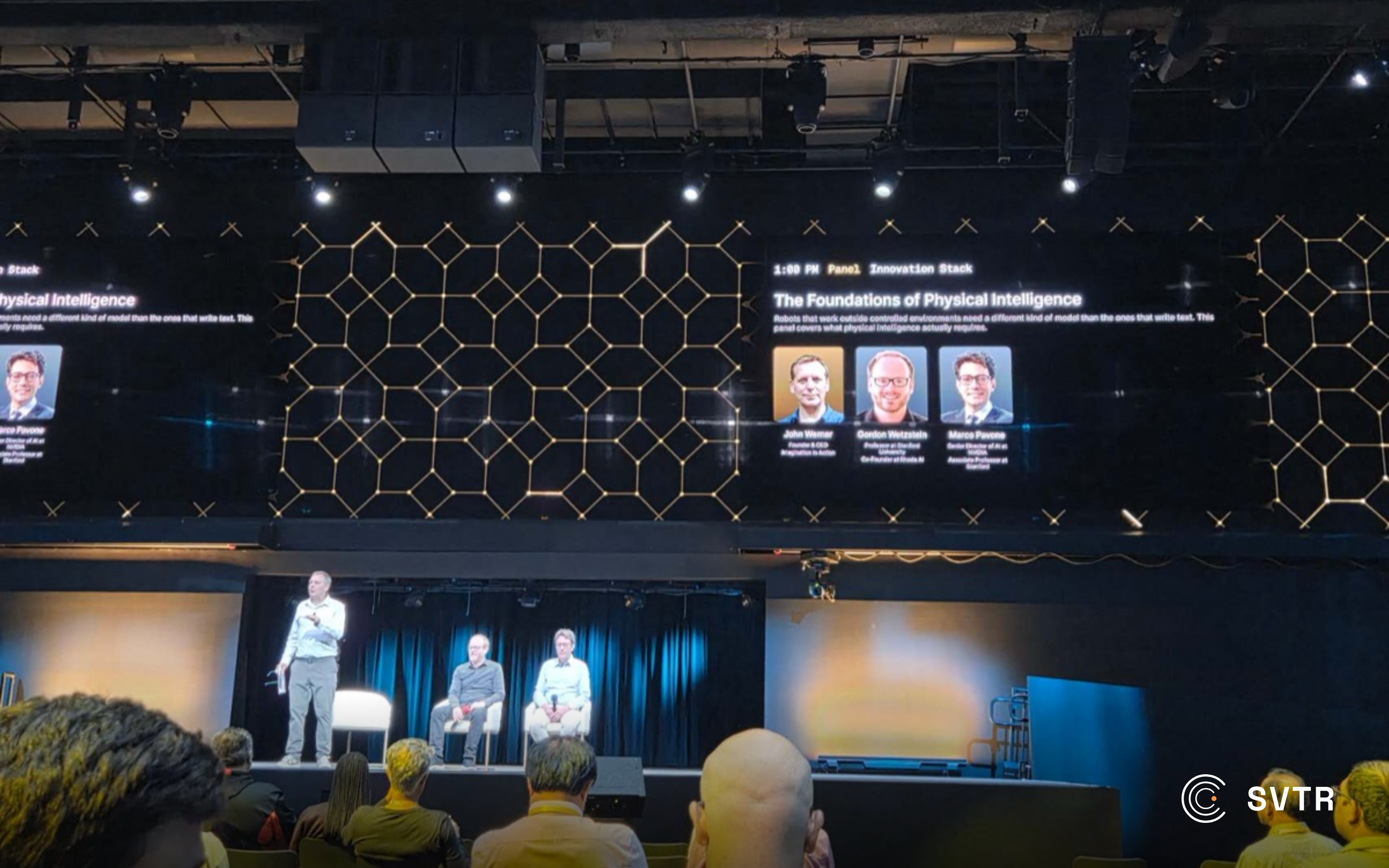
Day two of the Imagination In Action Silicon Valley AI summit on September 15 ran five tracks from physical intelligence through geopolitics. Per the SVTR AI Venture Database, robotics has 546 verified rounds and $27.2 billion, with Series A the thickest layer at 191 rounds and only 11 rounds left by Series D and beyond. Money goes in and does not come out. What blocks it is neither the model nor the dexterous hand: it is whether you can prove how often the machine fails, and who shows up the day it breaks.
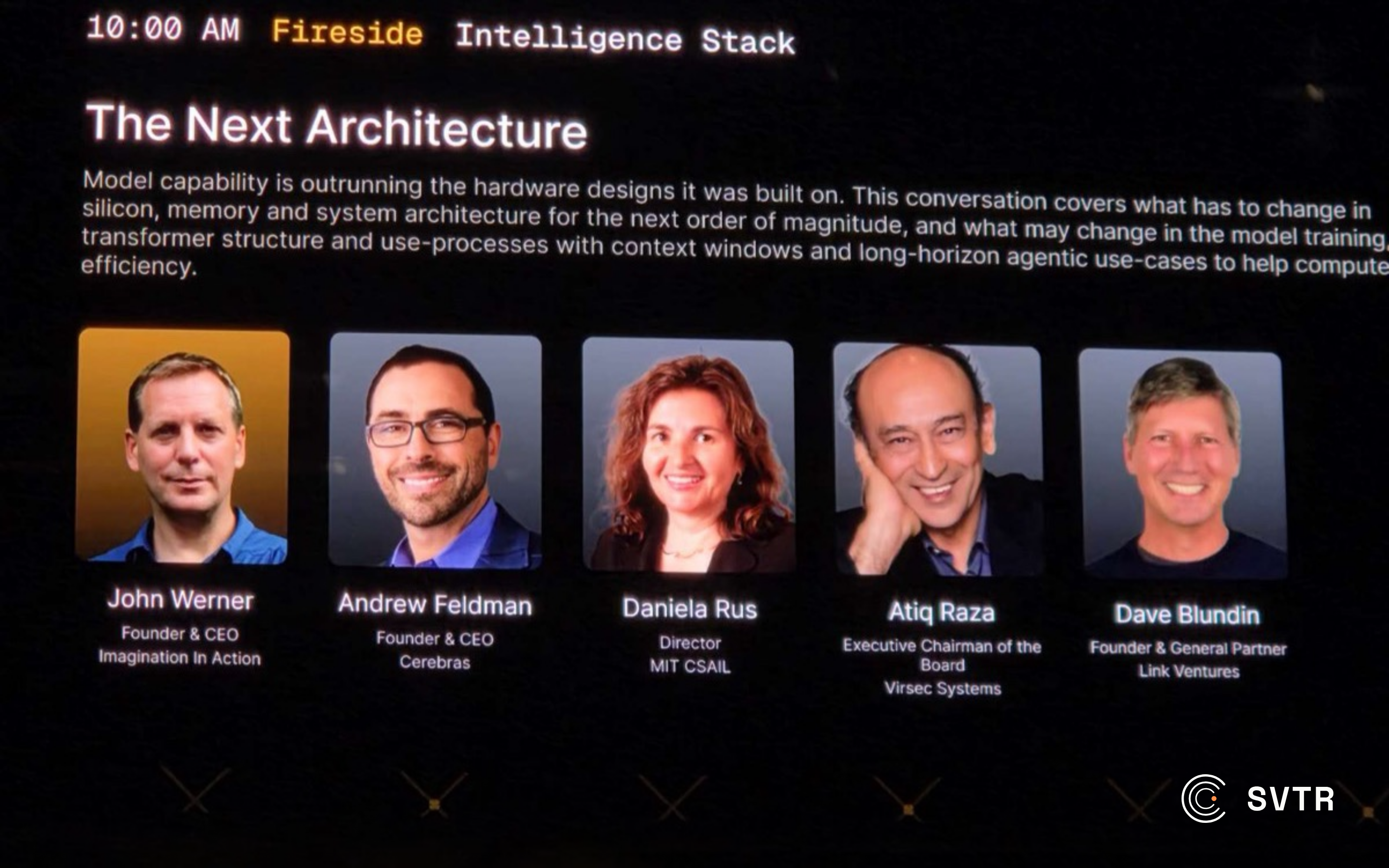
Day one of the Imagination In Action Silicon Valley AI Summit, September 14, 2026: five stages converged on one point. Capability keeps climbing while its purchase price collapses. Cerebras raised $2.9 billion privately over a decade and $5.55 billion in a single May IPO; Kimi K3 reaches near-frontier performance while activating 104 billion parameters per token; and none of the four things blocking enterprises is the model. SVTR's judgment: what is scarce now is the ability to deliver a result at a given cost, and it sits in routing architecture, proprietary data and physical supply chains.
SVTR's database tracks 175 AI4S companies that raised 118 confirmed rounds totaling roughly $7.50 billion over the past 12 months, with 13 companies taking 73% of it. Stage explains nothing: Periodic Labs raised a $300M seed in its founding year, while Aureka reached Series B for $100M. Age explains nothing either: the within-cohort spread runs to 27x against a sub-3x gap between age groups. Checking all 13 nine-figure companies against primary sources, what sets the tier is not pipeline versus tools but whether anyone else can build the thing in the near term: Chai Discovery licenses its models to Pfizer and Lilly and raised $400M, while Adaptyv Bio, which runs protein validation for Chai, raised $40M. Capital is not waiting for validation. It priced capability scarcity in the very first round.
On August 17, the Motion Picture Association signed its first AI copyright protection framework with ByteDance, focusing on what the model cannot generate. SVTR's AI venture database shows that in the past 12 months, 21 confirmed rounds of funding totaled approximately $1.96 billion, with nearly 70% flowing to those building and hosting models. The only company in the application layer to secure significant funding, Synthesia, sells enterprise training videos with constraints. The middle layer - 'tools that use models to create content for others' - is being replaced by its own customers building in-house solutions; in China, 76% of the money only recognizes one position in the model layer.
What an early-stage AI project needs most is not a standalone score; it is a position. SVTR reads five signal dimensions (team, market, product, moat, traction) and places each project into a coordinate system of same-sector, same-stage peers to find the gap that most needs closing. From five-dimension ratings across nearly 6,000 AI companies: the strongest dimension is team, and what is most commonly missing is real evidence of moat and traction. A deck, a text intro, or a website all work; evaluation is not the end, it is the entrance to the SVTR venture network.
In an era where generative AI and large model tools are rapidly approaching 'zero-barrier' access, the technical barriers to creation are collapsing quickly. Writing is no longer scarce, code is within reach, and products are becoming increasingly similar. This trend is already reflected in multiple cases in SVTR's AI venture database: founders are shifting from 'engineering thinking' to 'creative operations', because in a world where tools are highly homogenized, the real moat is not technology, but taste and distinctiveness.
A transcript of a closed-door investor discussion between Liang Wenfeng and investors in May 2026 has circulated in the Chinese venture capital community. SVTR does not restate the sensitive figures on card volume and financials, but instead distills four judgments that are more worth tracking in the long term: how domestic computing power can bypass CUDA, why open source can become a cost strategy, what the computing power gap between China and the US really means, and why continuous learning comes after Agent. Combined with the DeepSeek capital map and Liang Wenfeng's relationship map from SVTR's AI venture database, the four judgments share the same set of trade-off logic.
Embodied intelligence was the star of the WAIC 2026 exhibition, but when spreading out the funding of the 385 participating companies in SVTR's AI venture database, capital remains highly concentrated at the model layer. The real structural insight: regardless of China or the U.S., capital is paying for the 'brain,' not the 'body.'
Sequoia's David Cahn estimates AI infrastructure needs to earn back roughly $3 trillion cumulatively, but the real risk isn't the total, it's the distribution: capital is concentrated among a handful of hyperscalers and frontier labs, while revenue leaks toward users and cheaper open-source models, many from China. Per SVTR's AI venture database, model-layer and infrastructure-layer companies make up only about a fifth of its 5,718 AI companies, yet hold nearly 70% of disclosed funding. The people paying and the people profiting are splitting apart.
Global venture firms have spent two decades copying USV's content playbook: blogs, podcasts, weekly newsletters. But in 2026, USV itself has moved on, turning twenty years of judgment into a queryable, compounding asset. SVTR's view: content's moat was never output volume, it's whether judgment gets structured. In China, this layer of asset is nearly absent.
As a key player in Europe and the global AI ecosystem, France will host the Artificial Intelligence Action Summit on February 10, 2025. Leaders from various countries and global tech giants will gather in Paris to discuss the trends in artificial intelligence. The summit is expected to announce...