

Signal | SVTR Forward Signal
SVTR Editor's Note:
Shield AI raised $2.5 billion this week, but only $1 billion was equity bought at the headline valuation. The other $1.5 billion came from Blackstone structured equity and a JPMorgan loan, and JPMorgan is also on the shareholder list for the round. The same mix keeps showing up across the last four rounds of two defense-hardware companies. We look only at how the money is structured, not at whether the valuations are high: venture funds are no longer the only ones funding and pricing these rounds.
On November 5, Shield AI, which builds military drones and autonomy software, announced a $2.5 billion raise at a $28.8 billion post-money valuation, along with a $5.3 billion acquisition of solid-state radar maker Echodyne. The $2.5 billion has three parts: $1 billion of Series H equity co-led by growth fund Disruptive and Innovation X Capital, $1 billion of structured equity from Blackstone, and a $500 million loan from JPMorgan. The same day, CesiumAstro, which makes phased-array communications payloads for satellites, announced a $730 million Series D and another $100 million of debt from the Export-Import Bank of the United States and JPMorgan.
Our view: in late-stage US defense and hardware AI rounds, banks are no longer underwriters who arrive only at the IPO. They now fund every round. JPMorgan uses equity to get a seat, then makes the round bigger with loans and structured capital. The equity bought at the headline valuation can end up as a small slice of the round.
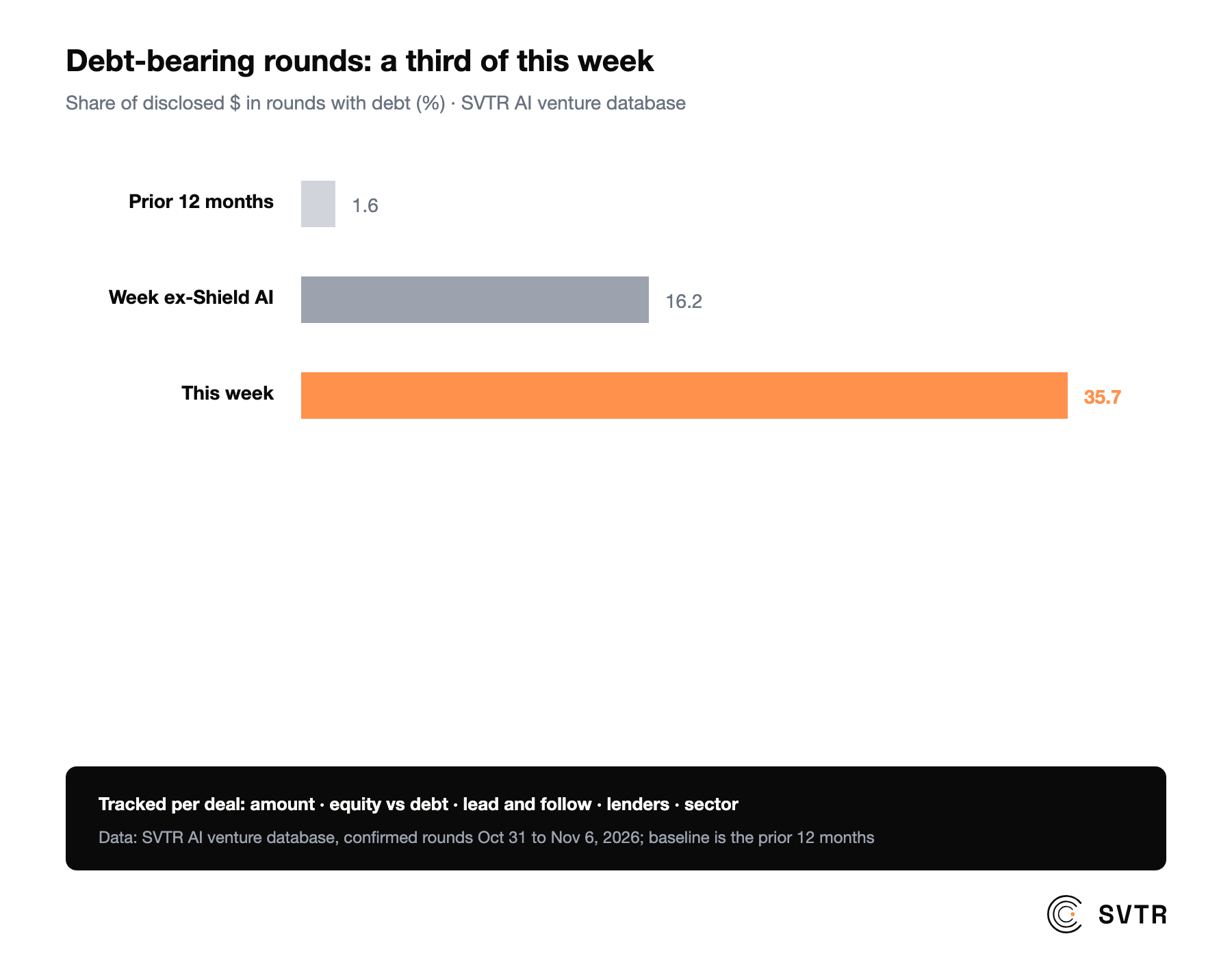
This week the SVTR AI venture database tracked 94 confirmed AI rounds with $10.741 billion disclosed. The 5 rounds with a debt component (3 equity-plus-debt, 2 pure debt) totaled $3.833 billion, or 35.7%, versus 1.6% over the prior 12 months. Without Shield AI the share is still 16.2%. Equity-plus-debt rounds appeared 11 times in the last four weeks, against an average of 0.3 a week over the prior 12 months.
Signal 1 | JPMorgan was in every one of two companies' last four rounds
Shield AI's $1.5 billion Series G in March was co-led by the direct investment arm of JPMorgan's Security and Resiliency Initiative (SRI) and private equity firm Advent International. Blackstone added $500 million of fixed-return preferred equity (shares that pay a fixed annual dividend and get paid back ahead of ordinary investors), plus a $250 million delayed-draw facility. In November's Series H, JPMorgan was both a shareholder and the provider of a $500 million loan.
Of CesiumAstro's $470 million Series C in February, $270 million was equity and $200 million was a loan package from the Export-Import Bank of the United States (the US government's export credit agency) and JPMorgan. This week's Series D came with another $100 million of debt from the same two lenders.
Table 1 | Funding mix of large US defense and hardware AI rounds, 2026
| Company · round (date) | Round total ($M) | Priced equity share | Non-equity money from |
|---|---|---|---|
| Shield AI · Series G (2026-03-26) | 2,000 | 75% | Blackstone fixed-return preferred 500 |
| Shield AI · Series H (2026-11-05) | 2,500 | 40% | Blackstone structured equity 1,000; JPMorgan loan 500 |
| CesiumAstro · Series C (2026-02-02) | 470 | 57% | EXIM and JPMorgan loans 200 |
| CesiumAstro · Series D (2026-11-05) | 830 | 88% | EXIM and JPMorgan loans 100 |
| Zipline (2026-11-05) | 1,500 | 100% | None; JPMorgan joined as a shareholder |
| Nooks (2026-11-04) | 500 | 0% | General Catalyst Customer Value Fund 500 |
Data: SVTR AI venture database, as of 2026-11-06. Note: “priced equity” counts only the Series G, H, C or D round itself, excluding Blackstone's structured and preferred equity.
Only Shield AI's equity share fell; CesiumAstro's rose from 57% to 88%. So we don't claim that equity is shrinking. What we can say is that each of these two companies' last four rounds included a layer of money that either gets paid back ahead of venture investors or earns a fixed return, and JPMorgan was in every one. Of the four largest rounds this week, three announcements named JPMorgan. The only one that didn't was generative media platform Fal.ai and its $1.3 billion.
Signal 2 | A $28.8 billion valuation set by $1 billion of equity
In a little over seven months, Shield AI's valuation went from $12.7 billion to $28.8 billion, roughly 2.3 times. That price was set by $1 billion of Series H equity. Blackstone's $1 billion and JPMorgan's $500 million in the same round have their returns written into their terms; they don't move with the valuation.
For growth funds coming in later, the valuation number means something different now. Blackstone's March check was preferred stock with an annual dividend; the terms of this week's check are not public. Across the two rounds, at least $1.5 billion sits ahead of ordinary preferred stock when it comes to getting paid back, plus the $500 million loan. If the company later goes public or sells below $28.8 billion, that money gets paid first. The headline valuation went up, and the equity bought at that valuation now carries more of the downside.
The money has a clear use. The Echodyne deal is valued at $5.3 billion: $4.8 billion in cash and stock at closing, plus up to $500 million tied to performance, with closing expected in early 2027. Part of this round's $2.5 billion is earmarked for it. In March, Shield AI likewise raised money and bought flight-simulation company Aechelon at the same time.
Signal 3 | The money buys production lines and factories
Echodyne's radars are used mainly for counter-drone work. Its factory in Kirkland, Washington covers about 86,000 square feet, cost $40 million and can make about 30,000 radars a year. CesiumAstro plans to spend $500 million over five years on a 270,000-square-foot facility at its Austin headquarters, and has acquired Jariet Technologies, 1Aardvark and Vidrovr. Zipline's $1.5 billion is all equity, and the announcement says it will expand US manufacturing.
This is why we think banks are willing to come in: factories, inventory and government orders can be priced as loans, so that part of the funding doesn't need to be diluted at a $28.8 billion valuation. In August, Signal #35 argued that “production assets are funded with credit,” using Castelion's $1 billion Series C as the example. This week goes one step further: the bank that lends has also joined the shareholder list, so a single institution is both owner and creditor of the same company. In October we wrote about compute financing moving to convertible structures. Defense companies are now using the same structures.
Why now
JPMorgan launched SRI in October 2025: $1.5 trillion of financing over ten years for industries tied to national security, including up to $10 billion of direct equity investment. Its one-year update on October 19, 2026 said $5 billion of equity had already gone out in year one, with more than $230 billion financed or facilitated. Direct investments are run by the Strategic Investment Group under Todd Combs. According to CNBC, in August JPMorgan helped lead the $1.4 billion round of Hadrian, which builds automated factories for defense parts, and took part in the $1 billion round of low-cost hypersonic missile maker Castelion.
Equity is only the way in. The SVTR AI venture database tracks 35 sourced investments by JPMorgan, including Nscale: the roughly $3.05 billion data center project debt in August was arranged by JPMorgan and Goldman Sachs. The Next Web reported on August 27 that JPMorgan had started sounding out lenders for a roughly $5 billion debt package for Volta, a Norwegian AI cloud company. Our read is that the bank uses equity to get a seat, and the loans, bonds and IPO underwriting that follow can all happen inside the same company. Beyond the equity returns, it earns fees across a whole set of financial services.
The other push comes from the companies. Shield AI said both it and Echodyne expect revenue growth above 100% this fiscal year. With fast growth and government-backed orders, borrowing is cheaper than selling more shares at a $28.8 billion valuation.
Who is affected
Growth funds investing in late-stage defense and hardware companies are hit hardest. What they buy is a shrinking slice of each round that gets paid back later and later. The headline valuations of these companies can no longer be compared directly with software companies at the same level; you first have to see how much money ranks ahead.
The exit path for early-stage defense founders is also changing. Platform companies holding structured capital are buying component and sensor makers: Shield AI bought a radar company, and CesiumAstro bought three companies in a year. This week France's Gallium Defense, which makes counter-drone radar, raised an $8.2 million seed round. Companies like it are likely acquisition targets for these platforms.
The application layer shows the same pattern. Nooks, which builds an AI assistant for sales teams, took $500 million from General Catalyst's Customer Value Fund, which provides non-dilutive capital to companies with predictable unit economics. Nooks says its revenue tripled year over year with 135% net revenue retention. The rule is the same: if revenue is predictable, a company doesn't have to raise only by selling shares.
The evidence is still thin: every case was checked against company announcements, but it comes mainly from two companies and one bank. Over the next three months we are watching two things. First, whether large US defense and hardware AI rounds keep including loans or structured capital; if they go back to pure equity, this view does not hold. Second, whether JPMorgan becomes both shareholder and lender at any AI company beyond Shield AI; if none does, Shield AI was a one-off.
If you work at Shield AI, CesiumAstro or Zipline, or at JPMorgan's Strategic Investment Group or Blackstone, you're welcome to claim your company or personal profile in the SVTR AI venture database. To see similar hard-tech companies currently raising, the project showcase is open to members who have completed investor verification.
Follow-up | Signal #31 “The angel round is just a name now”: not confirmed
Original view: “The angel round is just a name now: AI capital is pricing day one on the endgame”. Metric: whether at least one of PokeBot, DISCOVER Robotics and Volta announced a next round, a valuation step-up or a bigger order within 90 days. At least one meant front-loaded capital was still accelerating; zero, with density falling, meant isolated packaging.Result: between August 8 and November 6, none of the three announced a new round. PokeBot's latest round is still its nine-figure Pre-A in early August, co-led by Shunwei Capital and Matrix Partners China. DISCOVER Robotics' latest is still its $100 million Angel+ round on August 5. For Volta there is only The Next Web's August 27 report of JPMorgan shopping a roughly $5 billion debt package, not yet announced. The metric was not met. But the other half of the “isolated” condition did not appear either: a separate follow-up found that over the 8 weeks to October 3, companies no more than 18 months old raised rounds of $50 million or more at 2.5 a week, so density did not fall. Front-loaded rounds are still happening, just not repeatedly at the same companies.