

SVTR Editor's Note | Sequoia Capital partner David Cahn has put the AI infrastructure bill at $3 trillion, and Apollo chief economist Torsten Slok warns that getting this wrong could drag down the S&P. Most of the market is arguing over whether AI is a bubble. SVTR thinks the more important question is this: even if AI ultimately creates value well beyond $3 trillion, the people footing the capex, the people driving costs down, and the people capturing the revenue may not be the same people. This piece is for investors tracking AI infrastructure, public-market spillover, and the US-China compute split: what matters isn't how big the gap is, but whose pocket the value actually ends up in.
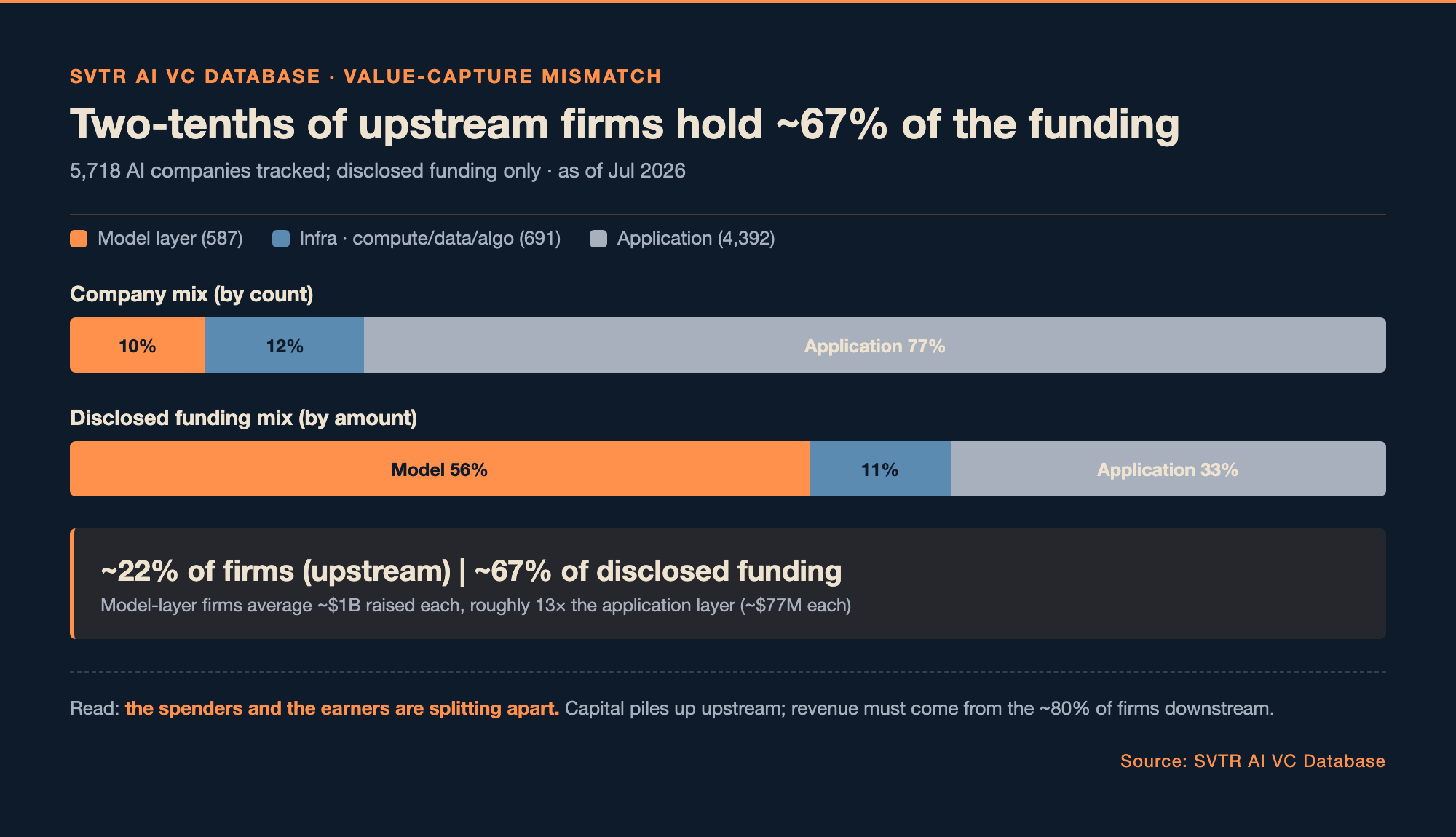
Reading the chart: money is heavily weighted toward the upstream. Based on 5,718 AI companies in the SVTR AI Venture Database as of July 2026; only companies with disclosed funding are counted, classified by the database's three-layer taxonomy (infrastructure / model / application).
I. The Gap Isn't About Filling a Total, It's a Distribution Problem
Let's start with the math. By Cahn's July estimate, hyperscalers' 2026 AI data center capex will run about $750 billion (Amazon, Alphabet, Microsoft, and Meta alone already total roughly $710-725 billion). Using his standard 2x multiplier, which covers non-chip costs and a 50% margin, that year's spending needs about $1.5 trillion in end-user revenue to earn an adequate return. Cumulated from ChatGPT's launch, that revenue requirement rolls up to roughly $3 trillion. Note this is the revenue that needs to be earned back, not the cash spent this year. The two are often conflated.
On the other side of the ledger, OpenAI and Anthropic combined generate roughly $100 billion in annualized revenue (per SemiAnalysis's July model, which projects Anthropic's Q3 operating profit could exceed $1 billion, though frontier labs as a group are still burning cash). The $3 trillion figure is a cumulative revenue requirement, while $100 billion is a current annualized run rate. One is a stock target, the other a flow snapshot, so strictly speaking they aren't the same measure. But the gap is wide enough to show that current commercialization is still an order of magnitude short of what the infrastructure buildout is promising.
The real structural risk isn't the total, it's the distribution. This money moves among four groups, and the ones paying in aren't the ones getting it out. The ones footing the bill for capacity are a handful of hyperscalers, data centers, and frontier labs. The ones driving costs down are open-source models, inference optimization, and cheaper chips. The ones picking up productivity gains for free are enterprises and ordinary users adopting AI. The ones with a real shot at capturing the money are application companies that hold onto users, workflows, transaction points, and proprietary data. The payers are crowded at the very top of the stack, and the earners are scattered across the bottom.
This split isn't a theoretical projection. Of the 5,718 AI companies in the SVTR AI Venture Database, model-layer and infrastructure-layer companies together make up only about a fifth, yet account for nearly 70% of disclosed funding. The remaining nearly 80% are crowded into the application layer, averaging less than a thirteenth of what model-layer companies get per company. The money has already landed upstream, while the revenue is being asked to come from an army of downstream players.
II. Efficiency and Open Source Are Rewriting Who Gets Paid
The "token factory" business model assumes one thing: build the capacity and usage will grow to fill it. Cahn's $200 billion question three years ago was gradually absorbed by exactly that kind of usage explosion. But two variables emerging in 2026 aren't moving usage, they're moving who the revenue belongs to.
The first is efficiency. OpenAI's latest GPT-5.6 Sol is 54% more token-efficient than competing models on agentic coding tasks, according to Sam Altman on July 9. For users, that means fewer tokens for the same task. For model makers, whether it translates into lower revenue, higher margins, or a further usage explosion depends on how fast prices fall and whether new demand shows up to absorb it. So whether the money actually shrinks is itself an open question.
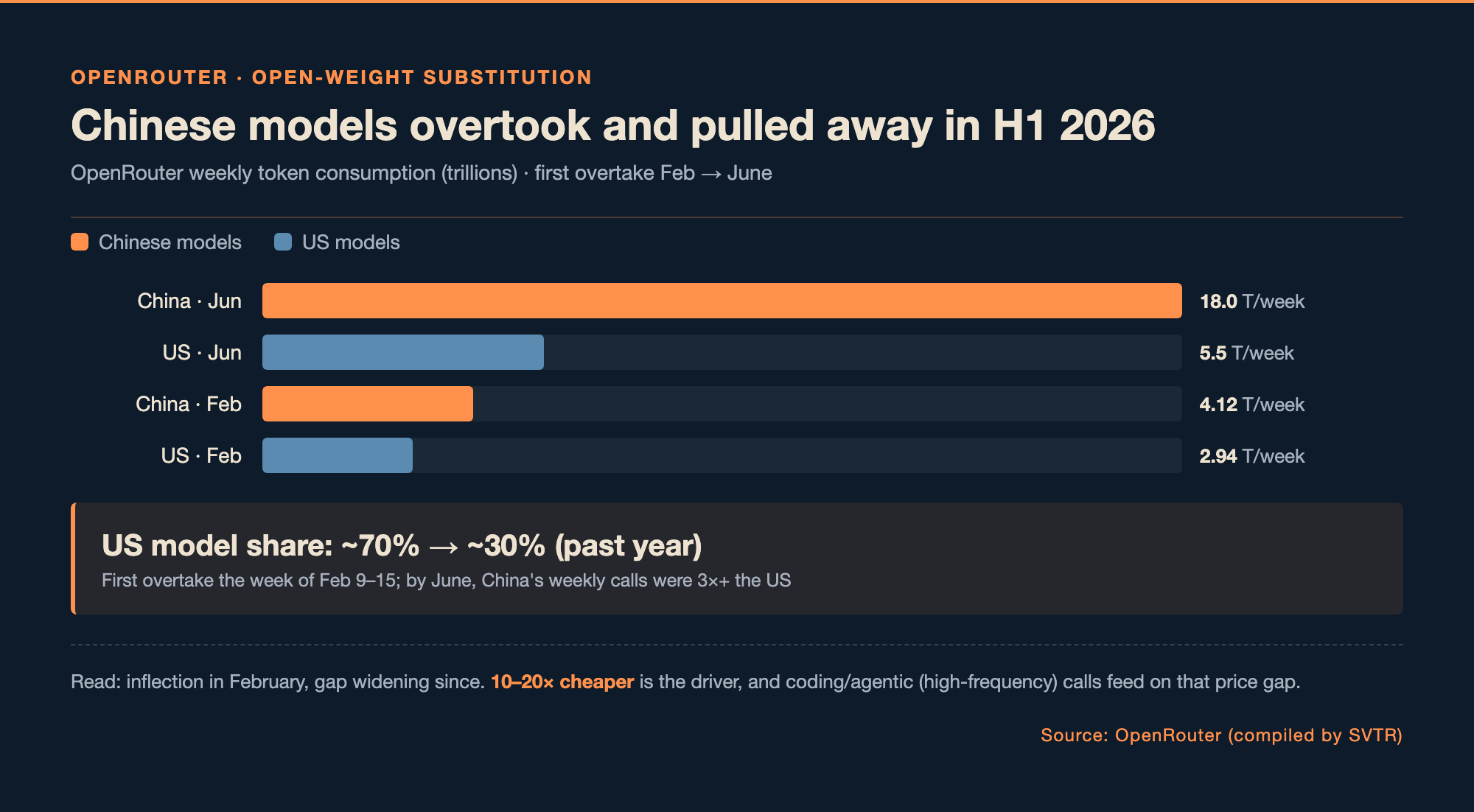
The second is open source. Per OpenRouter data, Chinese models' weekly token consumption first overtook US models in the week of February 9-15 (4.12 trillion versus 2.94 trillion), widening to roughly 18 trillion versus 5.5 trillion by June. US models' share on the platform slid from about 70% to about 30% within a year. The driver is straightforward: Chinese models are 10 to 20 times cheaper.
The Jevons paradox (cheaper means more usage) all but guarantees total AI usage keeps growing. That part isn't in question. What's genuinely up in the air is who the money belongs to. Once the price per unit of intelligence falls faster than demand rises, the extra usage leaks in bulk toward whichever side isn't paying for that $750 billion in capex. The real repayment risk for the "token factory" is that usage keeps climbing while the money flows somewhere else.
III. From China's Vantage Point: Not Answering the Question, But Making It Harder
Unlike US labs, which push the absolute frontier by pouring in massive capital, leading Chinese players like DeepSeek, Qwen, and Kimi are taking a different engineering path: pushing training efficiency, inference cost, and open-source distribution to the extreme, and using low prices to win developers and usage. They're competing in the same model race, just with a different playbook.
But one point is easy to misread: Chinese-origin open weights don't mean those calls skip paying for US infrastructure. They may still run on AWS, Azure, or Google Cloud, still burn Nvidia GPUs, and still pay for US data centers and power. What open source actually thins out first is the model layer's premium and high-margin API revenue, not necessarily the entire infrastructure layer's revenue.
Put more precisely: open source isn't making AI investment collectively unable to pay for itself. It's shifting value from model ownership to compute hosting, product distribution, and the workflows where it ultimately lands. Frontier labs may lose the API premium, but cloud and compute providers can still collect on inference demand, and chips and power still get paid depending on where the model actually runs. What China is doing isn't answering "can AI earn back $3 trillion." It's commoditizing output to strip out the high-margin portion of that question, stretching out the payback period for whoever in the US is footing the bill.
For players without deep pockets, there's actually a realistic path here: don't compete with the giants on capex, use cheap models to claim a position in application and distribution instead. The precondition is that the application layer builds stickiness above the token itself. Otherwise it gets undercut just the same by something "good enough and cheap."
IV. The Risk Transmits, and It Lands on Founders
What Slok worries about isn't AI itself, it's transmission. The market is broadly betting that as today's compute buildout comes online, the combined free cash flow of Google, Meta, Microsoft, and Amazon will more than quadruple from 2026 to 2030. But the "Magnificent Seven" now carry too much index weight, so if the payback pace slows, the problem won't stay contained. It will travel from chips, power, and data centers straight through the entire S&P 500. In Slok's own words, a slower payoff "could push the economy into recession and the S&P into a correction."
The same question demands different follow-ups depending on who's asking. Infrastructure funds need to ask who's actually paying for the capacity they've backed. Software AI VCs need to ask whether efficiency gains and open-source substitution will thin out application-layer pricing power too. Public-market and strategic capital need to ask whether the consensus on cash flow materializing after 2028 has already been overpriced into today's valuations. Shouting "AI bubble" in general terms doesn't mean much. What matters is whether you're the side paying to build the capacity or the side positioned to collect from it.
In the end, AI will almost certainly create economic value well beyond $3 trillion, but the people who put up that $3 trillion in capital won't necessarily get a proportional share of the revenue back. So over the next 12 months, the real bet isn't on model capability. It's on who can lock down a high-frequency workflow, accumulate proprietary data that models can't copy, and hold onto the final customer relationship and transaction point. As tokens keep getting cheaper, the API call itself stopped being a moat a while ago. What still is one is embedding that call into a business outcome. SVTR's AI Venture Database will keep tracking how funding splits between compute infrastructure and the application layer, watching both the US and China sides side by side.