

SVTR Editor's Note
In early October, JILA physicist Jun Ye shared the 2026 Wolf Prize in Physics with Immanuel Bloch. He is usually described as "the atomic clock guy," and quantum investors usually put their money into quantum computers. This piece starts from the companies that have grown out of his lab and asks a more practical question: on the same technology tree, where does the money go, and where do the orders land first? It is written for investors and founders who follow deep tech but do not study atomic physics.
In early October, the Wolf Foundation announced that Jun Ye, a physicist at the US National Institute of Standards and Technology (NIST) and JILA, would share the 2026 Wolf Prize in Physics with Immanuel Bloch of the Max Planck Institute of Quantum Optics, for "transformative, widely applicable advances in the control of ultracold atomic systems."
Ye is best known for the strontium optical lattice clock. From an investor's point of view, though, his lab works more like a technology source: the capabilities it has built around atom control, precision spectroscopy and ultrastable lasers have spilled over into quantum computing, navigation and timing, and medical diagnostics.
Our view: on this technology tree, venture capital is betting on quantum computing, but orders at scale are landing first on clocks and sensors. A single computing company can raise hundreds of millions of dollars; many sensing companies are still at the tens-of-millions level.
Precise enough, a clock becomes a sensor
An optical lattice clock uses lasers to hold tens of thousands of strontium atoms in a "lattice" made of light, then reads their transition frequency to keep time. That frequency is about 47,000 times higher than that of the cesium clock that defines the SI second. The higher the transition frequency, the finer the time resolution.
NIST once described Ye's clock on an extreme scale: it would take tens of billions of years to accumulate one second of error. In 2022, the team measured, within a single cloud of atoms, the gravitational redshift across a height difference of about 1 millimeter, the effect predicted by Einstein's general relativity: the closer to Earth's center, the slower time runs.
At this precision, a clock is no longer just a clock. Comparing how fast time runs in two places lets you infer mass distribution underground or changes in elevation. The clock becomes a sensor for gravity.
In 2025, the team used quantum entanglement to reduce measurement noise, pushing a single clock's precision to 1.1×10⁻¹⁸ and beating the standard quantum limit (the ceiling you reach by simply adding more atoms). It shares a core capability with quantum computing: preparing, preserving and manipulating quantum correlations among many atoms.
One set of capabilities, two kinds of companies
One mainstream approach to quantum computing is "neutral atoms": lasers arrange individual atoms into an array, and each atom serves as a qubit. Cooling atoms, holding them with light, extending how long they stay in a quantum state and steering them precisely with lasers are exactly the problems Ye's lab has worked on for more than two decades.
So beyond being technical neighbors, neutral-atom computing and JILA share people:
- Atom Computing (builds neutral-atom quantum computers): founder Ben Bloom did his PhD with Ye, working on the strontium clock; Ye is the company's scientific advisor. In June, the company closed a $100M Series C led by Third Point Ventures and signed a letter of intent with the US Department of Commerce for another $100M.
- Infleqtion (neutral-atom computing and quantum sensing): spun out in 2007 from the lab of another JILA fellow, Dana Anderson, under the name ColdQuanta, and listed on the NYSE in February through a merger with a special purpose acquisition company (SPAC). Its product line puts quantum computers next to optical atomic clocks and inertial sensors.
New money is arriving faster. Caltech-rooted Oratomic (neutral-atom quantum computers) raised a $300M Series A in July and a $475M Series B on October 8, $775M in its first year. France's Pasqal listed on Nasdaq in August. In China, Buchou Quantum and MatriQ, both founded in 2025, have each raised about $140M.
Capital chases computing, orders land on clocks first
Table 1 | Neutral-atom quantum computing vs. atomic clock and quantum sensing companies: total raised (as of 2026-10-23)
| Company | What it does | Total raised ($M) | Latest round ($M) |
|---|---|---|---|
| Quantum computing · 6 companies total | Neutral-atom approach | ~1,883 | |
| Oratomic | Founded 2026 | 775 | Series B 475 (Oct 2026) |
| Atom Computing | Fault-tolerant quantum computers | 300 | Series C 100 (Jun 2026) |
| Pasqal | France, listed | 300 | Nasdaq listing (Aug 2026) |
| QuEra | Cloud and on-site systems | 230 | 230 (Feb 2025) |
| Buchou Quantum | Full systems | ~139 | Series A, several hundred million yuan (Aug 2026) |
| MatriQ | Full-stack | ~139 | Strategic, undisclosed (Oct 2026) |
| Clocks and sensing · 2 disclosed total | ~29 | ||
| Mesa Quantum | Chip-scale atomic clocks without GPS | ~16 | 11.8 (Sep 2026) |
| Atomionics | Quantum gravimeters for mining | 12.7 | Series A 12.7 (Sep 2025) |
| Guoce Quantum | Chip-scale clocks, stabilized lasers | Undisclosed | Series B, over 100 million yuan (Jul 2026) |
Data: SVTR AI venture database, as of 2026-10-23. Total raised covers equity plus signed government funding commitments: Atom Computing's $300M includes the $100M Commerce Department letter of intent, QuEra's $230M includes $60M subject to conditions, and Pasqal's figure is pre-listing. Yuan amounts are converted from disclosed ranges and are estimates. Infleqtion does both computing and sensing and is not counted on either side.
By this table, six neutral-atom computing companies total about $1.88B, about $1.61B for the four in the US and Europe and $278M for the two in China. On the timing and sensing side, the two with disclosed amounts total about $28.7M, less than a tenth of Oratomic's latest round alone.
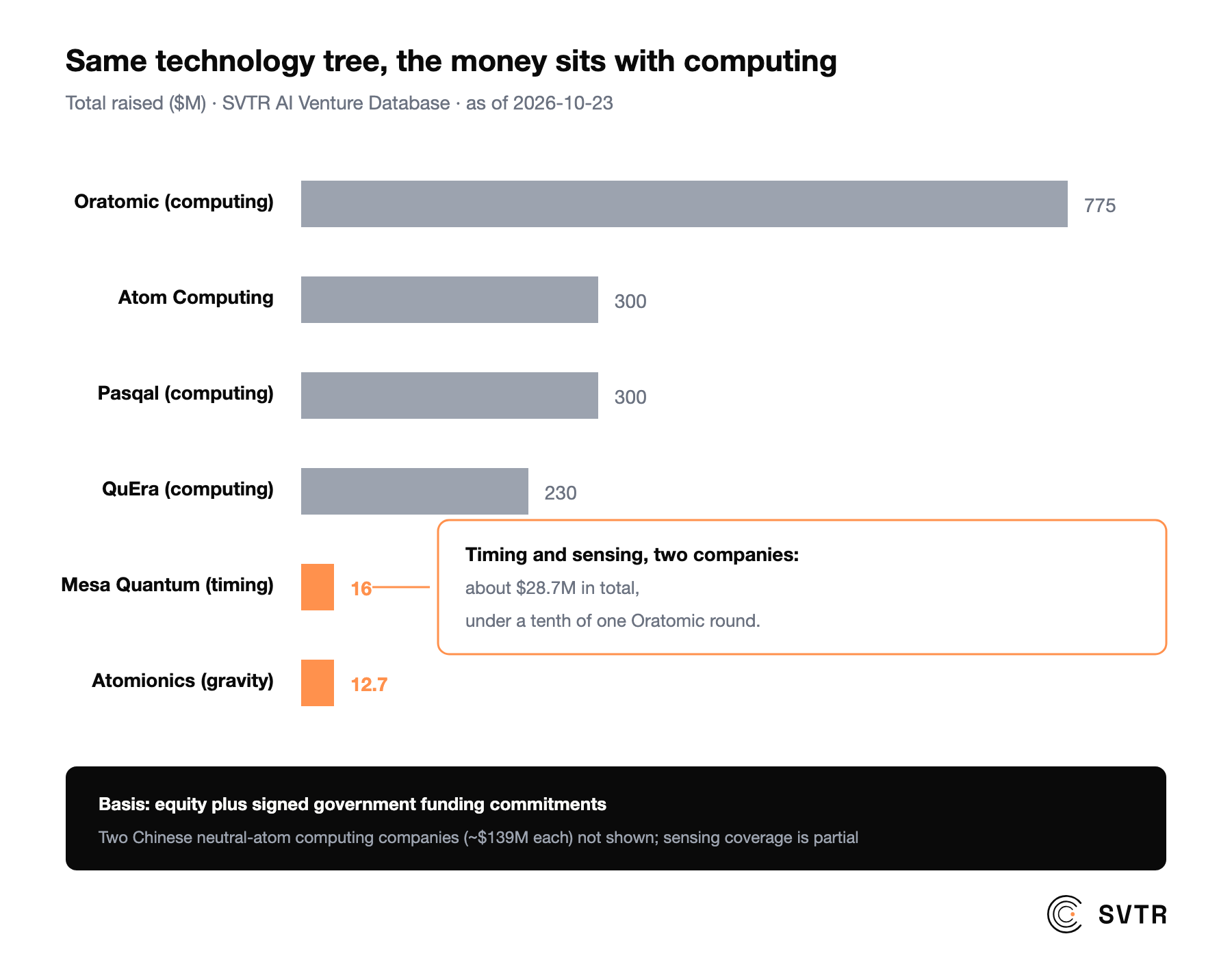
The database centers on AI companies and its quantum sensing coverage is partial, so these numbers are not a full market count. The direction is clear, though.
On the procurement side, the market moves at a different pace. Vector Atomic, which builds optical atomic clocks and navigation and timing equipment, had won more than $200M in government contracts before IonQ acquired it in an all-stock deal last October. In August, DARPA extended its existing contract with IonQ by $28M for up to 125 compact optical atomic clocks: 25 in the first delivery, with an option for 100 more worth another $30M. The orders are starting to move from R&D toward production.
GPS can be jammed and spoofed, while telecom networks, data centers, power grids, financial infrastructure and defense systems all depend on precise timing. Keeping a time reference when satellite signals are unavailable or untrustworthy is a need that exists today and already has budget behind it.
The computing side also has customers and commercial deployments; Atom Computing's system built with Microsoft is commercially available. But enterprise demand large enough to match billions of dollars of capital and valuation still depends heavily on fault-tolerant quantum computing (machines that correct their own errors) actually arriving.
Deep tech investor DCVC, which appears on the cap tables of both Atom Computing and Mesa Quantum, is one example of a firm betting on both ends.
Breath testing: Flari sells lung cancer screening
Another tool from Ye's lab is the optical frequency comb, which turns laser light into thousands of precisely spaced frequency lines, like a ruler for light with extremely fine markings. Shine it through a single breath and it can read the concentrations of more than a thousand molecules at once.
Ye and team member Qizhong Liang applied the method to disease screening, with research covering COPD and lung cancer. Flari Tech, formed around this work, won CU Boulder's 2024 Lab Venture Challenge, received a $400K DARPA award in 2025 and joined CU's deep tech accelerator this year.
Flari does not pitch itself as a "quantum company." It talks about breath testing for lung cancer. If it reaches the clinic, what hospitals buy is a diagnostic tool that assesses disease risk, with precision spectroscopy sealed inside the product. The hard part has nothing to do with quantum either: clinical trials and US Food and Drug Administration (FDA) approval take years.
This may be what much of quantum technology looks like once it is commercialized: the technology is still quantum, but the product no longer needs to be called "quantum."
Two steps further out
- Nuclear clocks: these keep time using energy levels inside the thorium-229 nucleus, which is less sensitive to outside electromagnetic interference. In 2024, Ye's team and collaborators including TU Wien directly compared the thorium nuclear transition frequency with a strontium clock for the first time. A 2026 study in Nature showed that two differently doped thorium crystals reached a nuclear transition frequency reproducibility of about 1.1×10⁻¹³ over seven months. Systematic errors from temperature and the crystal environment remain unsolved, and commercial products are far off.
- Lasers on the Moon: in May, Ye and researchers including Germany's national metrology institute (PTB) proposed in PNAS placing a silicon optical cavity in a permanently shadowed region at the lunar south pole, at about 50 kelvin, to build an ultrastable laser that could provide a time reference for lunar navigation and ranging. For now it is a concept proposal.
Where this view could be wrong
- Clocks have a low ceiling: buyers of timing equipment are concentrated in defense and critical infrastructure, with heavy reliance on a few large customers. That makes it hard to build a valuation story like quantum computing's.
- Sensing may be a feature, not a company: Vector Atomic was ultimately acquired by IonQ, and Infleqtion keeps computing and sensing in one company. If that is the norm, standalone sensing companies look more like acquisition targets with capped returns.
- A computing breakthrough would flip the returns: if fault-tolerant quantum computing arrives within a few years, money invested on the computing side today will return far more than money in sensing. Oratomic's two rounds in three months show capital already pricing in that outcome.
To judge a lab, ask what it made measurable for the first time
Once measurement precision improves by several orders of magnitude, the first things to make money tend to be settings where someone is already paying for imprecision: timing when GPS fails, finding minerals underground, early cancer screening. The grandest applications come later.
When evaluating a frontier lab, rather than asking what products it could make, ask two questions: what has it just made measurable or controllable for the first time? And who is paying a price today because they cannot measure it? The answer to the second question often determines where the first company grows from.
Deal Showcase: early teams following the same pattern
Put those two questions to the early-stage teams in SVTR's Deal Showcase and you find the same pattern, deep technology sealed inside a product that a buyer pays for to solve a concrete problem:
- Squilla: a programmable optical platform built on microLED optical interconnects and a metasurface light engine, raising its angel round. Like Ye's lab it works on controlling light more precisely, but what it sells is bandwidth and power savings for AI data centers.
- A saliva-test diagnostics company: a test strip goes into a reader and returns a fatty liver disease risk score in 10 to 15 minutes; it is raising a pre-seed round. We heard its pitch in person at an angel pitch event this month. Like Flari, it faces a multi-year FDA device pathway; clinics buy the test, and drug makers buy the aggregated data.
The Deal Showcase is open to SVTR members who complete investor verification, with full team, fundraising and materials, and introductions through SVTR. Every later round and investor change for the companies in Table 1 will keep updating on their profiles in the SVTR AI Venture Database. If you are building on this technology tree, submit your company.
About the data: most companies and people in this piece have profiles in the SVTR AI Venture Database. Founders and team members can claim their profiles there and add team, mentorship and funding information.