

SVTR AI Venture Database · At a glance (data as of 2026-10-14)
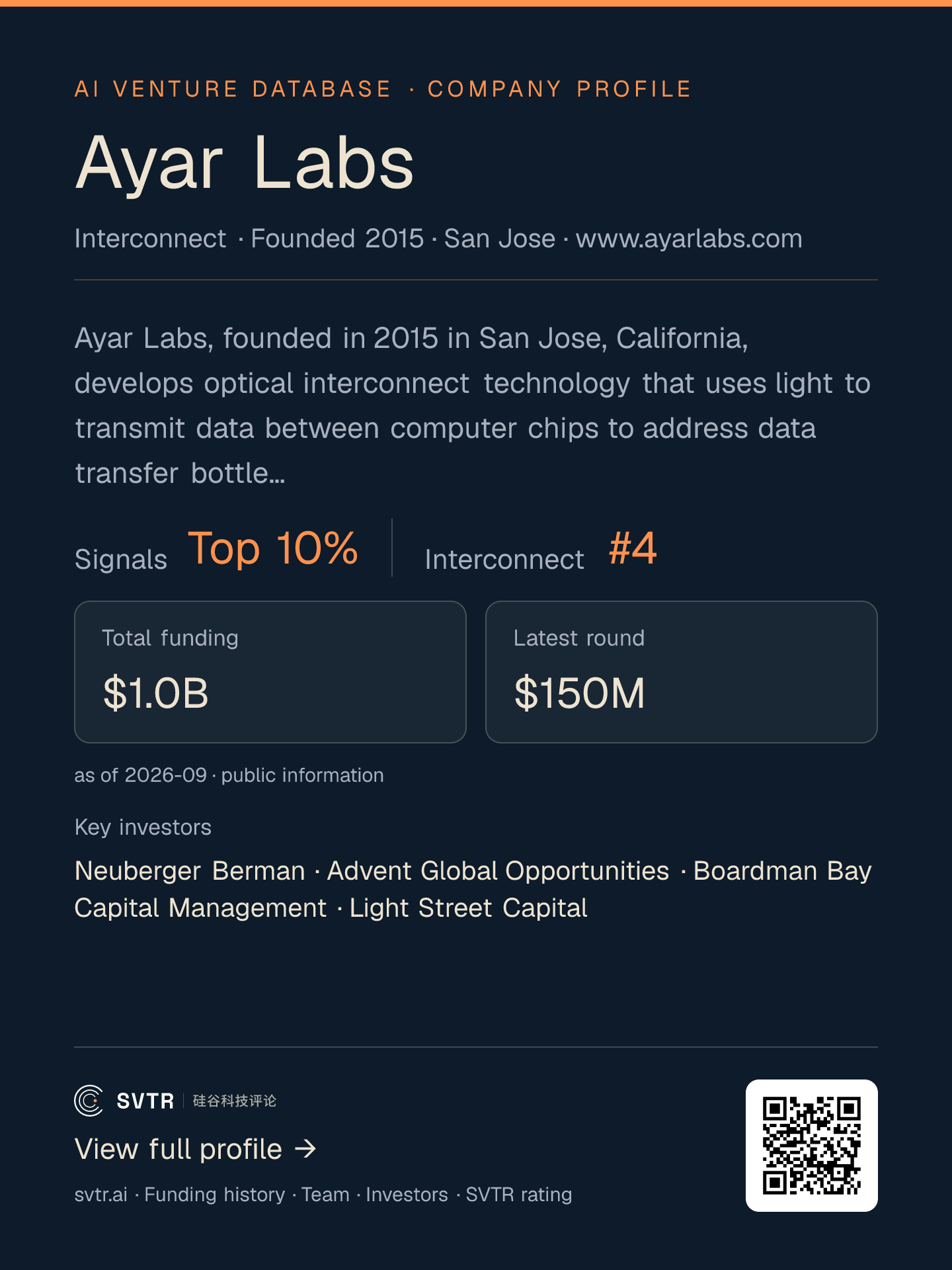
- Ayar Labs has raised about $1.02 billion in total, $650 million of it in two raises during 2026. Its Series E in March valued it at $3.75 billion post-money; the Series D 15 months earlier had valued it at just over $1 billion
- The database tracks 61 companies in the interconnect sector; Ayar Labs ranks first by total funding
- Across the whole database, only 3 companies count NVIDIA, AMD and Intel all as investors. Ayar Labs is the only one of them working at the chip level
On February 2, 2026, Marvell closed its acquisition of optical interconnect company Celestial AI, with upfront consideration of about $3.25 billion at signing. A month later, on March 3, Ayar Labs, working on the same problem, announced a $500 million Series E at a $3.75 billion post-money valuation, with AMD and NVIDIA among the investors.
Both companies do the same thing: replace copper with light to connect AI chips. When it came time to pick a side, they answered in opposite ways. Celestial AI sold itself to a chip company. Ayar Labs made several competing chip companies shareholders at once.
Our view: Ayar Labs' $3.75 billion valuation mainly pays for its neutral position. NVIDIA, AMD and Intel have all invested, on the condition that none of them owns it. Turning that position into revenue requires one of the majors to put its optical chips into production racks. Until then, the shareholder list shows that nobody wants to miss out. It does not show that anyone has placed an order.
Team: it started with a processor that talks in light
In December 2015, Nature published a paper describing a 3-by-6-millimeter chip carrying two processor cores, more than 70 million transistors and 850 photonic components, communicating with other chips directly through light. The work was funded by DARPA, the US Defense Advanced Research Projects Agency, with a team from UC Berkeley, MIT and the University of Colorado Boulder. The co-lead authors were Chen Sun and Mark Wade.
The key point in the paper is not a performance figure. According to Berkeley's announcement, the chip was made in a foundry that mass-produces high-performance chips, with no changes to the process. Optical components could be built on existing chip lines. Everything Ayar Labs does starts there.
The company was founded the same year. Its co-founders include Mark Wade, Chen Sun, Berkeley professor Vladimir Stojanović, and founding CEO Alex Wright-Gladstein, an MIT Sloan MBA. In November 2018, former Intel vice president Charles Wuischpard took over as CEO. In December 2023, Mark Wade moved from CTO to CEO and Stojanović became CTO. The technical founders took back the helm just as the product was moving from samples to volume production.
Wuischpard's next stop was NVIDIA: in January 2024 he became NVIDIA's vice president of sales for North America and Latin America. Beyond equity, NVIDIA and Ayar Labs are now also linked through people.

Business: bringing fiber right up to the GPU package
AI training links thousands of GPUs into one "big machine". Inside the rack, that still mostly runs over copper. The higher the data rate, the shorter the distance copper can carry a signal and the more power it burns. Light travels farther with less loss, but conventional optical modules plug into the front panel of a switch, with a stretch of electrical circuitry still between them and the compute chip.
Ayar Labs' approach is co-packaged optics (CPO): packaging the optical transceiver together with the compute chip. It has two products:
- TeraPHY optical chiplet: sits next to a GPU or CPU. According to the company, it delivers 8 Tbps of bidirectional bandwidth with 10 nanoseconds of latency per chiplet, and uses UCIe, the industry standard for chiplet interconnect
- SuperNova light source: the laser sits outside the chip and supplies light separately, with 16 wavelengths from one source
Moving the laser off the chip is the key design choice. Lasers are sensitive to heat and fail more easily next to a hot GPU. Supplying light from outside makes them more reliable and easier to service.
The moat is compatibility. In March 2025 the company launched what it called the industry's first UCIe optical chiplet. In June 2026 it joined NVIDIA's NVLink Fusion ecosystem (NVIDIA's program that lets outside chips connect to its high-speed interconnect), and says its products are now optically and electrically compatible with NVIDIA's technology. Any company's chips can connect. That is what "neutral" means at the technical level.
Progress: the money is in, volume customers are not yet named
- December 2024: $155 million Series D, valuation above $1 billion
- March 2026: $500 million Series E led by Neuberger Berman, $3.75 billion post-money; a new office in Hsinchu, Taiwan
- June 2026: joined the NVLink Fusion ecosystem
- September 2026: another $150 million, bringing 2026 funding to $650 million; a new design center in Bengaluru
The gaps are just as clear. Both 2026 funding announcements say the money will go to "scaling high-volume production and test capacity" and mention "customer milestones", but neither names a single volume customer or gives shipment numbers. The only shipment figure available comes from Contrary Research: about 15,000 units shipped cumulatively by December 2024. The company has not confirmed that number in its announcements.
Business model: the shareholder list is the customer list
Ayar Labs sells chiplets and light sources to companies that build GPUs, custom AI chips and servers. The strategic investors in its two 2026 raises cover almost the entire customer chain:
- Chip companies: NVIDIA, AMD, Intel
- Custom chip design: MediaTek, Alchip (a design-services firm that builds custom AI chips for cloud providers)
- Server manufacturing: Wiwynn (a contract manufacturer of cloud servers)
The three chip companies came in at different times: Intel Capital was already in the 2018 Series A, NVIDIA joined in the 2022 Series C, and AMD in the 2024 Series D. Each new one made the "neutral" claim more credible.
The choice of Hsinchu for a new office points the same way: most of its potential customers and manufacturing partners are in Taiwan.
Long-term revenue tracks how many optical chiplets go alongside each AI chip. The key assumption is that GPU-to-GPU links inside the rack switch from copper to light around 2027 to 2028. If that slips, the $3.75 billion valuation will have to be carried by a longer stretch of cash burn.
Competition: the majors either build it or buy it
Table 1 | Key players in optical interconnect (as of October 14, 2026)
| Player | Approach | Latest status |
|---|---|---|
| Ayar Labs | Optical chiplet plus external light source, sold to every chipmaker | Series E valuation $3.75B (2026-03) |
| Celestial AI | Optical interconnect platform | Acquired by Marvell in 2026-02, about $3.25B upfront |
| Lightmatter | Optical interconnect plus photonic computing | Valued at $4.4B after Series D (2024-10) |
| NVIDIA | In-house silicon photonics switches | Launched Spectrum-X / Quantum-X Photonics switches in 2025-03 |
| AMD | Acquired a silicon photonics team | Acquired Enosemi in 2025-05 |
Celestial AI's price shows that chip majors are willing to pay more than $3 billion to bring optical interconnect in-house. That cuts both ways for Ayar Labs: there is now a reference price for an exit, and there is one fewer neutral peer, since Marvell's customers now have an in-house option.
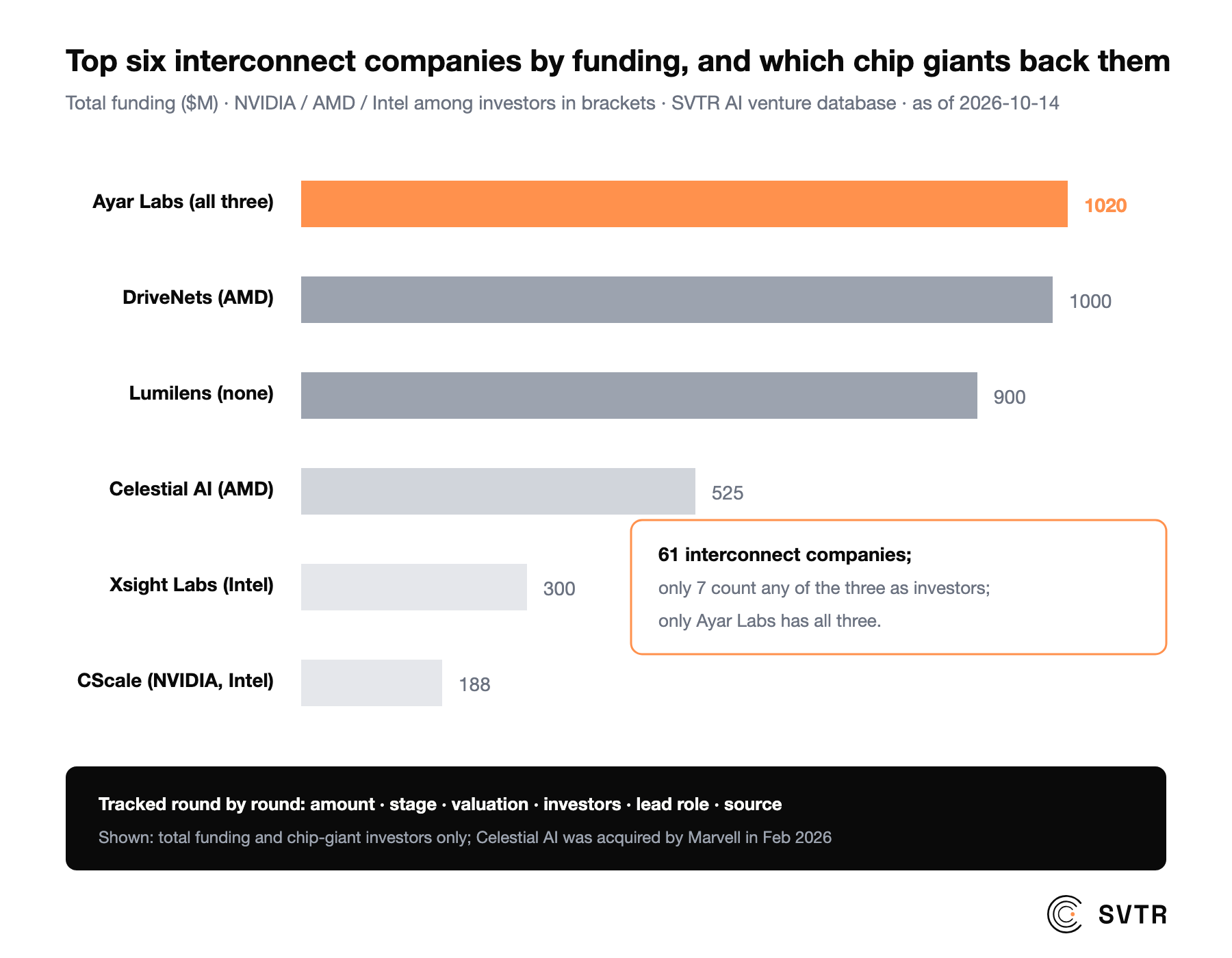
Of 61 interconnect companies, only 7 count any of NVIDIA, AMD or Intel among their investors, and only Ayar Labs has all three. Across the whole database, the other two companies backed by all three are open-source model platform Hugging Face and Hark, the new AI hardware company from Figure founder Brett Adcock.
Hugging Face is a useful comparison. The three chip companies all invested in it in 2023 because a model platform sits where every chip has to be supported. They invested to make sure their own chips were supported, not expecting it to make them much money. Ayar Labs' shareholder base follows the same logic: the chip majors are buying an option that says "this technology will not shut me out". The option's value lies in not being excluded. It is not a purchase commitment. Whether the valuation holds depends on whether anyone actually exercises it.
Risks: neutrality is most exposed when the majors close the gap themselves
- In-house substitution: NVIDIA already has its own silicon photonics switches, AMD bought Enosemi, and Marvell bought Celestial AI. Once the majors close the gap, outside suppliers risk being pushed into a backup role
- Manufacturing and testing: fiber has to be aligned to the chip with micrometer precision, test automation is limited, and volume yields will set costs. The company has published no data on this
- Valuation ahead of revenue: a $3.75 billion valuation, with no revenue ever disclosed
- Customers who are also shareholders: if any one of the majors moves to an in-house solution, it hits both revenue expectations and the pricing of the next round
Conclusion: what neutrality is worth depends on who orders first
Having NVIDIA, AMD and Intel as shareholders at the same time shows that Ayar Labs holds a position none of them wants to give up. Our view stands: the $3.75 billion pays for that neutrality, and it pays off only when one of the majors puts TeraPHY into production racks.
One variable to watch: by the end of 2027, will a chip company or server maker publicly announce a volume product that ships with Ayar Labs' optical chiplets? If yes, neutrality starts turning into revenue. If not, the next round's valuation will be renegotiated.
More in the SVTR AI Venture Database
The Ayar Labs profile tracks all 7 funding rounds since the 2018 Series A, each with its official source, so you can see at a glance in which round NVIDIA, AMD and Intel each came in.
If you are on the company's team, you are welcome to claim the profile. If you spot anything wrong or missing, let us know and help us keep this record complete.