

The fund Eric Schmidt co-founded mostly backs application software. The AI companies he backs in his own name mostly train their own models. Anthropic was the first bet of this kind, and the one that is paying off the most.
On October 19, Bloomberg reported, citing people familiar with the matter, that former Google CEO Eric Schmidt owns around 1% of Anthropic, from tens of millions of dollars he put into its 2021 Series A. PitchBook data put Anthropic's valuation in that round at $461 million; if the company is worth $2 trillion when it lists next month, the stake will be up more than 4,300 times. Schmidt and Anthropic declined to comment, and it is unclear whether he has sold any of it since.
A 4,300x return is easy to read as luck. We laid out every equity deal in the SVTR AI venture database where Schmidt appears by name, and a different picture emerges: from 2021 to today, 21 rounds in 20 companies, 13 of which the database classifies as model-layer, meaning they train their own models. Over the same period, Innovation Endeavors, the fund he co-founded, has backed almost nothing but application software.
Table 1 | Eric Schmidt investment profile (as of 2026-10-20)
| Item | Detail |
|---|---|
| Background | Google CEO (2001–2011), then executive chairman |
| Equity deals in his own name | 21 rounds · 20 companies, 13 building models |
| Fund he co-founded | Innovation Endeavors (2010) |
| Family office | Hillspire (founded with his wife Wendy) |
| Largest paper gain | Anthropic Series A, ~1% stake (per Bloomberg) |
Data: SVTR AI venture database, as of 2026-10-20; Anthropic stake per Bloomberg's 2026-10-19 report citing people familiar with the matter.
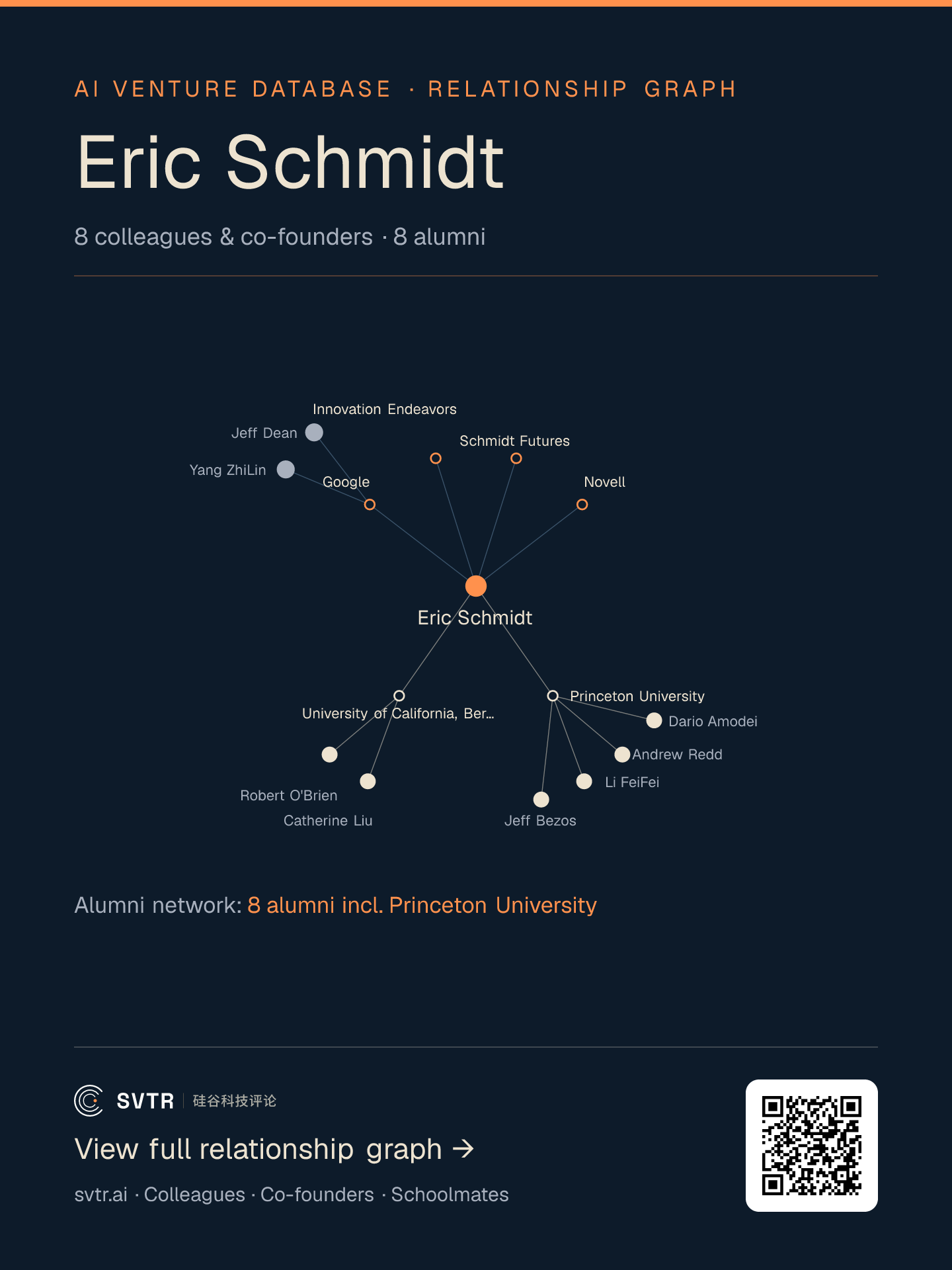
On the 2021 list, he was the only former Big Tech chief
Anthropic announced its $124 million Series A on May 28, 2021. The press release named just five backers: lead investor Jaan Tallinn, a Skype co-founder; Facebook co-founder Dustin Moskovitz; investor James McClave; the Center for Emerging Risk Research, a Basel-based group that studies catastrophic risks; and Eric Schmidt.
It was a list held together by concern about AI safety, with no venture fund on it. Schmidt was the only one who had run a trillion-dollar tech company. Two years later, in Anthropic's May 2023 Series C, Google appeared on the list.
Anthropic had only just been founded, had no product, and its team came mostly from OpenAI. Backing that round meant backing a group of people who knew how to train models.
Of 20 companies, 13 train their own models
Line up the equity deals in Schmidt's own name and model companies make up the majority.
Table 2 | Model companies Eric Schmidt backed personally (2021–2026)
| Company | What it does | Date and round | Round size |
|---|---|---|---|
| Anthropic | Claude models | 2021-05 Series A | $124M |
| Inflection AI | Models behind the Pi assistant | 2023-06 | $1.3B |
| Imbue | Models for autonomous agents | 2023-10 Series B | $12M |
| H | Agent models that operate software interfaces | 2024-05 seed | $220M |
| Stability AI | Image generation models | 2024-06; 2026-08 Series B | $80M; $76M |
| World Labs | Fei-Fei Li's 3D world models | 2024-09 | $230M |
| Vercept | Agents that read the screen and operate a computer | 2025-01 seed | $16M |
| Genesis AI | Robotics foundation models | 2025-07 seed | $105M |
| Reflection AI | Open-weight frontier models | 2025-10 | $2B |
| Gradium | Real-time voice models | 2025-12 seed | $70M |
| Goodfire | Research lab that interprets and edits model internals | 2026-02 Series B | $150M |
| AMI Labs | Yann LeCun's world models | 2026-03 seed | $1.03B |
| General Intuition | Agent models trained on game data | 2026-06 Series A | $320M |
Data: SVTR AI venture database, as of 2026-10-20. Counts only equity rounds that name Schmidt himself as an investor; money through his family office, funds or foundations is excluded. Amounts are total round sizes; Schmidt's own checks were not disclosed.
Some of the other 7 companies also train models but are filed under the application layer by their main business: Magic builds long-context models for coding, and Periodic Labs uses AI and robotic labs to find new materials. We count by the database's classification, so 13 is a conservative number.
Two more checks are not in the table but point the same way: Kyutai, a nonprofit lab in Paris, and LawZero, the AI safety research group Yoshua Bengio founded in Montreal. That money came from Schmidt Futures and Schmidt Sciences respectively, philanthropic organizations under Schmidt's name, as donations.
The comparison group is Innovation Endeavors. Schmidt co-founded it in 2010 with Dror Berman and others, and it was an early backer of Uber and SoFi. Since 2023, the database has tracked it into 27 AI companies; only 4 are model-layer, and the other 23 are filed under applications. Over the same period, 12 of the 19 companies Schmidt backed in his own name are model-layer.
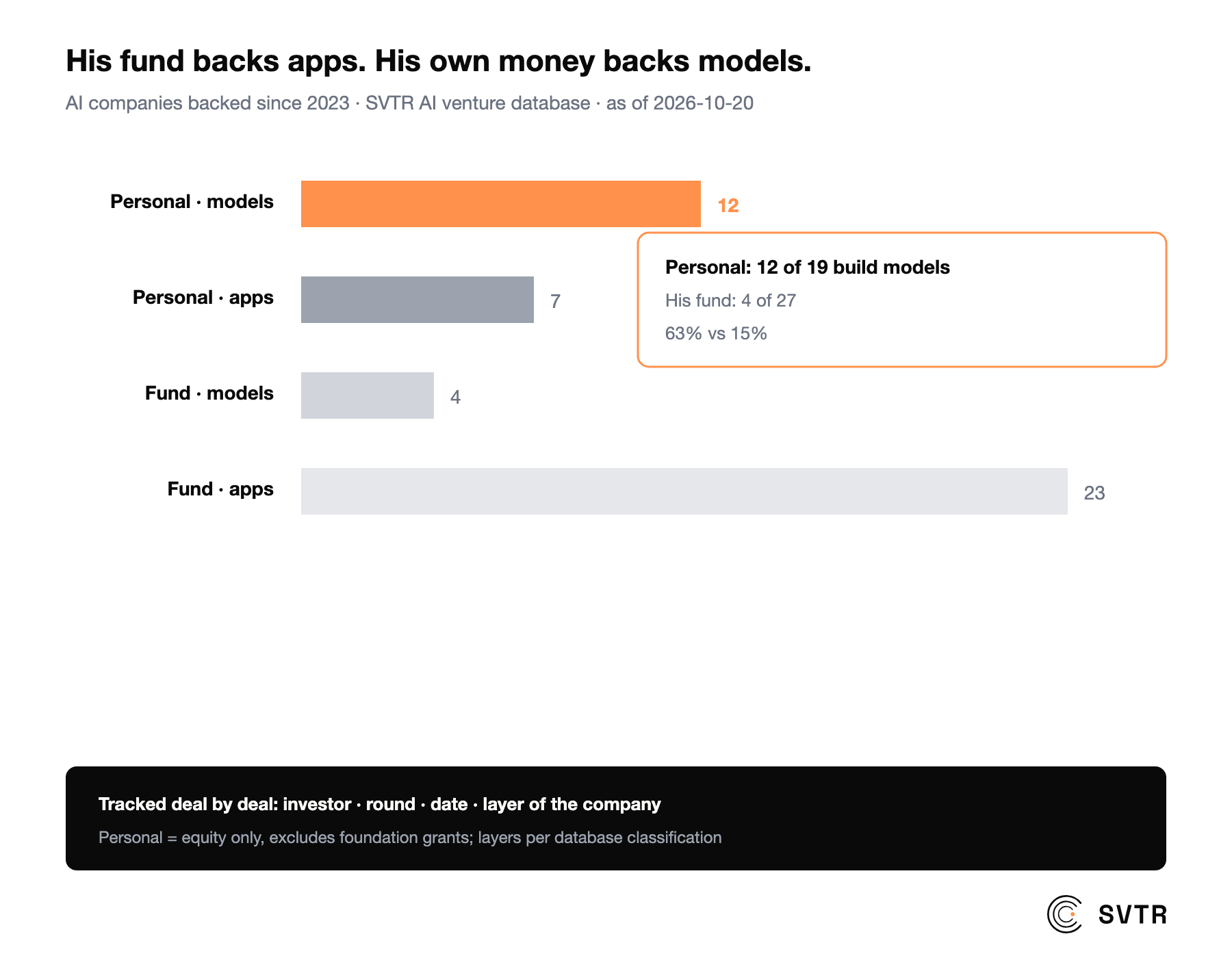
The fund backs applications; he backs models. The split is clear.
"I essentially invest in everything because I can't figure out who's going to win"
The line comes from a Stanford classroom conversation that surfaced in August 2024; the school took the video down soon after, over a separate remark he made about remote work at Google. In the same talk, he said that six months earlier he had thought the gap between frontier models and everyone else was narrowing, which is why he backed a number of smaller companies; now he suspected the gap was widening.
That does not contradict Table 2. "Everything," for him, means spreading bets within the model layer: large language models, world models, robotics models, voice models, one check per approach, without betting on which approach wins. He does not spread into applications. Those he leaves to the fund.
Anyone betting on model companies has to answer one question: as frontier models get more expensive, how do small labs survive? Schmidt's answer is not to answer. He puts a check on every approach and lets one bet like Anthropic cover the losses on the rest. That strategy suits an individual better than a fund. A fund has to report returns to its investors vintage by vintage; an individual does not.
A line that grew out of Paris
Of the 20 companies, 3 are in Paris: H, Gradium and AMI Labs. Add Kyutai, which Schmidt Futures co-founded, and the Series D of Mistral AI that his family office Hillspire joined in September, and France is where his bets outside the US are most concentrated.
It started on November 17, 2023. At Station F in Paris, telecom entrepreneur Xavier Niel, CMA CGM chief Rodolphe Saadé and Schmidt launched Kyutai with a budget of about €300 million, €100 million each from Niel and Saadé. Schmidt said at the event: "It's obvious that France should be a leader in this domain. These people have got the tech right … For that you need lots of smart people, and a lot of hardware, which somehow Xavier has managed to arrange."
Two years later, that donation produced a company. In December 2025, Kyutai's founding researchers left to start Gradium, which builds real-time voice models. Its $70 million seed round was led by FirstMark and Eurazeo, and Schmidt, Niel and Saadé were all on the list. The three parties behind Kyutai came back as shareholders.
Betting on model companies also means being bought out by Big Tech
Not every bet is Anthropic.
In June 2023, Inflection AI raised $1.3 billion at a $4 billion valuation, with Schmidt alongside Microsoft, Nvidia, Reid Hoffman and Bill Gates. Nine months later, Microsoft hired CEO Mustafa Suleyman and most of the staff and paid Inflection about $650 million, $620 million of it for a license to its models. According to Bloomberg, Inflection used that money plus cash on hand to pay investors back $1.10 or $1.50 for every dollar invested.
Investors got their money back; the company was gone. It is exactly the situation Schmidt described at Stanford: frontier models keep getting more expensive, and big companies can simply buy a small lab's team.
In a case this February, the buyer was Anthropic itself. Schmidt joined the seed round of Vercept, a Seattle company building agents that read the screen and operate a computer, in January 2025. On February 25, 2026, Anthropic announced it was acquiring the company; three co-founders joined Anthropic, the product shut down a month later, and terms were not disclosed.
Betting on the model layer, the wins look like Anthropic and the losses look like Inflection; sometimes the company that buys out one of his bets is his most profitable one.
We agree with Bloomberg that Anthropic will be Schmidt's largest personal return. What we add is where that return came from, and where the money is going. Three of the model companies he has backed since 2025 raised rounds above $300 million: $2 billion for Reflection AI, $1.03 billion for AMI Labs, $320 million for General Intuition. Our view is that the cash Anthropic's IPO unlocks will most likely flow back into this layer.
He is still backing the next batch
Anthropic could start marketing its IPO as soon as the week of November 9. For Schmidt, it is the payoff on that five-name list from 2021.
The second half of Table 2 is more telling. Since 2025, apart from a follow-on in Stability AI, he has backed 7 new model companies in his own name: Vercept, Genesis AI, Reflection AI, Gradium, Goodfire, AMI Labs and General Intuition. Vercept has already been absorbed by Anthropic; the other 6 are still independent. Sarah Guo, whom we profiled earlier, is betting the other way: that OpenAI and Anthropic cannot do every business and that independent companies will survive in the application layer. In a few years, the two bets will have an answer.
One variable to check: by the end of 2028, how many of those 6 companies will reach a frontier-lab valuation like Anthropic, and how many will see their teams bought out wholesale by a large company, like Inflection and Vercept?
Extended profile | SVTR AI venture database
The Eric Schmidt profile tracks the rounds he joined in his own name, each with its source; you can see at a glance in which rounds of Anthropic, Reflection AI and World Labs his name appears. Deals by Innovation Endeavors and Hillspire are on their own profile pages.
If you are on one of these teams, you are welcome to claim the profile; if you spot an error or omission, please let us know so we can keep improving this industry record together.