

Subtitle: The investor closest to the AI frontier is betting that OpenAI and Anthropic cannot build everything.
Key data (as of July 2026, per Colossus reporting)
| Fund size | Three funds totaling nearly $1B (first fund $100M) |
|---|---|
| Track record | 6 of the 21 AI-native companies valued above $10B |
| Notable bets | Baseten ($13B), Harvey ($11B), OpenEvidence ($12B) |
| The other side | Of $300B in Q1 2026 venture capital, 65% went to Anthropic / OpenAI / xAI / Waymo |
Source: Colossus, "Sarah's Wager" (2026-07) | svtr.ai
Editor's Note: Conviction founder Sarah Guo sits about as close to the AI frontier as any investor, yet argues against it in public: she is betting that OpenAI and Anthropic cannot build everything, and that the application and inference layers still leave room for independent companies. SVTR's interest is not the legend but whether the wager holds at the level of capital, and whether it is the same question in the US and China.
1. The pull-up bar on York Street
In San Francisco's Mission District, on York Street, an office dressed up as a gym has a chalked pull-up bar standing in the middle of the room. When someone hangs from it, the team blasts "Eye of the Tiger" and starts a timer. A black flag on the wall reads: "We do this not because it is easy, but because we thought it would be easy." This is the office of Conviction: eight people, four of them investors, twenty desks, the extras loaned to founders. The rule is about leaving: "If you hire eight people, or raise more than $20 million, it's time to move out."
Her name is Sarah Guo, 37, a little over five feet tall. Before she left Greylock, a firm founded in 1965, in 2022, she was the youngest general partner (GP) in its history. She walked out with a single premise: that artificial intelligence would be as big as the Industrial Revolution. She named the new fund Conviction.
Her wager is a claim that would have sounded absurd two years ago: in the shadow of the self-improving model, is there any company left to build or to back? Per Colossus's July 2026 reporting, OpenAI and Anthropic are no longer content to sell the model; they mean to build the tools, the agents, and the apps on top of it as well, filling every crevice where a new company might otherwise grow. The market is pricing in that they might succeed: of the record $300 billion of venture capital deployed in Q1 2026, 65 cents of every dollar went to four companies that already exist.
Guo is betting the other way. She is betting the labs cannot build everything: someone still has to wedge the agents into the law firm, the clinic, the support queue, the accounting close. This is the judgment this piece sets out, and SVTR repeats it at the end: the tell in this wager is not how visionary she is, but the day the first of her companies rings the IPO bell.
2. The company that started with fifty dollars
Guo grew up inside a company. Her father, Jerry Guo, came to the United States from Hunan in 1987 with $50 in his pocket and a transcript from Tsinghua, having scored first on the gaokao. Bell Labs hired both him and her mother, also an engineer. He could have stayed for life; instead, as the dot-com boom broke, he moved through startups and in 2003 founded his own broadband-equipment company, Casa Systems.
At 14 she built Casa's first website, did her homework in an office cubicle, and stayed overnight for bug bashes; at 19 she was pitching the company to investors. A lawsuit filed by a large incumbent, later shown to have no real legal basis, ran up legal fees that year exceeding the company's entire revenue. From this she absorbed what she would later call the central fact of building a company: it can die at any moment, the work is a small band of pirates against Goliath, and the only edge is speed, product, and the focus of always being at war. "The existential fear that people are trying to kill our companies is part of how we do venture," she says. "It's us against the world."
In 2017 Casa went public at a market cap above $1.2 billion. The man who had arrived with $50 had taken his company public. But public markets want other things: the stock peaked in 2018 and slid, and in 2024 Casa filed for bankruptcy. She had expected it to crush her parents. It didn't. "I find that very reassuring," she says. This upbringing is not backdrop; it explains the grain of two later choices: why she built the fund as an eight-person band, and why she believes companies hunted by giants still have a path.
3. Not crypto, but a general technology
One version has it that what she really wanted was a crypto fund, and the AI thesis was retrofit. The evidence is not nothing: in early 2022 her Twitter avatar became a zombie-style CryptoPunk, and she had co-hosted a crypto podcast with Greylock colleagues. But she says she was never going to do a crypto fund. At Greylock she had gone as deep in crypto as in AI, the two most interesting ideas in technology in a decade; she chose AI because "crypto is fundamentally a financial technology, however profound it has a boundary; AI is a general technology, it starts tiny and then, all at once, is everywhere."
When she left Greylock, her pitch to LPs was not pretty. Her husband, Pat Grady (a partner at Sequoia), recalls LPs asking again and again, "What's your strategy? How will you win?" Her answer was Patton's line, "A good plan violently executed now is better than a perfect plan next week," which translated to: "I don't have a strategy, I'm just going to go win." To an LP that is not a good pitch, but there are only so many people who can simply go execute, and she is one of them.
Conviction's first fund was $100 million. She did not get into OpenAI or Anthropic: the fund was too small, they were too big, and by the spring of 2023 it was too late. She came to see standing on the outside as an advantage: an investor holding an enormous position in one lab starts reading the whole ecosystem through it, and in a bubble the danger compounds, because people who make money begin to mistake their returns for intelligence. "It's a fine line," she says, "between conviction and being dishonest with yourself."
4. She is betting where the labs can't finish
Conviction's first check went to Harvey, AI for lawyers. No one thought legal AI was interesting, "zero," co-founder Weinberg recalls. But four years on Harvey is valued at $11 billion, with more than 100,000 lawyers working on it. What it sells law firms, beneath the software, is trust, and trust is delivered by people: the company built to do the work of lawyers has hired 200 lawyers of its own. Guo says this is a common finding across Conviction's portfolio: the better the models get, the bigger the work of helping a human extract value from them.
Her best-known bet is Baseten, an inference company she backed in 2019, three years before ChatGPT. Any company built on OpenAI or Anthropic has its prices, performance, and next-month roadmap held by the labs, the water everyone is tired of drinking. Baseten lets companies run their own models, including open-source models out of China and Europe that perform within striking distance of the frontier at a fraction of the cost. This year, as the labs raised token prices as much as a hundredfold, Baseten's inference volume grew 40-fold in a year and its valuation reached $13 billion.
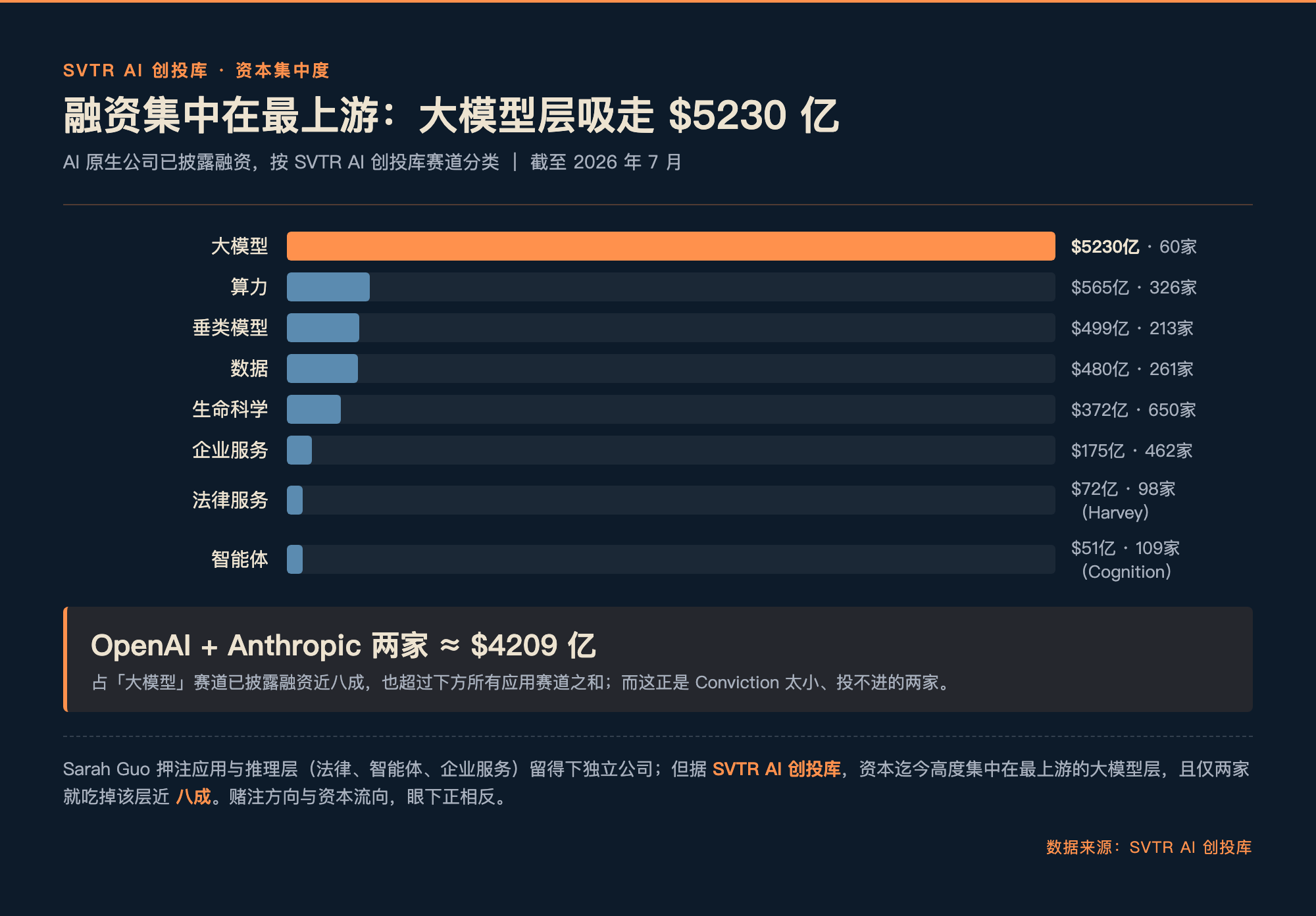
SVTR's take: Guo's wager points in the right direction; the timing may not be on her side. Per SVTR's AI venture database (as of July 2026), the 60 companies classified as "foundation models" have raised roughly $523 billion in disclosed funding, of which OpenAI ($296.5B) and Anthropic ($124.4B) alone account for nearly 80%, more than the combined funding of a dozen application sectors such as legal, agents, and enterprise software. And those two are precisely the ones her fund was too small to get into. She is betting the application and inference layers leave room for independent companies; capital, so far, is voting with its feet for the upstream taking all. For an early-stage fund, what decides the outcome is which layer produces a listable flagship first.
Switch to China, and the answer differs. RMB funds are also betting on the application layer, but the upstream model companies are largely propped up by internet giants' strategic capital and state-backed AI industry funds, so the seat of "independent inference supplier" is thinner; application-layer companies must at once consume the giants' models and guard against the giants building over them, with less room to maneuver than in Silicon Valley. The same wager faces two different forms of industrial organization in the two markets.
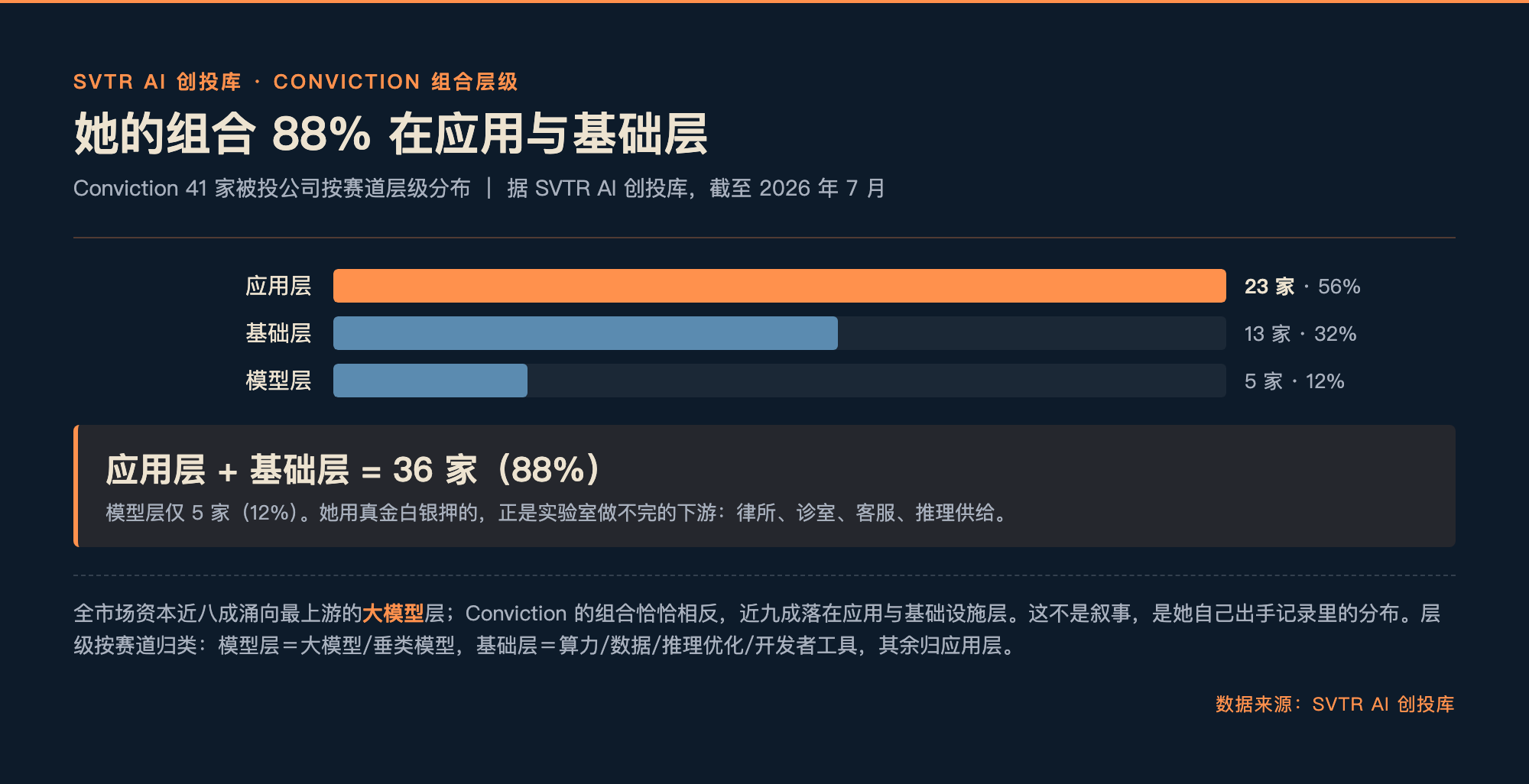
This is not just a stated preference. Per SVTR's AI venture database, of Conviction's 41 portfolio companies, 88% sit in the application and infrastructure layers and only 5 are in the model layer; and they skew early, with 15 of 41 rounds at seed, plus Series A and Pre-Seed making 24 early-stage rounds in all. Her own deal record is the footnote to the wager.
5. How eight people outwork Sequoia
Conviction is only eight people, winning deals by outworking everyone. There is a story people tell again and again: one Saturday, Guo and Grady drove two hours to wine country, and she was on the phone the whole way, one call after another, wrote a memo late into the night, held a call with her partners the next morning, and a week later had won the deal against Sequoia, a16z, and Benchmark. Her own explanation is blunt: "If you're just talking to me the whole weekend, you can't talk to anybody else. It's like filibustering."
Twice a year, Conviction runs a program called Embed: from over a thousand applications it selects around a dozen of the youngest teams, writes each a $250,000 check, and treats them as portfolio companies for ten weeks. The motive is simple: she wants to know what's happening at the technical frontier all the time, and the surest way is to meet the youngest companies pushing at the edge. Her number two is Mike Vernal, a former Facebook executive and former Sequoia partner, who says he is "a much better number two; I don't want to be the main person; my motivation is to make Sarah and Conviction as successful as possible."
6. The tell is the day the bell rings
The labs keep pulling people and companies out of Conviction's world. During the reporting window, Andrej Karpathy, who had written code for 20 years and is called "the programmer other programmers study," joined Anthropic. Yet Guo's side of the world keeps growing: between two visits, five portfolio companies raised again.
Back to the judgment. It was not the labs that built Harvey, Sierra, or OpenEvidence; someone still had to wedge the agents into a specific industry. Whether this wager wins is read not in the narrative but in the first company to ring the bell: that day is both proof she won the bet and the day these companies pass out of her hands to investors who never met her founders. "As the daughter of an entrepreneur who took a company public, I loathe the idea," she says. "And yet we will do it."
A verifiable variable sits here: over the next 12 to 24 months, at what valuation and on what market will the first AI company out of the application or inference layer ring the bell? If it keeps not happening while the upstream keeps absorbing capital, then the claim that "the labs cannot build everything" has not yet held, at least at the level of capital. Her father's company took 20 years to go from $50 to a public listing and on to bankruptcy; Guo is betting that among the companies she has backed, someone can travel that road further.
Appendix: sources and methodology
- Primary source: Colossus, "Sarah's Wager" (Dom Cooke, July 2026). Human detail, direct quotes, and company valuations (e.g., Harvey $11B, Baseten $13B) are from that report.
- SVTR's proprietary layer: (1) upstream capital concentration (60 model-layer companies at $523B combined, OpenAI + Anthropic ~80%); (2) Conviction's portfolio by layer (of 41 companies, application 23 / infrastructure 13 / model 5, 88% in application + infrastructure) and by stage (seed 15 + Pre-Seed 1 + Series A 8 = 24 early-stage rounds) — all aggregated deal-by-deal from SVTR's AI venture database (as of July 2026) via
round_participants→funding_rounds→organizations, using Conviction's own deal record to corroborate the core judgment; no external report carries this cut. The timing judgment and the US–China comparison of industrial organization are SVTR's independent analysis, not in the original report. - Data note: the database's
total_funding_usdis cumulative disclosed funding, a different measure from the valuations Colossus cites; the two coexist without conflict. - Unused cut: the
hq_city_rawfield is empty for all 41 Conviction portfolio companies, so no geographic / US–China distribution claim is made — better to leave it out than to fabricate.