

SVTR Editor's Note:
On October 26, Anthropic publicly filed its IPO registration statement with the US Securities and Exchange Commission (SEC). In 2021 it pitched 22 venture firms and 21 said no, a story usually told as "a few people saw the future." The prospectus discloses the share price of every round for the first time, so we can check them one by one: who placed a bet at which stage and at what price, and who held on to the end. Written for early-stage funds and angels looking at frontier research companies.
Anthropic's S-1 prospectus contains a table of preferred stock: Series A in May 2021 at $2.57 a share; Series B in April 2022 at $11.23; Series C in spring 2023, still $11.23; Series H this May and June at $589.01.
Our view: the round most worth looking back at in Anthropic's early financing is the 2023 Series C, not the 21 rejections of 2021. The Series C was issued from March to June, Claude opened to the public in the middle of it, and yet the price stayed where Sam Bankman-Fried (SBF) had led the Series B a year earlier. Both bought in at $11.23. Spark Capital held all the way to the IPO filing and added in every round; FTX's shares were sold off in bankruptcy.
The same price does not mean the price was wrong at the time. Series B shares carry no vote while Series C shares do, and the Series C terms may have been agreed before Claude launched. But within a single year that one price met both a product launch and the collapse of the previous lead investor, and the two checks ended very far apart.
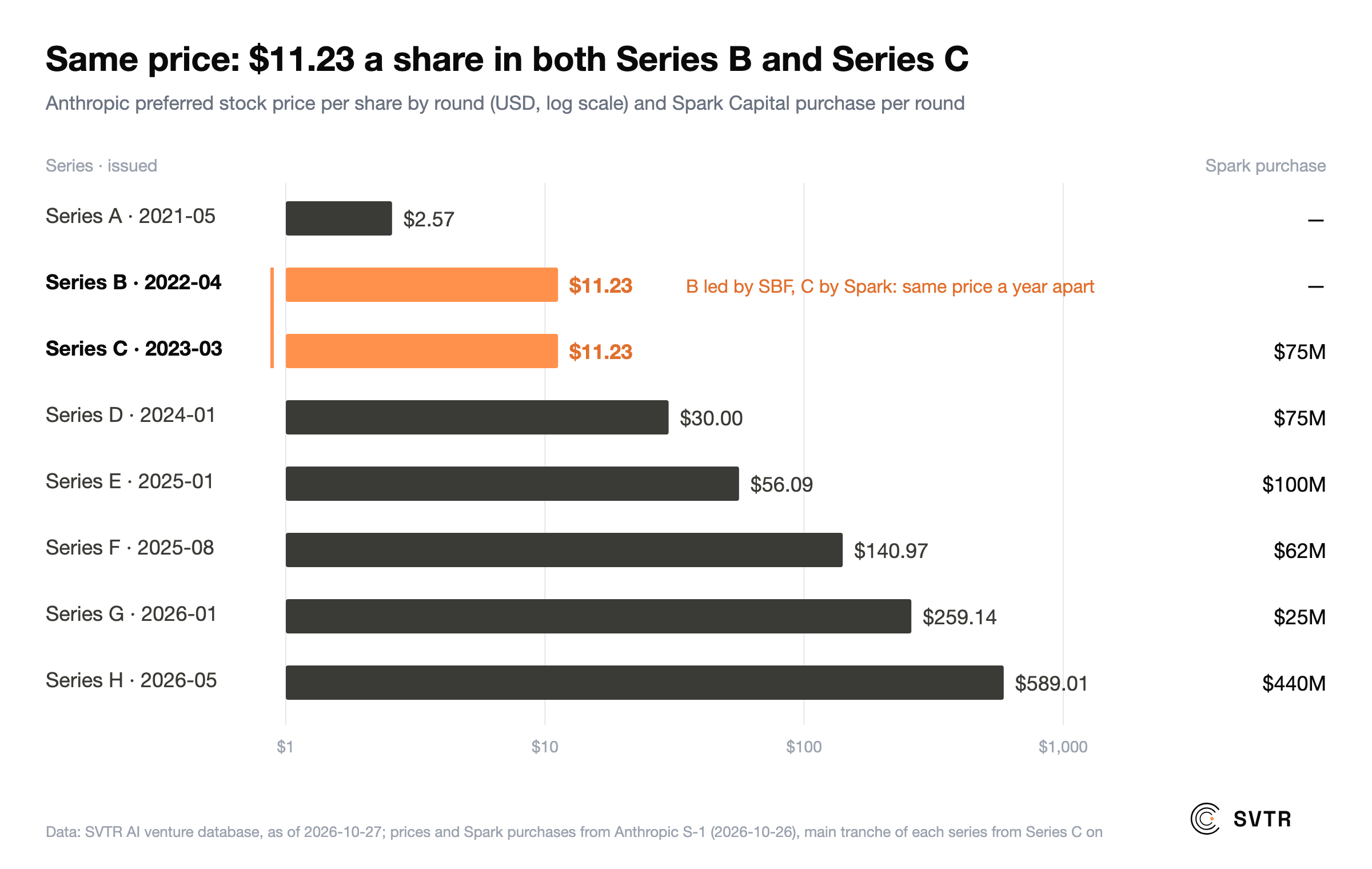
Table 1 | Anthropic preferred stock prices by round and Spark Capital purchases (2021–2026)
| Series (issued) | Price per share (USD) | Multiple to Series H | Spark purchase (USD m) |
|---|---|---|---|
| A (2021-05) | 2.57 | 229 | Not disclosed |
| B (2022-04) | 11.23 | 52 | Not disclosed |
| C (2023-03 to 06) | 11.23 | 52 | 75 |
| D (2024-01 to 05) | 30.00 | 20 | 75 |
| E-1 (2025-01 to 03) | 56.09 | 10.5 | 100 |
| F-1 (2025-08 to 09) | 140.97 | 4.2 | 62 |
| G-1 (2026-01 to 02) | 259.14 | 2.3 | 25 |
| H-1 (2026-05 to 06) | 589.01 | 1 | 440 |
Data: SVTR AI venture database, as of 2026-10-27. Prices and Spark purchases are from Anthropic's S-1 filed on October 26, 2026 (original issue price table and related-party transactions section); from Series C onward, the main tranche of each series is used. The multiple is simply the H-1 price over each round's price and is not any investor's actual return. Spark's figures are related-party purchases disclosed in the prospectus and do not represent all of its holdings or exits.
21 rejections: aiming for $500 million, landing at $124 million
Early backer Anjney Midha recalled on the 20VC podcast this April: "I introduced them to 22 friends up and down Sand Hill Road. We got 21 nos." One investor, after reading the materials, asked what GPT-3 was. The people across the table were the ones who had built GPT-3.
The team wanted $500 million and had to settle for around $100 million. The Series A announced in May 2021 came to $124 million, led by Jaan Tallinn with Dustin Moskovitz, Eric Schmidt, James McClave and the Center for Emerging Risk Research. Not one venture firm. We think the 21 rejections had two layers:
- They didn't get it: an investor who had not heard of GPT-3 was not going to believe in scaling laws (bigger models with more compute and data get more capable).
- They couldn't afford it: a team with no product was asking for $500 million, more than most funds can put into a single company.
In the end, the money came from people investing their own.
Tallinn: paying $2.57 for a company he worried about
Tallinn was a founding engineer of Skype and co-founded both the Centre for the Study of Existential Risk at Cambridge and the Future of Life Institute. In April 2023 he told Semafor: "My philosophy has been that I want to displace money that doesn't care."
In the same interview he admitted that plan had failed: none of the labs he had backed came out in support of the call to pause frontier research. "Anthropic is way more safety conscious than any of the labs that I've seen, [but] that doesn't change the fact that they're dealing with dangerous stuff and I'm not sure if they should be."
By Table 1, the price rose 229-fold from Series A to Series H, the highest in the table. That is only a ratio of two prices; how much Tallinn put in and whether he has sold are not public. What is certain: the 229x shows he bet right that AI capability would advance fast. It does not show he bet right on safety.
Razavi's two memos
In early 2023, ChatGPT had just taken the world by storm. Anthropic co-founder Daniela Amodei later told Forbes that at the time "AI was not viewed as this supersexy, exciting thing that you would want to invest in." The same report says most VCs saw Anthropic as an also-ran chasing OpenAI and were afraid of pouring billions into the wrong horse. When Spark partner Yasmin Razavi made the call, she was 37, and Anthropic had no public product and no revenue.
She wrote two long investment memos and argued the case to her fellow partners. "It was a big leap of faith, but this was the team that built GPT-3," she later recalled. Spark put in $75 million to lead the $450 million Series C, valuing Anthropic at about $5 billion. In her words, it was the biggest check the firm had ever written.
The prospectus shows Razavi has been an Anthropic director since March 2023. According to Newcomer, the seat was set to expire once Anthropic reached $1 billion in annual revenue, yet she is still there, the only venture investor on the board. Spark has followed in every round since; its largest check was $440 million in this year's Series H, at the highest price of all. Per the prospectus, Spark subscribed about $777 million across six rounds; its 6.68 million Series C shares alone are worth roughly $3.9 billion at the Series H price.
Same price, two endings
The Series B was announced in April 2022: $580 million, led by SBF. The prospectus shows the entire Series B was non-voting preferred stock. FTX entities put about $500 million into this round.
FTX went bankrupt in November 2022, and the estate sold the stake in two batches in 2024: about two-thirds in March, for $884 million, and the last roughly 15 million shares in June at about $30 a share, exactly the Series D price. Together they brought in about $1.3 billion.
The investment did not lose money: $500 million in, about $1.3 billion back, roughly 2.7 times. At the Series B price that is about 44.5 million shares; held to today, they would be worth roughly $26.2 billion at the Series H price. That is a paper number nobody could have traded at, and the entire gap comes down to when the shares were sold.
SBF and Spark bet at the same price. The difference was whose money lasted to the end. A frontier investment is usually judged on two questions: will the technology work, and is the price too high. FTX adds a third: can the investor itself survive until the payoff.
What $11.23 bought in 2023
Table 2 | Anthropic revenue and compute spending (2023 to H1 2026)
| Period | Revenue (USD m) | Compute and infrastructure (USD m) | Spending as a multiple of revenue |
|---|---|---|---|
| 2023 | 41 | 433 | 10.6 |
| 2024 | 386 | 2,522 | 6.5 |
| 2025 | 4,585 | 7,326 | 1.6 |
| H1 2026 | 16,286 | 8,945 | 0.55 |
Data: SVTR AI venture database, as of 2026-10-27; from the statements of operations in Anthropic's S-1. H1 2026 figures are unaudited. Compute and infrastructure spending covers research, model training, serving customers and internal use, and differs from cost of revenue in the traditional sense.
This table only exists in hindsight. In spring 2023 Spark could not see full-year revenue; it could see Claude newly opened, with partners such as Notion and Quora starting to integrate it. Looking back, Anthropic took in $41 million that year and spent $433 million on compute. Only in the first half of 2026 did revenue first exceed compute spending.
The risk Spark took was specific: the model had proven it worked, but no number yet showed that money spent on compute would turn into revenue. From the second half of 2022, private-market valuations were falling across the board, so a flat round was not cheap in itself; but with Claude already live, the market still put no premium on "the model works," and Spark bought that step at the 2022 price.
After getting it right once, where did they bet next?
The early backers of Anthropic have since gone in different directions. According to the SVTR AI venture database (whose records of individual investors may be incomplete):
- Spark bets one layer below the models: it has 101 verified deals. So far in 2026 it has led or co-led 10 rounds, 7 of them, $3.24 billion in total, in inference software (Baseten, RadixArk), optical interconnect (Lumilens), data center power (TAR, Rune) and quantum computing (Oratomic), about 70% of what it has led this year.
- Schmidt keeps betting on models: the database records 20 AI companies he has backed personally, most of them training their own models; see our Profile from October 20.
- Tallinn turned to funding safety research: in June 2025 he joined Schmidt and others in funding LawZero, the nonprofit safety lab founded by Turing Award winner Yoshua Bengio, with about $30 million at launch. After investing in labs failed to steer their direction, he found another way to spend.
In China: no 21 rejections, and the money came from big tech and the state
Judging by the SVTR AI venture database, China's leading model companies rarely faced the kind of cold shoulder Anthropic did. Big money arrived early, mostly from internet giants, HongShan (formerly Sequoia China) and local state funds:
- Moonshot AI: a $1 billion round in February 2024, the year after its founding, from HongShan, Alibaba, Meituan and others.
- MiniMax: $250 million from Tencent in June 2023, then $600 million from Alibaba and HongShan in March 2024.
- Zhipu AI: Meituan, Alibaba, Tencent and others came in during 2023, and later money came increasingly from state funds in Beijing, Hangzhou and Zhuhai.
The exception is DeepSeek: founder Liang Wenfeng carried it with money from his quant fund High-Flyer until June 2026, when it raised outside capital for the first time.
In China, the years without revenue were carried by a different kind of money: big tech and the state. The price is that strategic investors usually come with demands around cloud, traffic or distribution. The kind of individual capital with no industrial agenda that backed Anthropic first has almost no counterpart in China; at DeepSeek, the founder played that role himself.
Where this view could be wrong
- A multiple is not a return: the IPO price is not set, and preferred conversion, lock-ups and the post-listing share price will all change realized gains.
- Survivorship bias: also in 2023, Inflection AI raised $1.3 billion in June, nearly three times Anthropic's Series C, from investors including Microsoft, Nvidia and Eric Schmidt. In March 2024 Microsoft hired away its two co-founders and most of its staff; according to Bloomberg and others, investors got back 1.1 to 1.5 times their money and kept their shares in the remaining company.
- The 21 rejections of 2021 were not necessarily mistakes: on what could be seen then, putting $500 million on a research team with no product was more risk than most funds can bear.
The next mispricing window: risk has fallen, price has not caught up
Today's leading model companies do not lack money, and 21 rejections are unlikely to happen again. The window worth watching is the 2023 kind: key technical risk is falling, commercial evidence is building, and the price still sits where the last round left it. We will be watching fields such as AI for science and embodied AI, where the technology works before the business does, for companies that launch a product yet raise again at the last round's price.
For early-stage funds, the table leaves two questions. When a research company's key risks have fallen but its revenue cannot yet support the valuation, would you pay the same price as a year ago? And if so, can your fund keep following for the next five rounds, and last until it goes public?
Keep exploring on SVTR
Deal Showcase is open to SVTR members who have completed investor verification, with full team details, funding needs and materials for the early-stage companies we have screened, plus introductions through SVTR. If you are building a research-driven AI company, you are welcome to submit your project.
About the data: The Anthropic profile tracks its rounds and investors since the 2021 Series A, and the Spark Capital profile tracks its 101 verified deals; Jaan Tallinn, Anjney Midha, Yasmin Razavi and others named here also have profiles in the SVTR AI venture database. If you are on the team of a company or fund named here, you are welcome to claim the profile; if you spot an error or omission, please let us know so we can keep improving this record together.
The price multiples and rough valuations in this article are research comparisons. They do not represent any investor's actual or realizable return and are not investment advice.