

At an SVTR AI venture event in early July, the stage featured talk of BaZi (Chinese Four Pillars astrology) and Western birth charts, while the room held investors from Matrix Partners China, CITIC, and Alibaba's strategic investment arm, plus a ByteDance algorithm lead. The same room also drew several tarot readers and fortune-telling practitioners. What brought these two normally separate crowds to the same table was a simple question: why are users willing to pay every day to find out what today is good for.
Who This Event Drew
SVTR's AI venture events aren't pitch-deck theater. They put early-stage teams that capital hasn't fully priced yet in front of industrial capital and hard-tech funds, so technology, orders, and overseas expansion all get discussed at one table. The registration profile for this session was itself a signal.
All 66 attendees registered on their own by scanning a poster QR code, and their backgrounds spanned a wide range: 18 founders, 15 investors, 15 frontline engineers, 5 industry-service providers, and the remaining 13 from academia, media, and other industries. The investor list ranged from Matrix Partners China and CITIC to Alibaba, Momentum Capital (势乘资本), and Suzhou Wutong Ventures (水木梧桐创投). The engineer list included a ByteDance algorithm lead and product managers from major tech firms. The same roster also listed the founder of "Mihuan Tarot" (秘幻塔罗), a founder building Zi Wei (紫薇, Purple Star astrology) culture-tech products, and someone who described themselves simply as an "AI metaphysics practitioner."
That hard-tech investors and fortune tellers were drawn to the same project delivers a verdict before the project itself does: AI plus metaphysics has moved from a fringe topic to a direction people are seriously willing to pay for.
A Company That Splits Metaphysics Into Two Layers
The company onstage was Timing (顺时, operating entity Spark Timing, product domain timingai.app), positioned as an "AI decision companion." Its aim is to combine Eastern BaZi astrology, Western birth-chart astrology, and eventually wearable-device physiological data to generate a daily "energy curve" for each user, telling them when in the day is best for output, communication, or rest.
The key lies in the architecture, not the metaphysics itself. According to the founder's presentation, the underlying layer is a deterministic algorithm: BaZi astrology (using the Eating God system) layered with Western birth charts, with weights dynamically adjusted via regression analysis based on user feedback, producing something like a probability-distribution inference. The result is calculated first; the team calls this scoring system its proprietary AES (Action Energy Score) model. The large language model only handles the output layer, translating the calculated result into natural language users can read, want to read, and can act on. Separating calculation from expression is meant to keep the LLM from directly "telling fortunes" and to avoid it generating content that sounds plausible but is inconsistent underneath.
This "rule-based calculation plus AI packaging" layering is increasingly common in vertical applications: core judgment goes to a domain model or rules system, while the large language model lowers the interaction barrier.
The founder's background is worth clarifying, since it's easy for the story to get distorted in the retelling. According to investor materials, Tiffany Yang spent four years as a quantitative risk researcher in KKR's insurance division, building hedge-ratio models for an annuity account worth roughly $20-30 billion (part of KKR's approximately $200 billion insurance platform), and separately has eight years of hands-on experience with fortune-telling products. She did not "manage $20 billion in assets"; rather, she brought quantitative modeling methods to the old business of fortune-telling. Co-founder Devin Han previously worked at Microsoft, Apple, and Clover, where he built a core platform serving more than 50,000 merchants.
Growth That Chases Trust, Not Traffic
Timing's main battleground is Reddit, which differs from how most consumer AI products prioritize TikTok and Instagram. According to the founder, short-video platforms generate a lot of noise, and metaphysics content spreads easily there too, but conversion from views to paid subscriptions isn't strong. Reddit, by contrast, is a place with strong communities, strong discussion, and high sensitivity to AI-generated content. As long as the content is genuine and substantive enough, it builds high-quality trust over time.
Its cold start was deliberately "unglamorous": early in the year it published long-form posts timed to naturally shareable moments like annual horoscope readings, cross-posted them across communities, and grew the community from zero to 1,000. In the early days, the team manually wrote 20 articles a day to calibrate professionalism and human authenticity, getting the manual process working before gradually automating it. This playbook is essentially community immersion, not content distribution.
On payment figures: the following are the founder's own account, given onstage and in investor memos, and SVTR has not independently verified them. Under organic growth, the company reached roughly 5,000 paying users. Ten days after launch, it ranked in the top 10% of RevenueCat's paid-user lifetime-value rankings. More than 10% of paying users made repeat purchases on 5 of the past 7 days. The single highest weekly spend by one paying user was about $200. Investor notes from March recorded more than 3,800 users, roughly 70% month-over-month growth in the Reddit community, and monthly views above 300,000.
What actually explains the willingness to pay isn't accuracy of prediction. When users are at a low point in life, confused about a relationship, or in emotional crisis, what they often want is an explanatory framework that lets them keep going. According to the founder, some users, including cancer patients and people in despair, get a sense of support from the product rather than a definitive prophecy. Emotional value, relief from a present problem, and brand trust, not prediction accuracy, are what drive repeat purchases.
Worth noting is the decision layer it targets. Traditional fortune-telling products focus on low-frequency, high-stakes questions: whether to change jobs, whether to get married. Timing instead wants to own daily, high-frequency decisions: when today to write, when to hold a meeting, when to rest. Once a product shifts from a once-a-year major decision to daily scheduling, it moves from being an occasionally opened consulting tool to a companion product with the potential to be opened every day, which is also the precondition for building repeat purchases and retention.
A Signal That Extends Beyond This One Company
Boil this event down to one sentence: the consumer AI products that actually command payment aren't necessarily the ones solving the most essential efficiency problems. They're the ones absorbing long-standing emotional and decision-making anxieties that have historically been hard to productize. Timing is just one sample in this category that has produced early data.
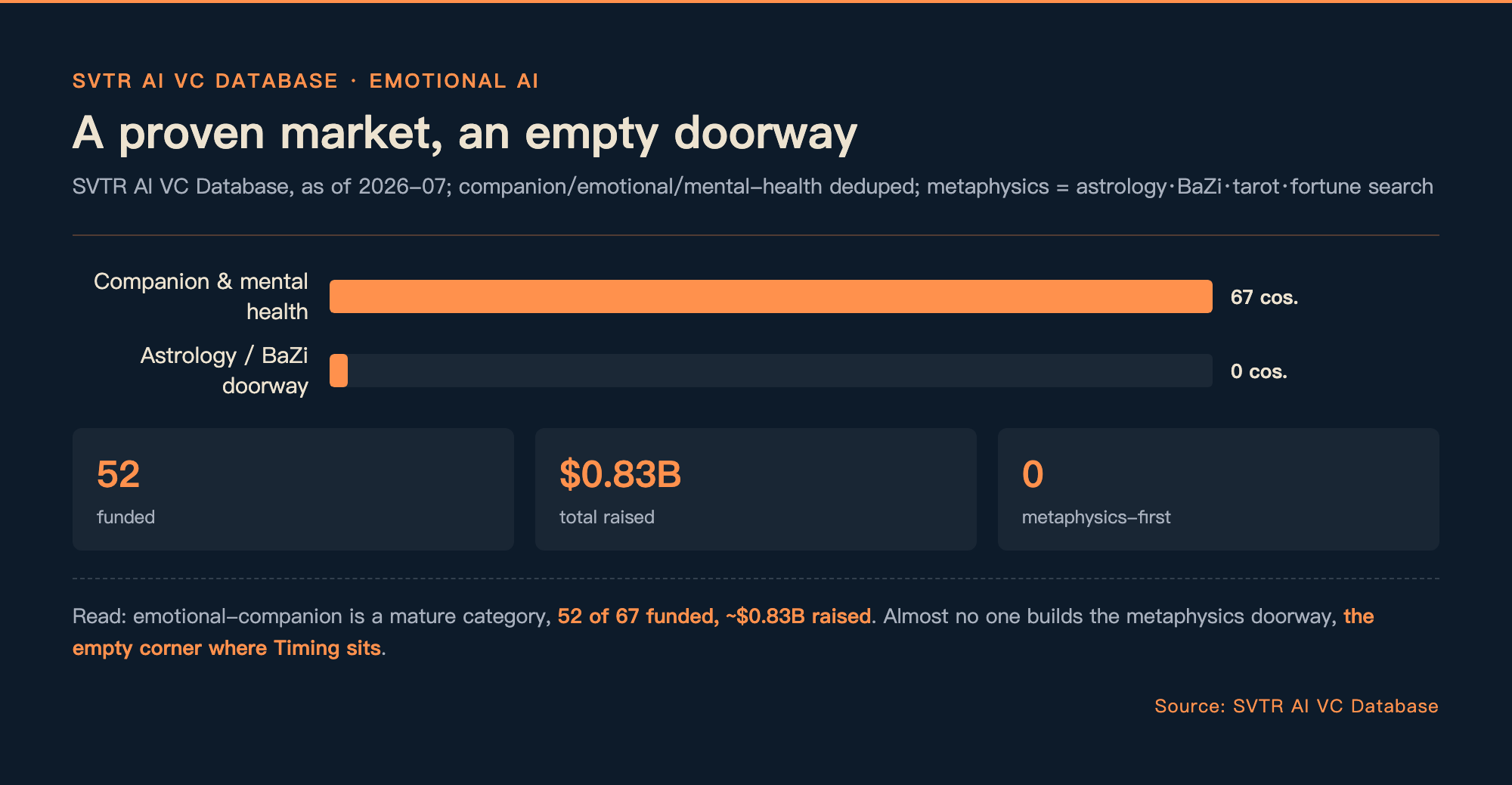
This isn't an isolated niche bet. SVTR's AI venture database tracks 67 AI companies in the emotional-companionship and mental-health space, 52 of which have known funding totaling roughly $830 million as of July 2026, with companies like Dimension Creation (次元造物), Eleos, and Portola each raising tens of millions of dollars in single rounds. But narrow the scope to astrology, BaZi, and fortune-telling entry points specifically, and the database is nearly empty: searches for BaZi, tarot, and horoscope terms return zero hits. That makes Timing's position clear: it sits inside an already-validated emotional-consumption category, yet has taken an entry point almost nobody else addresses directly.
This is also a difference that's only visible from a vantage point between China and the US, which is where SVTR sits. In the US, companies like Co-Star and The Pattern have already turned astrology into a social consumer product, and emotion plus astrology is high-frequency content on social media. In China, fortune-telling content has long lived inside mini-programs and private-traffic channels; it isn't short on depth, but scaling monetization has been hard. Timing takes a "West-leads-China" approach: using birth-chart astrology as the entry point overseas, lowering the comprehension barrier with broadly cross-cultural terms like "Energy," then introducing BaZi. A product finding its footing between two different sets of metaphysics-consumption habits in China and the US lands exactly on the boundary zone SVTR watches.
Following this high-frequency path, the team also plans to integrate the product into messaging contexts like iMessage, WhatsApp, and Telegram, so users can casually ask in everyday conversation whether today is a good day to send a particular email. Toward more technical integrations like MCP, the team is cautious, for a practical reason: its core users aren't necessarily developers, and they'd rather get simple, clear advice directly inside apps they already use.
The risk side deserves equal weight. Its growth and retention figures are all self-reported by the founder. Questions remain unanswered: where the metaphysics narrative draws the line between emotional support and rational advice, whether the human authenticity of its content can hold up at scale, and whether its Reddit community playbook can transfer to messaging channels. But its moat points to an increasingly important evaluation standard: features can be copied and model capability can be matched, but user relationships, community trust, and brand personality are hard to replicate quickly.
As AI infrastructure matures, competition at the application layer will come back to a simple question: why does a user open your product every day, and why are they willing to keep paying for it. Timing's answer is helping users find a better sense of timing amid an uncertain life. SVTR's AI venture events will keep putting early-stage teams like this in front of investors from both China and the US, letting judgment happen in the room.
If you're building an emotional-companionship product, consumer AI, or another early-stage product, you can apply to bring your project to an SVTR AI venture event and sit directly across from investors from China and the US. If you'd like to sit in on the next session and see how projects like this get taken apart in the room, scheduling and registration are on the events page. Register and log in at svtr.ai to keep following updates on the emotional-companionship category in SVTR's AI venture database, along with future project recaps.