

SVTR Editor's Note:
Four economists at Wharton and the University of Zurich assembled the funding and exit records of about 158,000 US venture-backed companies and 248,000 founders since 1987, and found that 88% of founders got nothing when their company was acquired or went public. Venture circles talk about valuations and unicorns; few talk about what founders actually take home. We think the most useful part of this ledger for founders is not the failure rate, but how founders of companies that succeeded still ended up with nothing. This piece is for AI founders who are raising, and for early-stage investors who design founding teams' equity.
In 2006, Noah Glass was pushed out of Twitter, the company he helped start. When Twitter went public seven years later, press reports at the time estimated he stood to make about as much from the IPO as Jack Dorsey's secretary.
This is not an isolated hard-luck story. In a working paper updated in July 2026, Eduardo Azevedo, Florian Scheuer, Kent Smetters and Min Yang matched funding data from PitchBook, CB Insights, Capital IQ and PrivCo against IPO prospectuses, and worked out, company by company and founder by founder, what each founder took home at exit:
- 88% of founders got nothing.
- Returns are concentrated in very few hands: the top 1% of founders captured 79% of all founder exit proceeds.
- The average founder took home about $5.6 million after tax, but that figure is pulled up by a few big winners; among founders who got anything, half received less than $4.8 million.
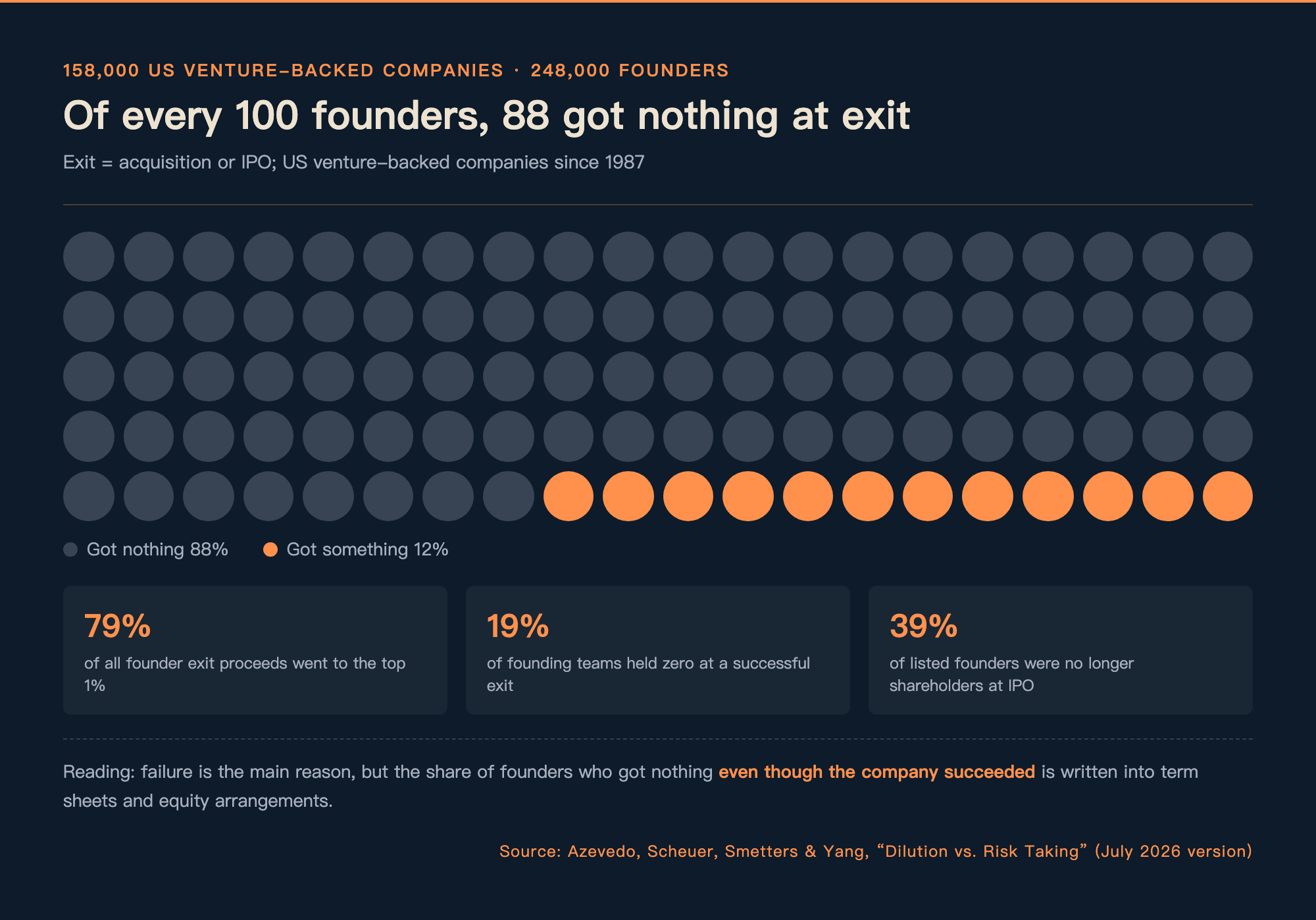
Failure is the main reason, of course: most companies never make it to an acquisition or IPO. The more revealing part of the paper is the founders who got nothing even though their companies succeeded.
The company succeeded. Why did the founders get nothing?
In companies that were acquired or went public, the founding team still owned 36% on average. The authors concede that this is likely too high: funding rounds missing from the data mostly go uncounted, so real dilution is larger.
Even among successful exits, 19% of founding teams ended with zero ownership. The reasons are in the investment contracts:
- Anti-dilution provisions: when a company raises at a lower valuation, earlier investors receive extra shares as compensation, and those shares come out of the founders' stake.
- Liquidation preferences: when the company is sold, investors first recover an agreed amount (the paper uses 1.25 times their investment) before common shareholders get anything. If the sale price is not high enough, the founders' share is zero.
These are reasonable protections for investors, but they only bite when things go badly. A company whose valuation fell midway and was then sold at a modest price counts as a successful exit on paper, while its founding team may walk away with nothing.
Within the remaining teams, individual founders may still get nothing. Comparing against 1,300 IPO prospectuses, the authors found that 39% of people tagged as founders in the databases were no longer on the shareholder list at the IPO. They include co-founders who left midway and people who sold their shares earlier; Twitter's Noah Glass and Tesla's Martin Eberhard fall in this group.
One more counterintuitive finding: the higher the exit value, the lower the founding team's ownership, a negative correlation. One possible reason is that more successful companies tend to raise more money, so their founders are diluted more.
Raising a Series A is far from safe
The paper also computes the table founders most need to see: once a company reaches a given stage, how likely is it still to be worth something at the end?
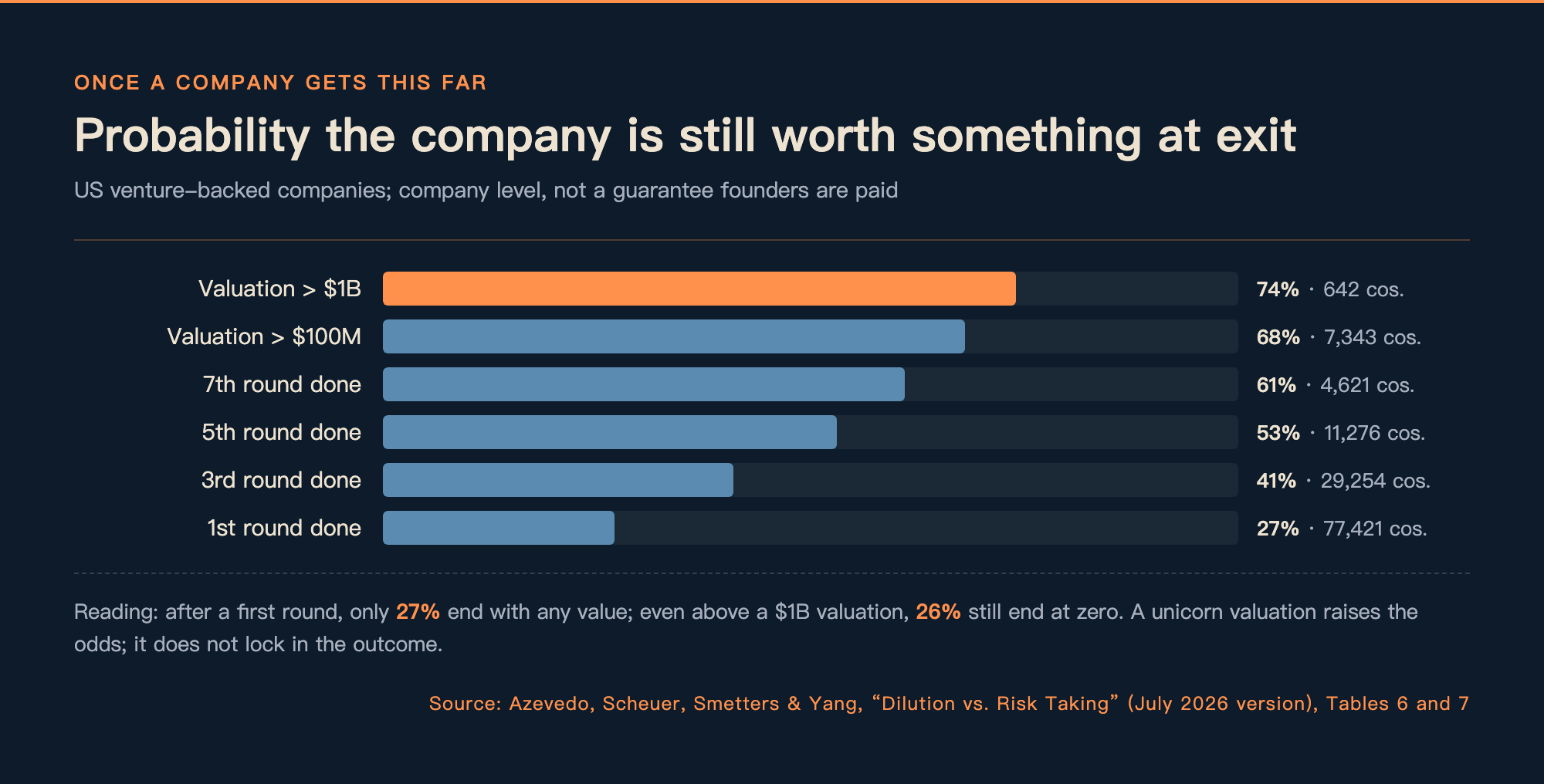
Table 1 | US venture-backed companies: probability of a nonzero exit value after reaching each stage
| Stage reached | Companies | Exit value above zero |
|---|---|---|
| Completed 1st funding round | 77,421 | 27% |
| Completed 3rd funding round | 29,254 | 41% |
| Completed 5th funding round | 11,276 | 53% |
| Completed 7th funding round | 4,621 | 61% |
| Valuation above $100 million | 7,343 | 68% |
| Valuation above $1 billion | 642 | 74% |
Data: Azevedo, Scheuer, Smetters and Yang, "Dilution vs. Risk Taking" (July 2026 version), Tables 6 and 7, translated by SVTR. "Exit value above zero" is at the company level and does not mean founders necessarily received anything.
Of companies valued above $100 million, 32% still ended at zero; of companies valued above $1 billion, 43% eventually sold for less than $1 billion. Becoming a unicorn raises the odds; it does not lock in the outcome.
Why earlier research overstated returns sevenfold
This ledger is far bleaker than the field used to think. In 2010, economists Robert Hall and Susan Woodward estimated with the data of their time that the expected return to entrepreneurship was about $2.4 million a year (in 2025 dollars). On the same basis, the new paper finds only about $350,000, a gap of nearly seven times.
Even restricted to companies founded between 1987 and 2008, the new data give only about $710,000. The authors attribute most of the gap to the data themselves: older databases were more likely to record companies that succeeded, while failed companies vanished quietly, inflating the average.
We see the same pattern in the SVTR AI venture database. It holds 75 AI companies with two or more publicly reported valuations, giving 102 pairs of consecutive rounds (May 2022 to October 2026): the median gap is about seven months, the median valuation step-up is 2.5x, and not a single pair is a down round.
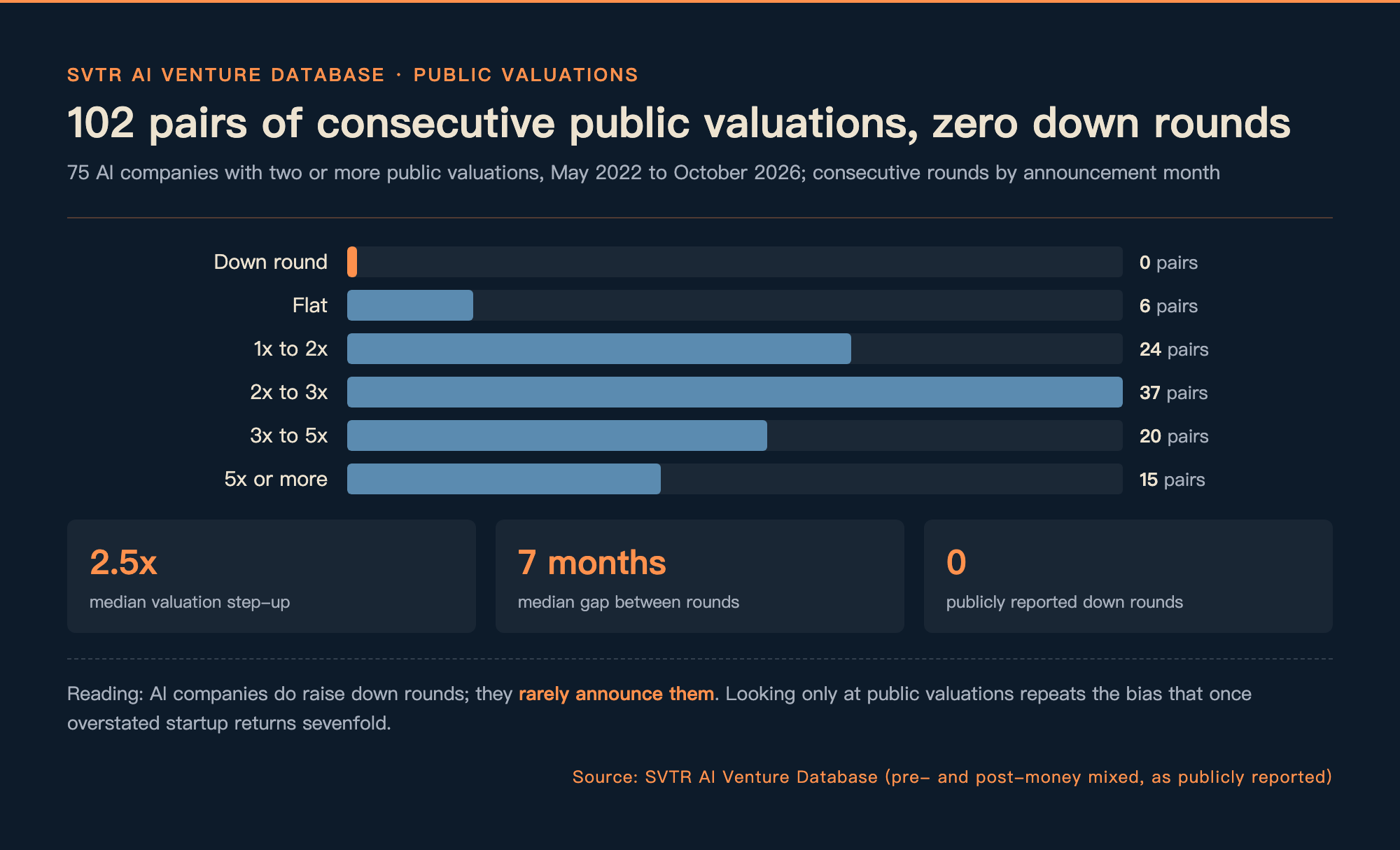
AI companies do raise down rounds; they just rarely announce them. Anyone looking only at public valuations would conclude that AI startups are a sure bet, which is exactly the bias that once overstated the returns to entrepreneurship sevenfold. For AI founders, the faster valuations climb, the more caution is warranted: every high-priced round may carry anti-dilution and liquidation-preference terms, and if the next round prices lower, those terms take effect.
Chinese founders: the worst case is below zero
In China, two things differ from the US.
First, founders' stakes at IPO are not low, but control rests on voting arrangements. According to MiniMax's Hong Kong prospectus, founder Yan Junjie holds about 28% through offshore entities, and dual-class shares (10 votes per share for the founding team) give him about 70% of the votes. At Zhipu AI, Tang Jie holds about 7.4% directly and, together with Liu Debing, CEO Zhang Peng and others acting in concert, controls about 37% of the votes. At both companies, ownership and control have become two different things.
Second, buyback clauses common in RMB financings push founders' downside below zero. According to a Tencent News analysis in October 2024 of 279 listing applications accepted by the Shanghai Stock Exchange from 2023 to the first half of 2024, among the 143 that named who bears the buyback obligation, fewer than 5% placed it on the company alone; in the rest, founders or other shareholders bore it personally or jointly. If the company fails to list by the agreed date, investors can require founders to buy back the shares out of their own pockets. Jiemian News has reported cases of founders who lost such bets and went from multimillionaires to court-listed defaulters.
The worst case for a US founder is getting nothing; the worst case for many Chinese founders is ending up in debt. Our view: even at similar failure rates, founders raising RMB financing carry more risk.
What founders can do
The failure rate cannot be negotiated; the terms can:
- Liquidation preference: aim for 1x, non-participating (once investors recover their money, they do not also share in what is left).
- Anti-dilution: aim for weighted-average protection and avoid full ratchet (which resets earlier investors' cost entirely to the new, lower price); the paper finds the latter is worse for founders.
- Co-founder equity: vest over time, and spell out what happens to shares when someone leaves, so that a departure does not leave shares or disputes behind.
- Buyback obligations: in RMB financings, limit them to the company rather than founders personally.
In July 2025, our piece "Founder Equity Defense" covered ways to raise money without giving up equity; the two are worth reading together.
None of this counts taxes yet
The question the paper originally set out to answer is about tax. If, as some US proposals would, unsold shares were taxed on their paper gains, founders would have to sell shares to pay the tax and be diluted further; but if the tax were refunded when a company fails, it would become a form of insurance. The authors estimate that full refunds would raise startup entry by 12%, while allowing losses to offset only future gains, with no cash back, would cut it by 38%.
On November 3, California voters decide on Prop 40, a one-time 5% wealth tax on billionaires. For founders, the first thing to check in any such proposal: if the company fails, is the tax paid refunded?
Featured projects and membership
Negotiating terms well starts with knowing what peers are getting. SVTR members with a paid seat and verified investor status can use featured projects to see the team, funding needs and materials of companies currently raising and request introductions directly. Founders who are raising can submit a project.
Further profiles | SVTR AI venture database
The MiniMax and Zhipu AI profiles track both companies' funding rounds, each with its source.
If you are on either company's team, you are welcome to claim the profile; if you spot errors or gaps, please tell us, so we can keep improving this industry record together.
About the data
- Paper: Azevedo, Scheuer, Smetters and Yang, "Dilution vs. Risk Taking: Capital Gains Taxes and Entrepreneurship," first version November 2025; this article relies on the July 2026 version, which has not yet been published. Founder ownership is the authors' reconstruction from funding rounds; valuations of rounds that did not disclose them were estimated by the authors.
- Database valuation statistics: AI companies with two or more public valuations, consecutive rounds compared in order of announcement month, verified rounds only (rumored and unconfirmed rounds excluded); valuations mix pre- and post-money as publicly reported.
- MiniMax and Zhipu AI ownership figures come from reporting on the two companies' Hong Kong prospectuses; the buyback-clause statistics come from a Tencent News report in October 2024.