

SVTR Editor's Note | For the past two decades, global venture firms have understood "doing content" as copying USV's form: starting a blog, launching a podcast, hiring media staff, running a weekly show. But by 2026, USV itself had already moved past that. SVTR's argument: content's moat was never output volume, it's whether judgment can be turned into a compounding, queryable asset. We are not arguing for "write more, post more." This piece is for GPs who want to build content into a long-term asset, and for anyone watching venture content across the US and China.
I. Same Firm, Twenty-Two Years: Content Went From "A Few Paragraphs a Day" to "Turning Judgment Into an Asset"
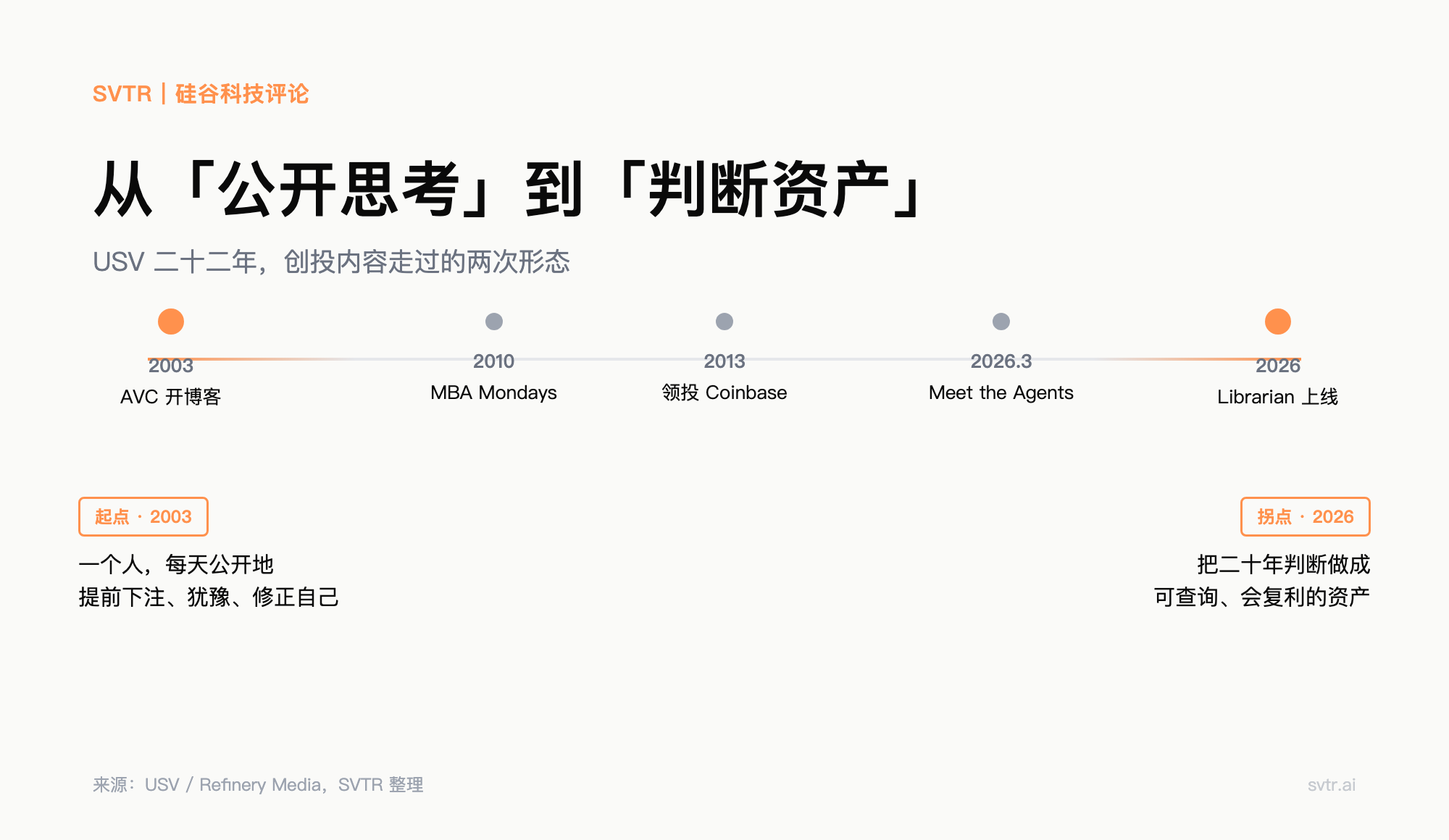
In September 2003, Fred Wilson started a blog called AVC. For nearly two decades afterward, he wrote almost daily: what he'd figured out the day before, what a deal had taught him, why he'd passed on a company. According to a rundown by Refinery Media (Laurie Owen), AVC made public writing part of the investing business itself, and the whole industry spent twenty years reverse-engineering its form.
What's notable is how the story ends. In 2026, USV rolled out an internal tool called Librarian: roughly 15,000 posts written by partners over more than two decades, plus meeting notes, all turned into a queryable system (according to USV).
Same firm, twenty-two years: content went from a few paragraphs a day to turning accumulated judgment into an asset. SVTR's read is that the industry is still copying the 2003 form, while USV has just demonstrated the real inflection point. Content's value is shifting from thinking out loud in public to a queryable, compounding asset of judgment. Structuring judgment, not producing more of it, is what actually makes content a moat today.
II. Compounding Content Needs Something Real Underneath It
One easily-missed mechanism first. What actually makes AVC valuable is a traceable record: a serious investor placing a public bet early, publicly hesitating, then publicly revising himself.
Crypto is the clearest example. Public records show Fred started writing about Bitcoin on AVC in 2011, at a point when he admitted he'd gone a year and a half without finding anything in venture that excited him. In 2013, USV led Coinbase's Series A (a bet reported to have later returned roughly $4.6 billion). By 2014 he was writing that Bitcoin was "money you can actually spend," then publicly reversed that view in 2017. Readers can watch him change his mind across more than a decade of archives.
Why can't most firms replicate this asset? Because they optimize for output (how much, which channels, how often), while content's actual leverage sits on the input side: how close it is to real work, how honest it is, whether it's willing to be wrong. The "spiral of silence" is a useful mirror here: the more people expect disagreement, the less willing they are to speak, so contrarian views get self-censored out and everyone's content gets edited into the same shape.
SVTR's take: Input sets the ceiling, output only sets the floor. Content with no real work underneath it won't compound no matter how often it ships. That's exactly why "content factory" strategies reset to zero after a couple of years.
III. From "Written" to "Queryable": The Real Inflection Point of 2026
A few things USV has done publicly over the past two years show it treats content as a living mechanism, not nostalgia.
Librarian turns twenty years of judgment into an asset that's queryable and usable by models. In March 2026, USV published a piece called "Meet the Agents at USV," publicly introducing the AI agents running its internal chores (according to USV). It's the same move as its widely-copied MBA Mondays series from 2010, just sixteen years apart. Back then, it tackled one problem founders actually got stuck on every week: fundraising, equity, boards, M&A. The core logic hasn't changed: publish what you're actually doing and actually learning, so outsiders can learn from it too. Sequoia has reportedly attempted a similar judgment-retrieval effort internally.
This mechanism is also still pulling people in. In April 2026, USV brought on a new partner, Michael Mignano (co-founder of Anchor, which sold to Spotify in 2019). According to USV, he described himself as a daily AVC reader who learned how to build his own company from the blog. Years later, he raised from USV, built the company, became a founder-turned-investor, and is now a partner there. Someone discovering a firm through its public writing, then working his way into it step by step: that closed loop is itself evidence that content functions as an asset, not as promotion.
Here's the key shift. Once judgment itself becomes queryable and callable by a model, it stops being content you read once and move past, and becomes an asset that thickens the more it's used. In 2003, the unclaimed move was writing a blog every day. In 2026, the unclaimed move is structuring judgment into something queryable. Most firms are still stuck at the first layer.
IV. In China, This Layer of Asset Is Nearly Absent
Apply the same yardstick to China and the conclusion looks very different.
China's venture content has stayed stuck in the "optimize for output" mode USV moved past twenty years ago: WeChat advertorials, institutional press releases, everything edited by successive layers into the same shape. It's not that no one in China can write. The structure simply doesn't reward being publicly wrong and publicly correcting course. RMB fund LPs are dominated by government guidance funds, state capital, and industrial partners, so decision-making authority doesn't rest with an individual GP's judgment. The cadence and metrics of fundraising, deployment, management, and exit also leave almost no payoff for publicly recording how you think, day after day, for twenty years.
The result: China has neither its own AVC nor anything like Librarian. For cross-border investors, this gap is both a cost and an opening.

V. Content's Compounding Doesn't Come From Publishing More. It Comes From Structure
Back to SVTR's own position. A single firm building a Librarian structures its own twenty years of judgment. We're pushing the same idea to the level of the whole market: across firms, across the US and China. SVTR's AI venture database tracks 10,000+ AI companies and 120,000+ investors. At its core, that's a market-level, queryable asset of judgment, not another weekly column.
That's the practical suggestion here for every firm: don't start by asking whether to launch another blog or podcast. Start by asking whether you've turned your judgment into something queryable and compounding. Format can be copied. Twenty years of archives cannot. And a structured asset of judgment can't be copied either.